Introduction
Want to bring the joy of the Festival of Lights into your classroom without overloading children or families? Thoughtful, brief activities rooted in culture, language, and safety help children learn about #lights, community, and respect while you meet learning goals. For a practical next step—training that helps you plan culturally responsive celebrations—consider Cultures in the Classroom  Buy Now $24.00 to sharpen inclusive practice; you may also find Montessori Cultural Activities Buy Now $24.00 useful for hands-on, play-based ideas.
1. How do I make the Festival of Lights a meaningful learning experience?
Why it matters: Celebrations like Hanukkah and other "festival of lights" traditions can strengthen children’s vocabulary, counting, symbolic play, and cultural literacy. Framing the holiday as a theme—light, family, kindness—lets you connect simple classroom standards (language, math, socio-emotional) to authentic experiences. Use short, concrete prompts: “What do candles do?” “How can we show kindness tonight?” These anchor learning without requiring children to adopt any belief system.
Classroom strategy (practical):
- Choose one clear learning target (vocabulary, counting 1–8, or sharing stories).
- Plan 2–3 short centers (10–20 minutes each) so children rotate without fatigue.
- Include a brief group read-aloud or song (5–8 minutes) and a calm closing routine.
For ready-to-use, classroom-friendly activities, see the ChildCareEd resource Hanukkah Activities Kids Will Love! Buy Now $0.00, which offers multi-age adaptations and low-prep centers you can borrow or adapt.
2. How can I design safe, inclusive, and respectful activities?
Inclusion and safety both need planned attention. Start with neutral, descriptive language: “Some families celebrate Hanukkah. Some families don’t.” Emphasize themes (light, family, giving) to invite all children to participate in ways that feel comfortable to them.
Safety essentials:
- Never use open flames in mixed classrooms—use battery tea lights or paper flames for hands-on counting and ritual demonstrations.
- Check allergies before offering food and provide non-food alternatives for celebrations.
- Design materials with age-appropriateness: avoid small coins with toddlers, supervise scissors, and tape sensory-bottle lids closed.
- Train staff in active supervision to keep special activities calm and well-monitored—see Active Supervision: A Strategy That Works Buy Now $35.00 for practical supervision tools.
State requirements vary - check your state licensing agency. For a quick, classroom-focused safety reminder, ChildCareEd’s Holiday Hazards 101 is helpful when you plan décor or food.
3. What hands-on activities teach skills while honoring tradition?
Hands-on experiences support language, math, motor skills, and social-emotional growth. Keep activities simple, repeatable, and scaffolded by age. For more ideas on making early number learning engaging through hands-on experiences, explore how Montessori math can foster a love of numbers.
- Infants: color discovery with red/blue scarves, rhythmic songs about light, gentle picture talk. Short, sensory-rich exposures build vocabulary and attention.
- Toddlers: parade movement with paper lanterns; popsicle-stick menorah counting; sensory bins with large, safe "gelt" coins for sorting.
- Preschool: dreidel spin art, menorah collage with pre-cut pieces, simple graphing of dreidel rolls (counting 1–8), and a “new year wish” mural for emergent writing.
- Kindergarten & school-age: small-group research (books or family interviews), map connections to show where traditions are practiced, and story-sharing circles to practice perspective-taking.
- Mixed-age tip: same theme, different challenge—everyone decorates lanterns, older children add labels or patterns while younger children focus on textures.
For a curated set of activities across ages, the ChildCareEd printable pack Hanukkah Activities Kids Will Love! Buy Now $0.00 provides easy centers, sensory ideas, and literacy extensions you can implement the same week.
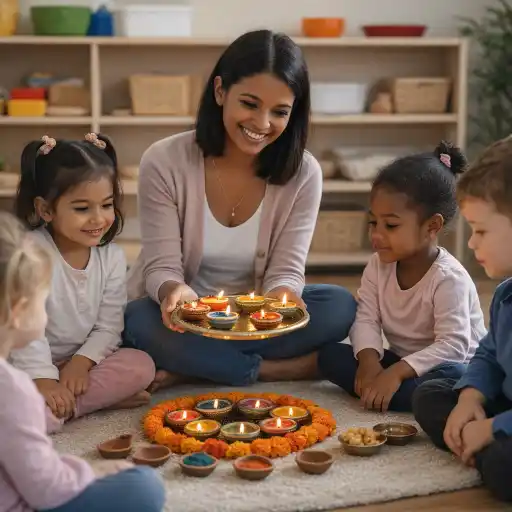
4. How should I partner with families and avoid cultural pitfalls?
Family partnership makes celebrations accurate and comfortable. Start by surveying families: a short form or email asking if they want their child to participate, whether they celebrate, and whether they’d like to share a family story or song. Offer opt-out choices so no child feels pressured.
Practical communications:
- Share your classroom theme in advance and say what materials will be used (foods, battery candles, sensory bins).
- Invite contributions but never require them; some families prefer privacy or have religious reasons to decline.
- When inviting family presenters, supply a short script or sample questions so contributions stay developmentally appropriate and non-religious.
- Use community-building language: focus on universal values like kindness and family rather than theology.
If you want deeper training on family collaboration and culturally responsive practices, consider Bridging Cultures: Family Communication & Collaboration Buy Now $55.00 or Building Bridges for Dual Language Learners Buy Now $25.00 to improve two-way communication and engagement.
5. What common mistakes should I avoid, and how will I know I succeeded?
Common mistakes and quick fixes:
- 🔸 Overplanning: trying to cover every night of the holiday. Fix: pick one or two centers you can repeat and rotate each day.
- Ritual pressure: assuming every family celebrates. Fix: use inclusive framing and offer alternatives like a generic “festival of lights” week.
- Too-complex crafts: projects that require long prep. Fix: pre-cut parts and set up assembly stations so children complete a portion each day.
- Unsafe props: open flames or small choking hazards. Fix: use battery lights, felt candles, and large manipulatives for little ones.
Measuring success: collect quick indicators—teacher notes, one-line family feedback, and a student artifact (a drawing, number mat, or short sentence) that shows the target skill (e.g., counting 1–8, new vocabulary use, or a kindness example). Use these artifacts for staff reflection and to plan next steps.
Conclusion
Bringing the Festival of Lights into your program can be a rich, manageable learning opportunity when you plan with inclusion, safety, and clear learning goals. Focus on short, developmentally appropriate experiences that highlight #community, #culture, and #kindness while avoiding common pitfalls. To extend your team’s skills, explore courses such as Cultures in the Classroom Buy Now $24.00, Montessori Cultural Activities Buy Now $24.00, Active Supervision: A Strategy That Works Buy Now $35.00, From Play to Planning Buy Now $55.00, or Building Bridges for Dual Language Learners Buy Now $25.00 to strengthen practice. Remember: small, respectful experiences in the classroom help children learn about others and build social-emotional skills—state requirements vary - check your state licensing agency.
FAQ
Q: Can I light a menorah in class?
A: Use battery candles or pretend flames in mixed-age classrooms; if you plan any real flame (usually outdoors and under strict conditions), follow licensing rules, family permissions, and program policy.
Q: How do I handle families who prefer not to participate?
A: Offer alternatives and emphasize voluntary participation; invite families to share only what they’re comfortable with.
Q: What if I don’t know much about the tradition?
A: Use brief, accurate books and ask families for guidance. ChildCareEd resources and courses listed above can help you prepare respectfully.
Q: How can I adapt activities for toddlers with sensory differences?
A: Offer visual or tactile options (e.g., felt candles instead of lights), quiet corners, and advance warning before transitions to reduce overload.
Q: Are there low-cost materials that look special?
A: Tissue-paper flames, recycled CDs for dreidel art, and foil pans for light-reflective sensory bins are inexpensive but highly engaging.
Teaching the Festival of Lights well helps children notice light and symbol, practice counting and language, and experience respect for difference. Use your #Festival planning to support every child’s curiosity and belonging.
- CDA Home Visitor Subject Area 3 Part 3 Birth to 5
- Viewing Guidance in a Positive Light
- 1,2,3, Eyes on Me: Classroom Safety
- Children at the Wheel: Emergent Curriculum
- Pediatric RSV First Aid & CPR/AED
- Recognize, Respond, Respect: Supporting Diverse Learners
- CDA Bridge Bundle: Family Child Care without Portfolio Review
- Emergent Learning & Development
- Creating Environments that Nurture Growth and Community
- Texas Director Credential
- CDA Certification en Español: Recursos y Consejos para Educadores Bilingües
- 🔍 ¿Qué ves cuando observas a un niño aprender?
- 🤯 ¿Por qué este niño está teniendo un comportamiento difícil de repente?
- 🚌 ¿Qué Significan las Regulaciones de Transporte de Illinois para las Excursiones Infantiles? 🚦
- Recursos en Español sobre el Sueño Seguro del Bebé
- 10 Ejemplos de Cómo la Cultura Influye en el Desarrollo Infantil
- Reglas de Cuidado Infantil en Illinois
- Proporciones de Cuidado Infantil y Tamaños de Grupo por Edad en Nueva Jersey (Guía Rápida para Centros y Hogares)
- Proporciones de Cuidado Infantil y Tamaños de Grupo por Edad en Virginia (Guía Rápida para Centros y Hogares)
- Cómo Celebrar el Día Nacional del Kindergarten
- Lista para Guardería en Casa en Illinois: Cómo Iniciar una Guardería en el Hogar
- Lista para Guardería en Casa en Texas: Cómo Iniciar una Guardería en el Hogar
- Consejos de Supervisión Activa para Salones de Preescolar y el Juego al Aire Libre
- Cómo Ser Maestra de Preescolar en Illinois
- Las Mejores Ideas de Excursiones para Guarderías en Texas
- Canciones, juegos y preguntas de círculo para niños
- Cómo simplificar la capacitación para sus empleados de daycare
- How Can I Celebrate Lunar New Year Respectfully and Effectively in My Classroom?
- How can I introduce the Festival of Lights to young children in respectful, developmentally appropriate ways?
