One overlooked tablet or damaged charger can turn an ordinary classroom routine into a serious fire hazard. This Fire Prevention Week, October 4–10, 2026, use NFPA’s safe-charging guidance to strengthen your program’s everyday practices—and consider Building and Physical Premises Safety  Buy Now $10.00 to build practical skills in identifying and preventing hazards in child care spaces. The course offers focused learning on physical premises safety that can help you review risks with your team; check your local training requirements to see whether it fits your professional development plan.
Why does safe charging deserve attention in child care?
Phones, tablets, laptops, toys, radios, and other equipment may use rechargeable lithium-ion batteries. These batteries store substantial energy in a compact space. When damaged or charged improperly, they can overheat and cause a fire. Charging is often so routine that staff may not notice an unsafe setup—such as a device tucked into a cushion or a cord stretched across a busy walkway.
In a child care environment, a charging hazard has implications beyond the device itself. Children may be nearby, classrooms contain combustible materials, and cords can create trip or access risks. A clear shared routine helps adults catch concerns before they escalate and protects pathways needed for supervision and evacuation.
NFPA’s 2026 Fire Prevention Week campaign, “Charge into Fire Safety: Safe Charging Is a Superpower,” centers on straightforward actions: use the right charger, charge on a hard surface, unplug when charging is complete, and stop using a device that shows warning signs. Those manageable habits can be built into opening checks, staff orientation, and room reset routines.
Fire prevention is not about blaming staff for a missed detail. Busy classrooms demand practical systems. When a program designates safe charging locations and clarifies who checks devices, safe choices become easier to repeat.
How should staff charge classroom devices responsibly?
Start with the device maker’s instructions. NFPA advises using the cord and charger supplied with the device or a replacement approved by its manufacturer. A plug that fits is not proof that a charger is appropriate. Staff should also check cords and charging equipment for visible wear and take damaged items out of service.
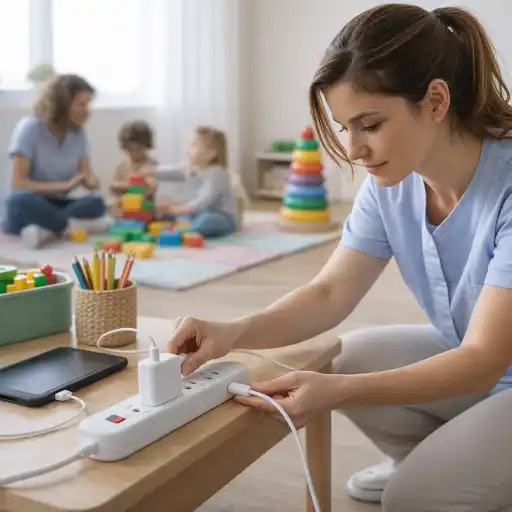
Choose a stable, hard, flat surface such as a desk or table. Soft items—including beds, couches, pillows, and cushions—can trap heat and restrict airflow. Keep chargers and devices away from paper, fabric, curtains, and other materials that can burn. Avoid placing equipment where children can pull cords, mouth cables, or reach charging devices.
- Use only manufacturer-supplied or manufacturer-approved charging equipment.
- Follow device-specific charging and storage instructions.
- Charge on a hard, flat surface with adequate ventilation—not on soft furnishings.
- Unplug devices when fully charged rather than leaving them connected longer than necessary.
- Keep charging areas orderly and away from exits, walkways, and children’s unsupervised reach.
Make the routine visible: designate a staff-only charging spot, label approved equipment where useful, and identify who checks devices at closing. A brief reminder is often more effective than an elaborate policy that is hard to follow during a busy day.
What electrical hazards should a classroom safety check catch?
Device charging is one part of electrical safety. During a room walkthrough, look for damaged cords, overloaded outlets, power strips connected to other power strips, and extension cords being used as permanent wiring. NFPA’s discussion of electrical safety notes that daisy-chaining power strips is prohibited under the fire code it describes; power strips should not be used as a substitute for permanent outlets. Ask a qualified professional or local authority about applicable requirements rather than modifying building wiring yourself.
Keep electrical equipment and cords away from water, sinks, and areas where spills are likely. Do not run cords under rugs or through doorways where they can be damaged or create a trip hazard. Children should not handle plugs, outlets, power strips, or charging equipment as toys or learning materials. Staff can teach a simple boundary: electricity is for grown-ups to manage.
Use the Classroom Supply Inventory Resource Guide Buy Now $1.49 as a helpful organizational prompt when reviewing classroom materials and equipment. It is designed to help educators track supplies, condition, and replenishment needs. Adapt the process by listing classroom electronics and charging accessories, noting their location and condition, and flagging damaged items for removal from use. This guide is an inventory aid—not a substitute for electrical inspection or manufacturer instructions.
State requirements vary - check your state licensing agency. When a concern involves wiring, outlets, or facility changes, follow your program’s maintenance process and contact qualified personnel.
How can providers recognize a failing lithium-ion battery?
A device may become somewhat warm during ordinary charging. However, stop using it if it becomes very hot or shows other unusual signs. NFPA and NIH safety guidance identify warning signs such as swelling, smoke, or a strange odor; other official guidance also notes leaking, popping, or hissing sounds. Treat changes in a device’s shape or color as a reason for caution.
Staff should not attempt to continue charging, open, or repair a suspect battery. Keep children away, alert the director or designated safety lead, and follow the facility’s emergency procedures. If there is smoke or fire, prioritize evacuation and call emergency services according to the program’s response plan. Do not put staff or children at risk to move a device. A safe response depends on the situation and local emergency guidance.
- Stop using a device that is unusually hot, swollen, smoking, leaking, or producing an unusual odor or sound.
- Keep children and other people away from a suspect device and notify the person responsible for safety.
- If smoke or fire occurs, follow the fire response plan, evacuate as required, and call emergency services.
- Do not place lithium-ion batteries in household trash or ordinary recycling; use an appropriate battery recycling location.
Make these steps part of staff orientation and refreshers, not just a poster. For age-appropriate learning, NFPA’s Fire Prevention Week classroom resources include child-focused materials about rechargeable battery safety. Keep the message calm and concrete: adults handle charging, and children tell a trusted adult if they notice smoke, unusual heat, or a strange smell.
How can directors make safe charging part of daily operations?
Translate guidance into a simple, consistent site routine. First, identify which devices are used in each room and who owns or maintains them. Set one or more designated charging areas with hard surfaces, airflow, clear sightlines, and no obstruction of exits. Keep charging away from children’s reach and from combustible supplies.
Next, establish practical responsibilities. A staff member can check that devices use approved chargers, cords are intact, and fully charged equipment is unplugged. Directors or facilities staff can review outlets and power strips during regular walkthroughs and arrange professional assessment for electrical problems. Make reporting straightforward so staff do not feel they must solve a technical issue themselves.
- Include charging locations and approved equipment in written room procedures.
- Add a quick charging and cord check to opening, closing, or weekly safety routines.
- Record damaged or missing equipment and remove questionable devices from use.
- Keep charging spots and electrical cords away from exit routes and high-traffic areas.
- Review emergency procedures and clarify who contacts emergency services and families.
📋 Try a five-minute charging sweep: note every plugged-in device, check its charger and surface, look for heat or damage, confirm that exits remain clear, and unplug equipment that is fully charged. Assigning the sweep to a role or shift makes it more dependable than relying on memory.
A dependable safety culture grows through supportive coaching. Invite staff to report hazards early, discuss near misses without shame, and revisit the routine when classroom technology or equipment changes. Small, repeated checks are a meaningful part of protecting children and colleagues.
What are the key takeaways for Fire Prevention Week 2026?
Safe charging is an everyday facility practice, not a one-week campaign. For child care providers, the essentials are to use compatible manufacturer-approved chargers, charge devices on hard and ventilated surfaces, unplug when charging is complete, keep cords and equipment away from children and exit routes, and act promptly when a battery shows warning signs.
Pair these habits with broader electrical safety: remove damaged cords from use, avoid daisy-chained power strips, keep electrical equipment clear of water, and seek qualified help for facility or wiring concerns. Add a brief device check to existing classroom routines, keep an inventory of equipment and its condition, and ensure staff know the emergency plan.
NFPA’s Fire Prevention Week takes place October 4–10, 2026, with the theme “Charge into Fire Safety: Safe Charging Is a Superpower.” Use the week to review one charging area, make one practical improvement, and share clear expectations with your team. For added professional learning, explore ChildCareEd’s Building and Physical Premises Safety Buy Now $10.00; for organized classroom supply tracking, see the Classroom Supply Inventory Resource Guide Buy Now $1.49. Together, sound routines and a thoughtfully maintained environment help answer the central question: how can child care programs charge devices safely? By making safe choices easy, visible, and consistent.
- 45 Hour Child Growth and Development
- CDA Home Visitor Subject Area 3 Part 3 Birth to 5
- SIDS: Saving Babies: A Change of Position, A Change in Tradition
- Pediatric RSV First Aid & CPR/AED
- Texas Director Credential
- Building a Healthier Tomorrow: Preventing Childhood Obesity
- Balancing Active Play in Child Care
- CDA: Stand With Respect and Professionalism
- CDA Certification en Español: Recursos y Consejos para Educadores Bilingües
- 👶 ¿Cuáles son las proporciones y grupos requeridos en Dakota del Norte? 🏫
- Recursos en Español sobre el Sueño Seguro del Bebé
- 10 Ejemplos de Cómo la Cultura Influye en el Desarrollo Infantil
- Capacitación en Salud y Seguridad Preventiva en Línea para Proveedores de Cuidado Infantil
- Cómo Solicitar una Licencia de Guardería en Texas
- Cómo Empezar una Guardería en Casa: Requisitos y Pasos
- Normas de Licenciamiento de Cuidado Infantil en Virginia para Centros Diurnos Infantiles y Hogares Diurnos Familiares
- Proporciones de Cuidado Infantil y Tamaños de Grupo por Edad en Maryland (Guía Rápida para Centros y Hogares)
- Proporciones de Cuidado Infantil y Tamaños de Grupo por Edad en Nueva Jersey (Guía Rápida para Centros y Hogares)
- Proporciones de Cuidado Infantil y Tamaños de Grupo por Edad en Virginia (Guía Rápida para Centros y Hogares)
- Normas de Licenciamiento de Cuidado Infantil en Illinois: Guía para Centros y Hogares de Cuidado Infantil
- Lista para Abrir una Guardería en Casa en Georgia: Cómo Empezar
- Lista para Guardería en Casa en Texas: Cómo Iniciar una Guardería en el Hogar
- Diversión fresca de verano: actividades del Día Nacional del Helado para niños
- Canciones, juegos y preguntas de círculo para niños
- Cómo simplificar la capacitación para sus empleados de daycare
- How Can Child Care Programs Add Device-Charging Hazards to a Safety Walkthrough?
- What Should You Do When a Rechargeable Classroom Toy Is Damaged?
- Fire Prevention Week 2026: How Can Child Care Programs Charge Devices Safely?
