As a child care provider, you see children every day. You notice when a child uses more gestures than words, gets frustrated, or seems quieter than peers. Knowing when to raise a concern helps families get help early. This article explains clear signs to watch for, what you can do in the #classroom, and how to talk with families about next steps for a child’s #speech, #language, #development, and #earlyintervention needs. For more detailed milestone lists and free tools, see What Toddler Milestones (12–36 Months) Are Typical and the CDC milestone pages at CDC: Learn the Signs. Act Early.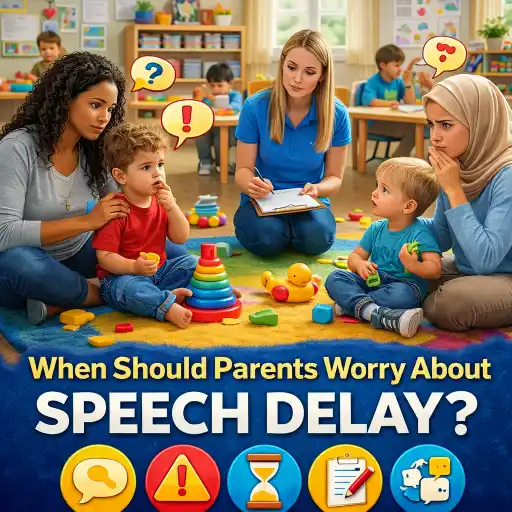
When should parents and providers start to worry about speech delay?
Most children follow common patterns for talking. But sometimes a child is far behind typical ages and needs attention. Use these clear age-based points as a guide:
- By 12 months, a few consistent words and babbling are expected. If a baby has almost no sounds or does not try to communicate, note it. See guidance from Supporting Children with Speech Delays in Child Care and CDC milestones.
- By 18–24 months: many children use several words and begin 2-word phrases. Very few words at 24 months is a common red flag.
- By 3 years: most children use short sentences and are mostly understood by family; speech that is hard for familiar listeners raises concern.
Other urgent signs at any age include: losing words or skills the child once had, showing almost no gestures or pointing, or having frequent ear problems that may affect hearing. The American Academy of Family Physicians explains risk factors and when to refer in clinical settings — useful background for talking with families and health providers: Speech and Language Delay in Children.
Remember: state requirements vary - check your state licensing agency. Use your observations across days and settings — one quiet day is not a pattern, but consistent differences over weeks are important to act on. For quick red-flag lists you can share with families, see ChildCareEd’s tips: Tips for Developmental Delay Concerns (Birth - 5 yrs) Buy Now $0.00.
What signs should I watch for in the classroom day-to-day?
Watch children during routines, play, and transitions. Look for patterns rather than single moments. Here are concrete signs that mean you should monitor more closely or share concerns with a family:
- Language milestones missed: very few words by 18–24 months, no two-word phrases by 2 years, or speech still hard to understand by 3 years. (See ChildCareEd milestones and CDC.)
- Limited attempts to communicate: little pointing, few gestures, or rare attempts to get a caregiver’s attention across several days.
- Loss of skills: the child used words before and then stops using them — this is urgent and needs immediate discussion with the family and health provider.
- Hearing concerns: frequent ear infections or not responding when called — consider audiology as a part of screening. The CDC and MedlinePlus note hearing as a common contributor to speech delays (see MedlinePlus: Speech and Language Problems and CDC: Early Intervention).
How to track what you see:
- 📝 Keep short, dated notes with examples: exact words, number of words, who understood the child, and the setting.
- 📸 If allowed, gather brief video or photos showing attempts (with family permission).
- 🔁 Re-check over 2–6 weeks to see patterns before making a strong recommendation.
Good tracking makes conversations with families and referrals more helpful. For classroom-ready checklists and examples, use ChildCareEd’s downloadable milestone resources: What are the developmental milestones from birth to 5 years? and the CDC Milestone Checklists: Milestone Checklists.
What can child care providers do right away to support speech?
You can make a big difference before formal services begin. Use these practical, classroom-friendly strategies every day. They are simple, natural, and help reduce frustration when words are missing.
- 📚 Build language into routines (read, narrate, label):
- Talk about what you do and what the child does—narration and parallel talk help children connect words to actions. See Promoting Language Development.
- 🤝 Use small-group and one-on-one time:
- Schedule 5–10 minutes of focused play where you slow down, give the child time to respond, and model short phrases. ChildCareEd suggests "Special Time" and Buddy Talk strategies in Supporting Children with Speech Delays.
- 🖼️ Use visuals and signs: pictures, simple sign language for "more/help/all done," and first/then boards reduce frustration and teach words.
- 🎵 Use songs, rhymes, and repetition to highlight sounds and words—language explosions often follow lots of modeling (see Language Explosions).
- 🗣️ Recast and expand: when a child says "car go," respond: "Yes—red car is going fast!" This model corrects grammar without pressure.
Common mistakes and how to avoid them:
- ❌ Mistake: Waiting too long to act. ✔️ Fix: Share observations early and offer simple home activities; track progress in 4–6 weeks.
- ❌ Mistake: Vague notes like "not talking." ✔️ Fix: Record exact words, number of words, who understood them, and settings.
- ❌ Mistake: Only teaching one child different strategies. ✔️ Fix: Use classroom-wide supports so children don’t feel singled out.
For more classroom tips and trainings, ChildCareEd has practical courses like "Language Development in Early Childhood" and tools to help teams stay consistent: #language-development resources.
When and how should we talk to families and refer for screening?
Talking with families is a key step. Your role is to share facts, listen, and partner on next steps. Use a calm, strengths-based approach and provide concrete examples from your notes.
- Prepare: gather dated observations, examples, and any classroom strategies you have already tried. See ChildCareEd’s guide on talking to families: How to Talk to Parents About Developmental Concerns.
- Use a clear, supportive script:
- Begin with strengths: "I love how Maya joins circle time."
- Share the observation: "Over the last month, she has used only one word at snack and doesn’t combine words with peers."
- Ask about home: "How does she talk at home?"
- Offer next steps: screening options, pediatrician conversation, or a referral to early intervention.
- When to suggest screening or referral:
- 🔎 Little to no words by 24 months or very limited two-word phrases.
- 🔎 Loss of words or skills at any age.
- 🔎 Speech still mostly unintelligible to familiar listeners at 3 years.
- How to refer: share the CDC's screening resources and your local early intervention contact. The CDC encourages timely evaluation: CDC: Early Intervention. The AAFP gives clinical referral guidance for health providers that can help when you talk with parents and pediatricians: AAFP.
Practical steps to support families through the referral process:
- Offer to share your notes with the family and, with permission, with specialists.
- Help parents find local early intervention numbers or school-based preschool services — families can self-refer in many places.
- Keep supporting the child in your classroom while waiting for evaluation — small daily wins matter.
State rules differ for eligibility and referral—state requirements vary - check your state licensing agency. For free parent-friendly milestone checklists to give families, use CDC Milestone Checklists: Milestone Checklists.
Conclusion and FAQ
Early noticing and kind conversations make a big difference. Your observations, clear notes, and partnering with families speed up help for children who need it. Early intervention improves outcomes for language and later school success — research and programs show lasting benefits when services start in early preschool years (see research summary).
Quick FAQ
- Q: Should we worry about bilingual children being quiet? A: Not usually. Bilingual children may use each language less at first but that is not a delay by itself. Support both languages and use visuals; see ChildCareEd resources on dual language learners: Language Explosions.
- Q: When is referral urgent? A: Loss of skills, almost no communication (no gestures or sounds), or severe hearing concerns warrant fast action and conversation with the family and pediatrician.
- Q: Who pays for early intervention? A: Many state programs are free or low-cost; eligibility and services vary by state—state requirements vary - check your state licensing agency and local early intervention offices (see CDC).
- Q: What should I document to help a referral? A: Dated examples, exact words used, who understood the child, settings, and any patterns of change over time. These notes help specialists quickly understand the child’s needs.
Thank you for the caring work you do. Your daily attention, warm support, and clear notes are often the first step to a child getting the help they need to thrive.
- Retraso del Habla en la Guardería: Cómo Pueden Ayudar los Proveedores
- What Are Developmental Milestones and How Can We Track Them in Early Childhood?
- What Signs of Developmental Delays Should Michigan Childcare Workers Watch For?
- How Can North Dakota Caregivers Help Toddlers with Speech Delays?
- How can North Dakota daycares help shy children come out of their shell?
- How can I support a child in New York childcare who refuses to speak to any adult?
- How Can Child Care Providers Recognize Signs of Developmental Delays?
- Starting an Inclusive Daycare for Children with Speech Delays
- When a Child Has a Speech Delay: Tips for Child Care Providers
- How to Open a Daycare for Children with Speech Delays
- Sign Language Activities That Help Children Communicate
- How can New York providers host effective parent-teacher conferences?
- How can we support early communication before children begin talking?
- How can I support speech and language development in toddlers?
- When Is Repetitive Speech Typical—and When Should Teachers Pay Closer Attention?
- What Are the Best Ways to Support a Child’s Speech Development?
- When Should Providers Be Concerned About Language Delays?
- How Can Child Care Providers Navigate Developmental Delay Conversations with Caregivers?
- How Do You Talk to Parents About Developmental Concerns?
- How Should Child Care Providers Handle Difficult Conversations With Parents?
