Beginning-sound practice is most effective when it feels like meaningful discovery rather than a worksheet drill. By combining listening, pictures, movement, print, and repetition, you can strengthen children’s early phonological awareness while keeping learning playful; Language and Literacy Foundations in Pre-K  Buy Now $16.00 offers additional professional learning to deepen language-rich classroom practice and may support training-hour goals where applicable.
Why does beginning-sound practice matter?
Beginning sounds are the first sounds children hear in spoken words. When children notice that ball, book, and bus begin with /b/, they are developing phonological awareness—the ability to attend to and think about the sound structure of language. This skill supports later phonics, word recognition, spelling, and reading comprehension.
Beginning-sound awareness is related to, but not identical to, letter knowledge. A child may recognize the letter B without consistently hearing /b/ in a spoken word. Another child may hear that two words begin alike before knowing which printed symbol represents the sound. Effective instruction respects this developmental sequence and provides support at the point where each child is ready.
The goal is not rapid memorization. The goal is to help children listen closely, compare words, connect speech with meaningful vocabulary, and gradually understand the alphabetic principle. As the NAEYC guidance on phonological awareness emphasizes, sound learning can be embedded in authentic, play-based experiences across the day.
- Builds auditory attention and sound discrimination.
- Connects spoken language, objects, pictures, and print.
- Expands vocabulary through naming and comparing familiar items.
- Prepares children for later reading and emergent writing.
- Provides educators with observable information for planning.
What should an effective beginning-sound lesson include?
A strong lesson has a clear target, familiar vocabulary, explicit modeling, active participation, and a brief opportunity to apply the skill. Begin with one sound and a small collection of words children know. Real objects, photographs, and classroom materials are often more accessible than abstract symbols.
For example, place a ball, block, and book in a basket. Say each word naturally, invite children to repeat it, and emphasize the initial sound: “Ball begins with /b/. Listen: /b/—ball.” Avoid adding several unrelated sounds at once. Young children benefit from a manageable target and repeated successful experiences.
- Name the object or picture.
- Invite children to repeat the whole word.
- Model the beginning sound without distorting the word.
- Ask children to compare the word with another familiar word.
- Introduce the matching letter when children are ready.
- Revisit the sound later in play, reading, or a routine.
Use prompts that invite thinking rather than guessing: “What do you hear first in sun?” or “Which picture begins like sock?” If a child struggles, reduce the number of choices, repeat the word, stretch the initial sound appropriately, or offer a gesture. The ChildCareEd guidance on beginning sounds recommends connecting listening, pictures, tracing, and repetition in meaningful contexts.
How should pictures, objects, and worksheets be used?
Pictures and objects lower the memory demands of sound practice because children can see and handle the vocabulary being discussed. Before beginning, confirm that children know what each image represents. If a child does not know the word acorn, difficulty identifying its initial sound may reflect vocabulary knowledge rather than phonological awareness.
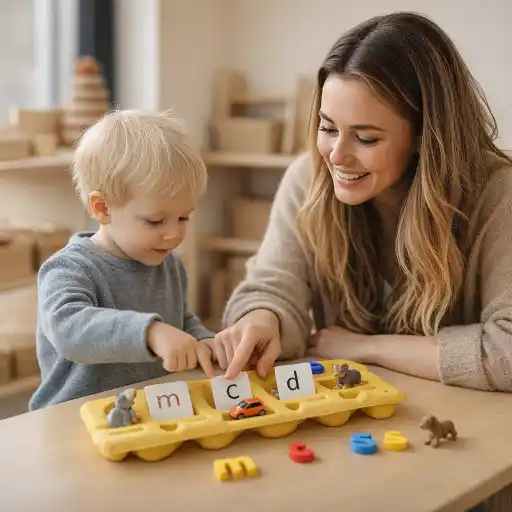
A Beginning Sounds Worksheet can be a useful resource when it is embedded in a broader, interactive sequence. Children can first name the pictures, sort them orally, and explain their choices. The worksheet can then provide a focused opportunity to cut, match, trace, or mark answers. It should extend hands-on learning—not replace conversation, play, and adult modeling.
- 🖼️ Sort pictures under two beginning-sound headings.
- Match an object or picture to an uppercase or lowercase letter.
- Search the classroom for items beginning with the target sound.
- Play “I Spy” using a sound clue instead of a color clue.
- Create a shared class book with children’s dictated words.
- Use the worksheet as a short follow-up after oral practice.
Real objects, gestures, photographs, and home-language labels can make the activity more inclusive. Children may also demonstrate understanding by pointing, touching, sorting, or using a sign rather than answering verbally. Provide multiple ways to participate while preserving the learning objective.
How can tracing and letter connections strengthen practice?
Tracing is most powerful when it follows meaningful listening. Children should first hear the target sound and connect it with familiar words; then they can explore the letter that represents the sound. This sequence prevents tracing from becoming isolated handwriting practice.
Introduce the letter with consistent language about its name, sound, and form. “This is uppercase B. It represents /b/ in words such as ball and book.” Invite children to trace the shape with a finger before using a crayon, marker, or pencil. Multisensory materials can support memory and fine-motor development without requiring children to remain seated for long periods.
- Trace a letter with a finger while saying its sound.
- Form letters with playdough, craft sticks, or textured materials.
- Air-write using large whole-arm movements.
- Trace over a highlighted path before making an independent mark.
- Draw or place pictures beside the letter that represents their beginning sound.
Offer uppercase and lowercase forms gradually and explain their relationship. Meaningful print is especially valuable: children can sign artwork, label a pretend store, identify the first letter of a name, or add a letter to a class message. Respect developmental variation in pencil grip and control. Lines, curves, scribbles, and large movements are legitimate steps toward conventional writing.
How can repetition build mastery without becoming monotonous?
Repetition helps children consolidate sound patterns, vocabulary, letter forms, and motor routines. However, productive repetition does not require repeating the same worksheet. Instead, revisit one target through varied experiences across several days.
A weekly focus on /m/ might include a morning chant, a picture sort, a name comparison, sensory letter formation, a read-aloud connection, and a classroom scavenger hunt. A simple sequence could include:
- Listen: identify /m/ in names and familiar words.
- Compare: sort words that begin with /m/ and words that do not.
- Connect: introduce M and m after oral practice.
- Form: build and trace the letter using varied materials.
- Apply: find or generate additional /m/ words during play.
Short, frequent practice is generally more manageable than one lengthy lesson. Integrate five- to fifteen-minute experiences into small groups, transitions, centers, outdoor play, and shared reading. Immediate feedback should be encouraging and specific: “Let’s say sun together. You heard /s/. Now let’s find the S card.” Avoid speed-based competition or public correction.
Directors can support consistency by providing shared picture sets, sound prompts, planning time, and opportunities for staff to review observations. Related training such as Science of Reading Foundations in the Pre-K Classroom Buy Now $16.00 can help teams connect phonological awareness, alphabet knowledge, emergent writing, vocabulary, and read-aloud practices.
How should educators observe progress and avoid common mistakes?
Observation should describe what a child can do, what support was provided, and what to try next. During a picture sort, note whether the child names each image accurately, listens to the entire word, identifies the initial sound, relies on visual placement, or benefits from repetition. Observe across several days rather than making decisions from one response.
- Overloading children: focus on one sound or a small contrast at a time.
- Using unfamiliar vocabulary: preteach words with real objects, gestures, photographs, or family input.
- Relying only on worksheets: include oral language, movement, manipulatives, songs, and play.
- Confusing letter names and sounds: teach the distinction explicitly and connect both meaningfully.
- Correcting harshly: model the target, acknowledge effort, and invite another try.
- Ignoring language differences: honor home languages and consult families or specialists when needed.
- Expecting identical progress: adjust choices, pacing, materials, and response options.
For children who need additional support, provide brief daily practice focused on one skill, use multisensory cues, and document progress over time. Persistent difficulty should lead to collaboration with families, literacy specialists, or speech-language professionals according to program procedures. State requirements vary - check your state licensing agency.
Conclusion: What should effective beginning-sound practice include?
Effective beginning-sound practice includes intentional listening, familiar vocabulary, explicit modeling, visual and tactile supports, meaningful letter connections, varied repetition, and responsive observation. The strongest experiences are brief enough to sustain attention and playful enough to invite participation, yet purposeful enough to build a clear foundation for phonological awareness and phonics. Because beginning-sound work is one part of a broader literacy foundation, educators may also find these strategies for fostering early literacy skills useful for connecting sound awareness with language, reading, and writing experiences.
Use the Beginning Sounds Worksheet as one tool within a richer learning sequence: talk about the pictures, sort real objects, move, trace, read, and revisit the target sound throughout the day. When educators combine practical resources with reflective planning and language-rich interactions, children gain more than worksheet accuracy—they gain confidence as listeners, speakers, and emerging readers.
Additional professional learning
- Language and Literacy Foundations in Pre-K Buy Now $16.00
- Science of Reading Foundations in the Pre-K Classroom Buy Now $16.00
- Classroom Tools for Emergent Literacy Buy Now $16.00
- Assessment of Language and Literacy Skills Buy Now $24.00
- Reading Aloud and Storytelling Buy Now $16.00
References
- ChildCareEd: Teaching Beginning Sounds with Tracing, Pictures, and Repetition
- ChildCareEd: Phonological Awareness
- ChildCareEd: Building Phonological Awareness in Preschool
- ChildCareEd: Simple Early Literacy Activities
- NAEYC: Word Play Throughout the Day
- AIM Institute: Evidence-Based Strategies for Literacy Success
- Fun-A-Day: Beginning Sounds Activities and Printables
- Little Learning Corner: Hands-on Beginning Sounds Activities
- You Clever Monkey: Teaching Beginning Letter Sounds
- Reading Rockets: Phonological and Phonemic Awareness Activities
- Super Teacher Worksheets: Consonant Sound Activities
- ChildCareEd: Beginning Sounds Worksheet Resource
- ChildCareEd: Beginning Sounds Resource Collection
- ChildCareEd: Language and Literacy Foundations in Pre-K Buy Now $16.00
- ChildCareEd: Language and Literacy Resources
- ChildCareEd: Related Classroom Resources Buy Now $0.00
- ChildCareEd: Professional Learning Resources Buy Now $0.00
- ChildCareEd: Language and Literacy Preschool Curriculum
- ChildCareEd: Classroom Tools for Emergent Literacy Buy Now $16.00
- ChildCareEd: Assessment of Language and Literacy Skills Buy Now $24.00
- Science of Reading Foundations in the Pre-K Classroom
- CDA Home Visitor Subject Area 5 Part 3 Birth to 5
- Bienvenido! Welcoming All Families
- Family Voices Matter: Tools for Meaningful Collaboration
- Pediatric RSV First Aid & CPR/AED
- CDA: Special Needs: Understanding the Whole Child
- Emergent Learning & Development
- CDA Infants/Toddlers: Stages of Development
- Preventative Health and Safety
- CDA Infants/Toddlers: Smart Nutrition & Feeding
- Phonological Awareness
- CDA Certification en Español: Recursos y Consejos para Educadores Bilingües
- Lista para Guardería en Casa en California: Cómo Iniciar una Guardería en el Hogar
- Lista para Guardería en Casa en Texas: Cómo Iniciar una Guardería en el Hogar
- Want to Become a Daycare Assistant? Start With These Essential Training Skills
- Active Supervision Examples: 10 Real Classroom Scenarios—Safe or Unsafe?
- Rosh Hashanah Sensory Bin Ideas: Apples, Honey, Shofars, and Sweet New Year Play
- Learning Through Choice: Why Do Classroom Choice Boards Work?
- How Can Sound Bingo Sharpen Listening Skills in Preschoolers?
- How Can Picture Task Cards Support Emerging Readers?
- What Are the Best Print-and-Play Activities for Substitute Teachers?
- Why Is Beginning-Sound Bingo a Smart Step Toward Reading?
- How Can Child Care Providers Help Children Recognize Letters Through Play?
- How Can Child Care Providers Strengthen Young Children’s Listening Skills?
- How Can Child Care Providers Teach Beginning Sounds with Tracing, Pictures, and Repetition?
- How Can Seasonal Picture Sorting Build Phonemic Awareness in Early Childhood?
- What Should Effective Beginning-Sound Practice Include?
- How Can Providers Connect Letter Formation, Sound, and Vocabulary in Phonics Instruction?
- How Can Animal Words Strengthen CVC Decoding?
- How Can Picture Task Cards Help You Assess Beginning Sounds?
