When children can choose a meaningful way to participate, engagement often becomes more visible, purposeful, and joyful. Classroom choice boards give child care providers a practical structure for supporting autonomy, differentiation, and independence; for deeper guidance on planning these experiences, explore Creating Engaging and Meaningful Learning Experiences  Buy Now $55.00, which can strengthen classroom practices and contribute to professional learning hours where applicable.
Why does choice matter in early childhood learning?
Choice is more than allowing children to select a toy or activity. Thoughtfully designed choice gives children an appropriate sense of agency: “I can make a decision, try something, and communicate what matters to me.” This experience supports motivation, persistence, problem-solving, and emerging self-regulation. The Centre for Teaching and Learning at the University of Alberta connects meaningful choice with autonomy, internal motivation, creativity, and deeper investment in learning.
For young children, autonomy must be paired with warm relationships and clear boundaries. A choice board does not mean that children are left to manage everything independently. Instead, the provider establishes a safe framework, introduces the possibilities, models expectations, and remains available to scaffold participation.
Choice boards can also make learning more equitable. A child who is hesitant to speak in a large group might choose drawing or building to demonstrate understanding. A dual language learner may benefit from picture-based options, gestures, or a familiar home-language label. A child who needs additional support may select an activity with fewer steps while another child extends the same goal through a more complex challenge.
- Children practice decision-making in a manageable context.
- Providers gain information about interests, strengths, and support needs.
- Learning becomes more responsive without requiring an entirely separate lesson for every child.
This is the heart of #choice: freedom within a thoughtfully prepared environment.
What is a classroom choice board?
A classroom choice board is a visual menu of related activities from which children select. The options may be displayed as photographs, drawings, symbols, or simple words, depending on children’s developmental levels and communication needs. In early childhood settings, boards can support centers, small-group learning, transitions, early finishers, movement breaks, or project work.
For example, a board connected to a study of plants might include:
- Draw and label a plant.
- Build a garden with blocks.
- Sort seeds by size or color.
- Read a plant-related book with a partner.
- Plant a seed and dictate an observation.
- Act out how a seed grows.
Each activity should connect to a shared learning intention, even though the process or final product may differ. This distinction is essential. A board is not simply a collection of entertaining activities; it is a planned set of pathways toward meaningful learning.
For preschoolers, begin with two or three options rather than a crowded nine-square grid. Some children enjoy extensive choice, while others experience decision fatigue. Progressive choice—introducing a small number of options and expanding them as children gain confidence—can protect agency while reducing overwhelm.
Printable materials are especially useful because they create consistency across classrooms and routines. The individualized learning guidance from ChildCareEd similarly emphasizes responding to children’s interests, strengths, developmental progress, and needs when planning experiences.
How do choice boards support engagement and development?
Engagement grows when children see a connection between their interests and the experience before them. A choice board can invite a child who loves movement, construction, storytelling, or sensory exploration into the same broader concept through a personally meaningful entry point. This does not lower expectations; it improves access.
Choice boards also encourage active learning. Instead of waiting for an adult to assign every next step, children practice selecting materials, beginning a task, sustaining attention, seeking assistance, and reflecting on what they did. These actions support executive-function development and self-regulation over time.
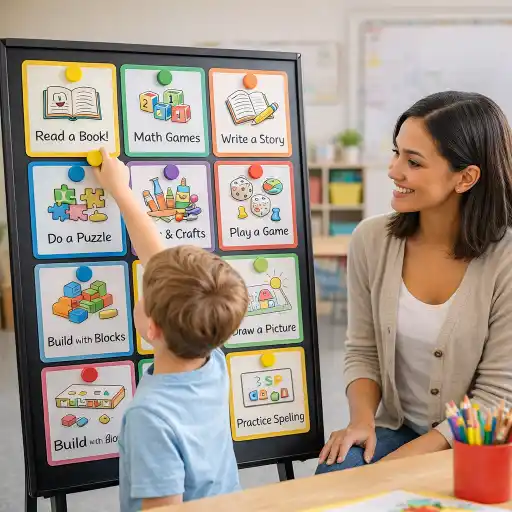
The benefits are especially clear when providers observe and respond intentionally:
- 🧩 Cognitive development: Children compare options, plan actions, solve problems, and make connections.
- Language development: Children explain preferences, negotiate roles, dictate ideas, and learn vocabulary related to the activity.
- Social-emotional development: Children experience competence, practice flexibility, and learn to respect peers’ decisions.
- Physical development: Boards can include fine-motor, gross-motor, sensory, and movement-based pathways.
- Approaches to learning: Children build initiative, curiosity, persistence, and creativity.
Providers should avoid treating the board as a rigid “learning styles” system. Research does not support labeling children as permanently visual, auditory, or kinesthetic learners. Instead, offer varied ways to engage and use observation to determine which materials, prompts, pacing, and supports help each child participate successfully.
Choice is most powerful when it is connected to relationships. Ask, “What made you choose this?” or “What could you try next?” Such questions turn the board into a conversation rather than a compliance tool.
How can providers design an effective choice board?
Begin with the learning goal, not the decoration. Ask what children should explore, practice, or demonstrate. Then design several options that address the goal through different materials, levels of support, or forms of expression.
- Identify one clear intention. For example, “Children will compare objects by size” or “Children will represent a story sequence.”
- Choose two to five accessible activities. Include a balance of structured, creative, collaborative, sensory, and movement-based options.
- Use concrete visuals. Pair a photograph or icon with a short phrase. Include home-language labels when possible.
- Plan scaffolds. Add sentence starters, a model, adaptive tools, fewer steps, or a peer option.
- Clarify the amount of work. Children might choose one activity during center time or two activities during a project cycle.
- Define what completion looks like. Use a simple picture checklist, a “finished” basket, or a brief conference.
- Include reflection. Invite children to point, tell, draw, or show what they discovered.
A printable choice board can reduce preparation time and provide a reusable structure. The Planning with Purpose resource reinforces the value of flexible, inclusive planning that anticipates varied abilities, languages, and developmental pathways.
Design for accessibility from the beginning. Ensure materials are reachable, images are uncluttered, and activities can be completed with alternative response modes. A child may communicate through speech, gestures, pointing, drawing, construction, or an assistive device. The objective can remain consistent while the route to participation changes.
How should choice boards be introduced and supported?
Children need explicit teaching before they can use a choice board independently. Introduce one section of the board at a time. Name each option, show the materials, model how to select, and demonstrate how to clean up or transition. Practice when the classroom is calm rather than waiting for the first busy center period.
Use language that communicates both agency and responsibility: “You may choose the blocks or the story cards. When you finish, return the materials and show me what you made.” This framing helps children understand that choice includes caring for materials, respecting peers, and following safety expectations.
Observe without hovering. A provider might record which choices children select, how long they remain engaged, what prompts they need, and whether certain options are inaccessible or confusing. These observations guide revisions.
- Offer a “two-choice” version to children who become overwhelmed.
- Use a first-then visual when a child needs help beginning.
- Invite a peer partner when collaboration supports communication.
- Rotate materials while keeping the board’s basic format predictable.
- Allow children to revisit preferred activities while gradually encouraging new experiences.
Choice should never be used to pressure children into activities that are unsafe, culturally inappropriate, or beyond their current capacity. Nor should it replace attentive supervision. Providers remain responsible for safety, inclusion, and meaningful interaction throughout the experience.
Directors can support consistency by sharing a common template, discussing observations during staff meetings, and encouraging teachers to exchange successful adaptations. Professional learning such as Planning for Every Child: Responsive Strategies in Action Buy Now $55.00 can further develop observation-based differentiation and individualized planning skills.
What common mistakes should providers avoid?
Choice boards are effective when choices are purposeful, manageable, and supported. Several common mistakes can unintentionally undermine those benefits.
- Too many options: A visually busy board can overwhelm young children. Start with two or three choices and expand gradually.
- Choices without a shared goal: If activities are unrelated, children may experience the board as free time rather than intentional learning.
- Unequal effort: Options should require reasonably comparable engagement, even when the products differ.
- Inaccessible directions: Long text, abstract instructions, or materials placed out of reach can exclude children.
- Choice as a reward only: Choice can support everyday learning, not merely behavior management or early-finisher time.
- No observation or reflection: Without noticing what children do, providers miss valuable assessment information.
Another pitfall is assuming that every child must choose independently immediately. Independence develops gradually. Some children need a limited menu, a verbal prompt, a visual pointer, or an adult who calmly narrows the options. Support is not a failure of autonomy; it is how autonomy is taught.
Finally, avoid making boards “cute” at the expense of clarity. The most attractive board is not necessarily the most useful. Prioritize readable visuals, durable materials, culturally responsive content, and activities that reflect children’s actual interests and experiences.
State requirements vary - check your state licensing agency when documenting professional development, curriculum expectations, or required training hours.
How can directors and providers assess whether a choice board works?
Assessment should focus on both learning and participation. A successful board is not measured only by whether children completed a selected task. Consider whether children engaged more deeply, used new language, persisted through difficulty, interacted with peers, or demonstrated the intended skill.
Use brief, naturalistic documentation:
- Record the child’s selected option and level of independence.
- Note prompts, adaptations, and materials that supported participation.
- Collect drawings, constructions, dictations, photographs, or audio samples.
- Ask children what they chose, why they chose it, and what they might try next.
- Review patterns with colleagues and revise the board accordingly.
For example, if several children select the block option but struggle to explain their structures, the next board might include vocabulary cards, partner storytelling, or a photo sequence. If one option is consistently ignored, investigate whether it is unclear, inaccessible, insufficiently challenging, or disconnected from children’s interests.
Family perspectives can enrich assessment. Share a photograph or short description and invite families to describe related interests, cultural practices, or skills observed at home. This strengthens continuity between the classroom and children’s broader lives.
Choice boards also provide directors with an approachable coaching focus. During a classroom visit, a director can ask: What is the learning goal? How were the options differentiated? What did the teacher learn from children’s choices? What will change next time? These questions promote reflective practice rather than evaluation based only on appearance or compliance.
Conclusion: Why do classroom choice boards work?
Classroom choice boards work because they combine structure with agency. They help children practice decision-making, persistence, communication, creativity, and self-regulation while giving providers a practical way to differentiate learning. Their effectiveness depends on intentional design: begin with a clear goal, offer a manageable number of meaningful pathways, provide visuals and scaffolds, observe children’s participation, and revise based on evidence.
For child care providers, the most useful starting point is simple: choose one upcoming learning goal and create two visual options for reaching it. Model the routine, support children as needed, and document what you notice. Over time, printable choice boards can become a dependable part of centers, projects, transitions, and individualized planning.
To deepen your ability to design experiences that promote purposeful play, choice, independence, and inclusion, consider exploring Creating Engaging and Meaningful Learning Experiences Buy Now $55.00. Pairing ready-to-use materials with reflective professional learning can help turn a promising strategy into consistent, responsive practice.
Related ChildCareEd courses:
- Planning for Every Child: Responsive Strategies in Action Buy Now $55.00
- From Play to Planning: Building Culturally Competent, Child-Centered Curriculum Buy Now $55.00
- Play, Learn, Grow Buy Now $25.00
- Tailoring Instruction to Children’s Needs Buy Now $24.00
- Creating Engaging and Meaningful Learning Experiences Buy Now $55.00
- Teacher-Child Interactions for Stronger CLASS® Outcomes
- CDA Infants/Toddlers: Health and Safety
- CDA Infants/Toddlers: Abuse and Neglect Reporting Requisites
- 24 Hour Texas Pre-Service
- Play with Purpose: Supporting Children with Autism
- Creating Engaging and Meaningful Learning Experiences
- Texas Director Credential
- CDA Infants/Toddlers: Smart Nutrition & Feeding
- Ways to Serve: Leadership
- The Prepared Environment: Montessori Class Design
- Montessori for Toddlers: Fostering Independence and Learning
- ¿Cómo puedo usar escenarios de juego de roles de primeros auxilios en mi aula?
- Actividades de Otoño Fáciles para Preescolares esta Temporada
- Capacitación Previa al Servicio para Proveedores de Cuidado Infantil en Dakota del Norte
- How can Nevada preschool programs help children with special needs feel heard, included, and understood?
- How can Washington classrooms be more inclusive using nature, play, and community?
- Starting an Inclusive Daycare for Children with Speech Delays
- Cómo simplificar la capacitación para sus empleados de daycare
- How Do You Create a Neurodiversity-Affirming Classroom?
- How Can Early Educators Help Children Build a Lifelong Love of Learning?
- Veggie Faces, Rainbows, and Snack Boards: Creative Ways to Present Vegetables to Kids
- Learning Through Choice: Why Do Classroom Choice Boards Work?
- How Can Predictable Classroom Routines Support Autistic Children?
- How Can Child Care Programs Reduce Decision Fatigue for Children and Educators?
- Why Are Reusable Printables a Smart Investment for Child Care Providers?
- What Is Purposeful Play—and Why Is It Replacing Worksheets?
- How Can Task Cards Encourage Independent Learning?
- How Can Child Care Providers Support Children Who Watch an Activity but Are Not Ready to Participate?
- Why Should “None of These” Be a Choice for Children Who Communicate Without Speech?
- How Can You Make a Choice Board Truly Accessible to Every Child?
