Animal words can turn the work of sounding out short words into a playful, meaningful challenge. Use the Complete the Words - Animals Buy Now $1.00 worksheet to help children practice missing middle sounds, then build your assessment skills with ChildCareEd’s Assessment of Language and Literacy Skills  Buy Now $24.00 course, which offers practical guidance for observing literacy development and planning next steps. Together, these tools can help you make phonics practice engaging while responding more thoughtfully to each child’s progress.
Why are animal words a useful context for CVC decoding?
Consonant-vowel-consonant (CVC) words follow a simple three-letter pattern: a beginning consonant, a short vowel, and an ending consonant. Words such as cat, pig, hen, fox, and bug give beginning readers a manageable way to connect individual sounds with letters and blend those sounds into a whole word.
Animals add a familiar, engaging context. Many children already know these creatures from books, play, family experiences, or classroom themes. That familiarity can help children focus on the sounds rather than struggle to understand an unfamiliar word. Still, the picture is a prompt—not a substitute for decoding. Invite children to say the word, listen for its sounds, and use the letters to verify it.
Keep the goal clear: support children in attending to the sequence of sounds, especially the short vowel in the middle. A consistent missing-middle-letter format, such as c__t, can focus attention on this often-challenging part of a CVC word. The Complete the Words - Animals resource Buy Now $1.00 includes twelve animal words and uses this format to reinforce CVC spelling practice.
What does decoding involve, and where do animal words fit?
Decoding is the process of using knowledge of letter-sound relationships to read a written word. With a CVC word, a child can identify each letter’s sound, blend the sounds from left to right, and check whether the resulting word makes sense. For example, /c/ /a/ /t/ blends to cat. The child is not merely naming a picture; they are working out how the printed letters represent spoken sounds.
- Say the animal word and invite children to repeat it.
- Segment it into three phonemes, using counters or fingers as helpful supports.
- Match each sound to a letter, then blend the completed word.
- Ask the child to read the word again and confirm it matches the picture.
These small, deliberate steps make #phonics concrete and help children understand that words are built from ordered sounds and letters.
How can you guide children through the missing middle sound?
A missing-vowel worksheet can focus attention on medial sounds, but children benefit from a brief oral warm-up and clear modeling. Choose a familiar word such as dog. Say it at a normal pace, then stretch it: /d/ /ŏ/ /g/. Ask, “What sound do you hear in the middle?” If needed, model the sound and point out that the vowel letter represents it in the written word.
Move from supported practice toward independence. First, model one example aloud. Next, complete a word together, asking the child to contribute the middle sound. Then offer a new word and pause to observe what the child tries before prompting. The resource’s repeated format across animal words such as cat, dog, pig, hen, fox, rat, bat, bug, and cub lets children focus on the target skill while encountering different short vowels.
Helpful prompts include:
- “Say the word slowly. What sound do you hear after the first sound?”
- “Which letter can represent that sound?”
- “Let’s read all three sounds and blend them together.”
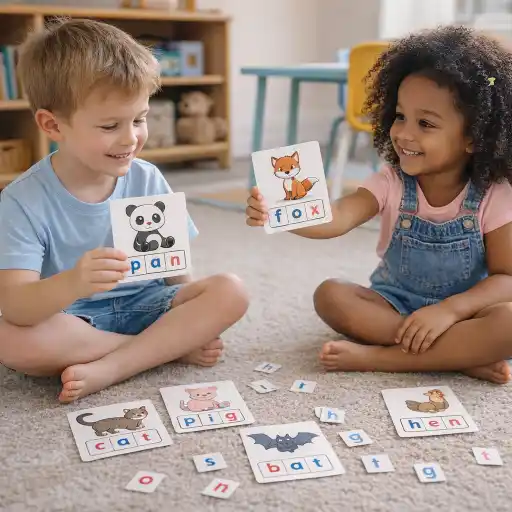
Keep feedback specific and encouraging: “You listened for the middle sound and chose the letter that spells it.” If a child guesses from the picture, acknowledge the useful observation, then return to the letters and sounds. Avoid rushing to correct; a short pause gives the child time to apply their own #decoding strategy.
How can you make animal-word practice playful and developmentally appropriate?
Young children learn through active, responsive experiences. A worksheet can be one useful practice opportunity, but it need not become a long or isolated lesson. Keep the task brief, notice children’s interest, and extend the words into conversation or play.
- 🐾 Animal sound stretch: Choose an animal picture, say its name, and tap once for each phoneme.
- Letter rescue: Place letter tiles nearby and invite children to find the vowel that completes a word.
- Word-and-picture match: After decoding, pair the written word with its animal picture.
- Movement blend: Take three small steps while saying the beginning, middle, and ending sounds, then say the whole word.
Use materials that fit your group’s needs. Some children may benefit from large print, fewer choices, tactile letters, repeated modeling, or extra wait time. Children who speak more than one language may have different experiences with English vowel sounds; invite family knowledge and avoid treating language differences as lack of ability.
The Complete the Words - Animals worksheet Buy Now $1.00 can be used in a phonics center, a small group, or a brief independent-practice window. When possible, pair paper practice with oral blending, letter manipulation, and meaningful #play.
How can you assess progress and avoid common pitfalls?
Assessment during CVC practice does not need to interrupt learning. Observe what children do as they say, segment, select, and blend sounds. Make concise, objective notes: Did the child identify the middle sound independently? Did they need a model, a verbal cue, or a choice of letters? Could they blend the word after completing it? These observations help you plan the next teaching step without turning practice into a high-pressure test.
ChildCareEd’s Assessment of Language and Literacy Skills course Buy Now $24.00 addresses objective observation, documentation, and using assessment information to create meaningful learning goals. It can help providers connect a specific classroom activity to an informed plan for individual children.
Watch for common pitfalls:
- Relying only on pictures: Ask the child to use the letters and sounds to verify the word.
- Giving the answer too quickly: Allow wait time and offer a graduated prompt before modeling.
- Mixing too many skills at once: Begin with a clear focus—such as hearing the short vowel—before adding spelling or handwriting demands.
- Interpreting one attempt as a fixed ability: Observe across days and activities, and consider language experience, attention, and familiarity with the words.
Keep notes factual and respectful. If a child has persistent difficulty, share observations with the family and follow your program’s developmental-support procedures. Assessment should guide supportive teaching, not label a child. State requirements vary - check your state licensing agency.
Conclusion: What should providers remember about animal words and CVC decoding?
Animal words can make CVC decoding concrete and inviting: children recognize the subject, listen for three sounds, connect sounds to letters, and blend the completed word. A missing-middle-letter activity is particularly useful for drawing attention to the short vowel, provided it is paired with oral practice and active guidance rather than picture guessing alone.
For your next literacy session, choose a few familiar animal words, model one example, and give children time to attempt the rest. Watch for the strategies they use, offer specific encouragement, and record brief observations that can inform your next lesson. The Complete the Words - Animals Buy Now $1.00 worksheet supplies focused practice, while the Assessment of Language and Literacy Skills course Buy Now $24.00 offers a deeper professional learning opportunity for interpreting children’s progress. With patient, playful support, children can grow more confident as readers—one sound at a time.
- 18-Hour Train the Trainer
- Understanding Print Knowledge in Preschool
- CDA Home Visitor Subject Area 3 Part 3 Birth to 5
- The Subtle Teacher: Nonverbal Communication in the Classroom
- Birth to Five CDA Credential with Portfolio Review
- Setting the Stage: Story Time
- Emergent Learning & Development
- Creating Environments that Nurture Growth and Community
- Texas Director Credential
- Every Moment Matters: Schedules and Transitions
- 💛🧩 ¿Cómo puedo hacer que mi enseñanza sea inclusiva para los niños con autismo?
- Actividades de Motricidad Gruesa que Desarrollan el Equilibrio, la Coordinación y la Fuerza
- 10 Ejemplos de Cómo la Cultura Influye en el Desarrollo Infantil
- Proporciones de Cuidado Infantil y Tamaños de Grupo por Edad en Nueva Jersey (Guía Rápida para Centros y Hogares)
- Proporciones de Cuidado Infantil y Tamaños de Grupo por Edad en Virginia (Guía Rápida para Centros y Hogares)
- Cómo Trabajar en el Cuidado Infantil en Carolina del Norte: Requisitos y Pasos
- Celebrando la amistad en el cuidado infantil durante el Día de los Mejores Amigos
- Canciones, juegos y preguntas de círculo para niños
- Cómo simplificar la capacitación para sus empleados de daycare
- How can child care providers support name recognition and letter awareness effectively?
- Why Do Predictable Books Help Preschoolers Feel Like Readers?
- Why Are Repetitive Books Perfect for Building Reading Confidence?
- Why Do Simple Books Build Early Reading Confidence?
- How Can Picture and Color Cues Help Children Decode CVC Words?
- How Can Familiar Household Words Help Children Complete CVC Words?
- How Can Animal Words Strengthen CVC Decoding?
- How Does Mixed CVC Practice Build Flexible Decoding Skills?
- When Are Children Ready for a Second Set of Mixed CVC Words?
- How Can Predictable Ocean-Themed Text Build Reading Confidence?
- A Child Has Memorized the Book: What Can You Teach Next?
