Every child care program needs a clear, written, and regularly practiced emergency plan that protects children during both everyday incidents and major disasters. Effective #emergency #preparedness includes procedures for evacuation, shelter-in-place, lockdowns, severe weather, medical emergencies, utility failures, missing children, communication, and family #reunification. Directors should assign specific responsibilities to #staff, maintain current emergency contacts and attendance records, prepare accessible supply kits, plan for children with disabilities or medical needs, and practice developmentally appropriate drills without creating unnecessary fear. This article provides prioritized, practical steps that help busy programs prepare confidently, respond calmly, and keep #children safe when the unexpected occurs.
To strengthen your program’s readiness, explore ChildCareEd’s self-paced online course Emergency and Disaster Preparedness – Online  Buy Now
 $55.00$45.00. The training covers essential emergency protocols, evacuation procedures, and strategies for maintaining safety and order during a crisis. Directors who need additional support developing their written procedures can also take Creating an Emergency and Disaster Preparedness Plan – Online Buy Now $16.00, which guides providers through building an effective, program-specific plan. State requirements vary, so always check with your state licensing agency.
Why this matters:
1) Prepared programs save lives and reduce injury by removing uncertainty during a crisis.
2) Practiced procedures shorten family separation and protect your program’s reputation and ability to reopen quickly. For templates and training, see the ChildCareEd Emergency Preparedness Plans for Child Care Programs and the free resources library.
1) What are the core elements every plan must include?
- 🔹 Risk assessment: list local hazards (fire, flood, severe weather, intruder, utility failure). See FEMA’s IS-36 overview for hazard identification (FEMA IS-36).
- 🔸 Response actions: clearly define when to Evacuate, Shelter-in-Place, Lockdown, or Relocate. Use simple language staff can remember under stress (ChildCareEd examples: what every provider should know).
- 🔹 Roles and checklists: name who leads, who takes attendance, who retrieves Go-Bags, and who communicates with families.
- 🔸 Communication & reunification: post primary/backup meeting sites and a reunification procedure (see CDC guidance on reunification: CDC Reunification).
- 🔹 Supplies & documentation: attendance, health forms, medications, and Go-Bags (store in waterproof folders).
- 🔸 Training & review schedule: drill frequency, documentation, and annual plan review.
For a step-by-step sample plan and printable templates, start with ChildCareEd’s Sample Child Care Emergency Action Plan.
2) How do we build classroom Go-Bags and center kits?
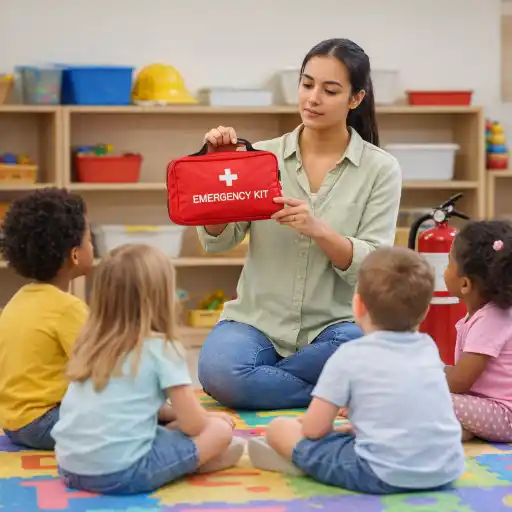
Quick, portable Go-Bags make the difference in the first 1–6 hours after an event. Follow a simple inventory and maintenance routine:
- 📌 Information (waterproof): current attendance record, emergency contacts, health forms, medication authorization—keep a printed set in each bag. ChildCareEd’s detailed Go-Bag checklist is a practical model: Your Emergency Go-Bag.
- 🥼 First aid & meds: complete first aid kit, gloves, CPR barrier, and procedures for prescription meds per policy and parental consent.
- 💧 Basic needs: water, non-perishable snacks, diapers/wipes, formula (if applicable), blankets, and comfort items like a small book or soft toy.
- 🔦 Tools & comms: flashlight, extra batteries, whistle, battery-powered/crank radio, charged power bank, and paper/pen.
- 🗓️ Maintenance: check bags every 3–6 months; rotate food, test radios, and update contacts when enrollment changes.
Tip: place one Go-Bag near each main exit and a larger center kit with extra water and documentation. Use your Go-Bag in every drill, so staff knows who is responsible for it during an evacuation.
3) How can staff be trained and drills run without frightening young children?
- 🎯 Train in short modules: 20–30 minute staff sessions that focus on roles, the evacuation route, and reunification steps. ChildCareEd offers both online and in-person trainings to meet state requirements (Emergency and Disaster Preparedness - Online Buy Now
$55.00$45.00). For additional guidance on preparing staff to create effective plans and respond to disasters, see emergency preparedness training for child care providers. - 🧸 Practice with care for children: use calm language—"We are practicing to be safe"—and age-appropriate games (e.g., "Sleeping Lions" for quiet drills). Avoid realistic simulations that could cause trauma.
- 📋 Debrief and improve: after each drill, log time, attendance accuracy, what worked, and what to fix. Make revisions visible to staff.
- 🤝 Involve community responders: invite local fire or EMS to observe and give practical feedback—this builds trust and clarifies expectations.
Common mistakes to avoid: 1) Not updating contact lists — remedy: monthly review. 2) Skipping practice — remedy: schedule short quarterly drills for non-fire scenarios. 3) Using scary simulations — remedy: use calm, trauma-informed practice. For more on simple plans and drills,lls see ChildCareEd’s how-to and FEMA IS-36 (FEMA).
4) What are best practices for communication and reunification with families?
Clear, redundant communication reduces family anxiety and speeds safe reunification. Use these steps:
- 📣 Before an event: publish your reunification site(s) and process in the parent handbook and at drop-off. Make sure families know the verification method (photo ID, sign-out, or colored card system).
- 📱 During an event: prioritize children’s safety first; once secure, send a brief, factual message via phone tree, group text, or the communication platform parents already use. Keep a printed contact list in the Go-Bag in case phones fail.
- 🧾 Reunification procedure: use signed release forms, check IDs, and log every release. CDC resources emphasize speed paired with controls—faster reunions improve outcomes for children (CDC Reunification).
- 📎 After reunification: provide a written incident summary and resources for emotional support; note any children who may need follow-up.
For printable forms and reunification templates, use ChildCareEd’s free resources and sample emergency forms: Emergency forms & sample plans.
5) How do programs meet regulations, coordinate with partners, and keep the plan current?
Compliance, coordination, and continuous improvement are core responsibilities:
- 📝 Regulatory alignment: develop your written Emergency Preparedness and Response Plan in consultation with local emergency management and licensing. Remember: state requirements vary - check your state licensing agency. Tennessee’s guidance is an example of required components: TN Child Care Emergency Preparedness.
- 🤝 Coordinate with responders: share your plan with local fire, police, and EMS; invite them to drills and ask for feedback. This relationship speeds response and clarifies roles.
- 📆 Review cycle: schedule plan reviews annually and after every real event or drill. Keep signed drill logs and documentation for licensing inspections. ToolFluency’s free SOP is a helpful operational checklist (ToolFluency SOP).
- 🎓 Ongoing training: assign a staff member to track certifications and arrange refresher trainings; consider ChildCareEd courses that include a fillable Emergency Plan Form for course completion (Creating an Emergency Plan Buy Now $16.00).
Conclusion — What to do this week
Short action checklist (post where staff will see it):
- ✅ Write or update a 1–2 page plan listing roles and three prioritized responses (evacuate, shelter, lockdown). Use ChildCareEd templates.
- ✅ Assemble classroom Go-Bags and a center kit; check inventories.
- ✅ Schedule and run a short staff drill; include a Go-Bag grab-and-go exercise.
- ✅ Share your reunification site and verification steps with families.
- ✅ Schedule an annual plan review and invite local responders to observe a drill.
FAQ (quick):
- Q: How often should we drill? A: Monthly fire drills are common; practice sheltering and lockdown quarterly—follow state rules.
- Q: Can staff transport meds in Go-Bags? A: Follow licensing and parental consent policies—document storage and chain of custody.
- Q: Who approves our plan? A: Your director, licensing consultant, and, ideally, local emergency responders.
- Q: What if phones fail? A: Use printed contact lists, radios, and an out-of-area phone contact in your Go-Bag.
Need templates and course options? Start with ChildCareEd’s resources: what every provider should know, the free sample plans, and the online course Buy Now $55.00$45.00 that includes an Emergency Plan Form. Your work preparing now is the single best way to protect children, support families, and sustain your program. Thank you for prioritizing safety.
- Stay Alert! Steps for Emergency Prep
- SIDS: Saving Babies: A Change of Position, A Change in Tradition
- Emergency and Disaster Preparedness
- CDA Family Child Care Credential
- CDA Family Child Care Credential with Portfolio Review
- 24 Hour Texas Pre-Service
- CDA Bridge Bundle: Family Child Care without Portfolio Review
- Texas Director Credential
- Prevention of Sudden Infant Death Syndrome and Use of Safe Sleep Practices
- Emergency and Disaster Preparedness- Online
- Ensure the Health and Safety of Young Children
- Emergency Preparedness training
- D.C. Emergency Preparedness Training
- Normas de Licenciamiento de Cuidado Infantil en Virginia para Centros Diurnos Infantiles y Hogares Diurnos Familiares
- Emergency Preparedness in Wisconsin Child Care: What to Have, Practice, and Document
- How do we handle a child care emergency in New York: policies, drills, and preparedness?
- How can child care centers be ready for emergencies?
- How do I write an emergency preparedness plan that meets Michigan licensing rules?
- How can childcare centers create effective emergency preparedness plans?
- What Emergency Preparedness Does Every Child Care Program Need?
- How can child care programs support children during extreme weather events?
- How Do You Create an Effective Emergency Staffing Plan for Your Child Care Program?
- How can I develop effective emergency leadership procedures for my childcare program?
- What Is the Difference Between Babysitting, Child Care at Home, and a Licensed Home Daycare?
- How to Become a Daycare Owner: What Qualifications Do You Actually Need?
- Pediatric First Aid for Teachers: Are Your Skills Still Fresh When an Emergency Happens?
- What Certifications Do I Need to Open a Child Care Center? Owner vs. Director Requirements Explained
- Do You Have to Retake Emergency and Disaster Preparedness Training in Maryland?
- Evacuate, Shelter, or Lock Down? How to Respond to Different Child Care Emergencies
- What Should Be Included in a Child Care Emergency Preparedness Plan?
