A clear emergency plan helps your team protect children, communicate with families, and make sound decisions when every moment matters. ChildCareEd’s Emergency and Disaster Preparedness – Online  Buy Now $55.00 course offers child care-specific learning on response procedures and emergency planning; explore it as a practical next step for strengthening your program’s readiness.
Why is a written emergency plan essential?
Emergencies may include fires, severe weather, utility failures, medical incidents, disease outbreaks, or threats to facility security. Their likelihood and impact differ by location, building, children served, and available community resources. A written plan turns that context into shared actions so staff are not forced to improvise while supervising children.
Preparedness is more than a document kept in a director’s office. It is an ongoing cycle of identifying risks, making plans, practicing responses, and improving after drills or real events.
Planning also helps programs account for inequities and individual needs. Families may have limited transportation, language access, or emergency supplies; children may need medication, mobility support, or familiar comfort items. A thoughtful plan identifies these needs ahead of time and coordinates with local emergency management, public health, licensing, and community partners. State requirements vary—check your state licensing agency.
What hazards and response actions should the plan address?
Begin with a site-specific risk assessment rather than relying on a generic checklist. Consult local emergency management, fire and law enforcement partners, public health officials, families, and staff. Consider both likely hazards and cascading effects—for example, a storm may lead to power loss, unsafe roads, or a need to relocate.
The written plan should explain when and how staff use each primary response:
- Evacuation: Identify primary and alternate exits, routes, outdoor assembly points, and the person who checks each area.
- Relocation: Name nearby and backup sites, transportation arrangements, and how children will be supervised until reunification.
- Shelter-in-place: Identify the safest interior area, supplies to bring, and procedures for monitoring official instructions.
- Lockdown: Define how staff receive the alert, secure spaces, account for children, and wait for an all-clear from appropriate authorities.
Use clear, plain-language steps and make the plan available in every classroom and other spaces used by the program.
How should roles, communication, and reunification be organized?
Assign each emergency task to a named role, with a backup person for absences or staff changes. Depending on program size, responsibilities may include incident leadership, first aid, facilities safety, attendance, transportation, supplies, family communication, and emotional support.
Prepare communication procedures for staff, families, emergency responders, and community partners. Specify who approves and sends updates, which channels are used, and how the program will communicate if phones or internet are unavailable. Keep current contact information and printed backups accessible during an evacuation.
Reunification procedures should identify approved pickup adults, a method for verifying identity, the location for family pickup, and a record of each child’s release. Practice communicating the location and next steps in clear, concise language. Keep custody instructions and emergency authorizations current, secure, and accessible only to staff who need them.
- Use more than one method to reach families, such as text, phone, and email, with a non-digital backup.
- Keep attendance rosters, emergency contacts, and approved pickup lists in a portable, protected format.
- Record reunification decisions and the time and identity of each authorized pickup.
How can the plan meet children’s health, access, and developmental needs?
Every child must be accounted for in the plan—not only the average child who can walk, communicate, and tolerate a sudden change in routine. Make individualized arrangements for infants and toddlers, children with disabilities, children with chronic health conditions, and children who use mobility, communication, or sensory supports.
For each child who needs additional support, document practical steps such as who carries the child, where essential equipment is stored, how medication and health care plans travel, and what supplies are needed for feeding, diapering, or comfort. Confirm that staff know how to access and follow current care instructions while protecting private information. Coordinate with families and, where appropriate, the child’s health care team.
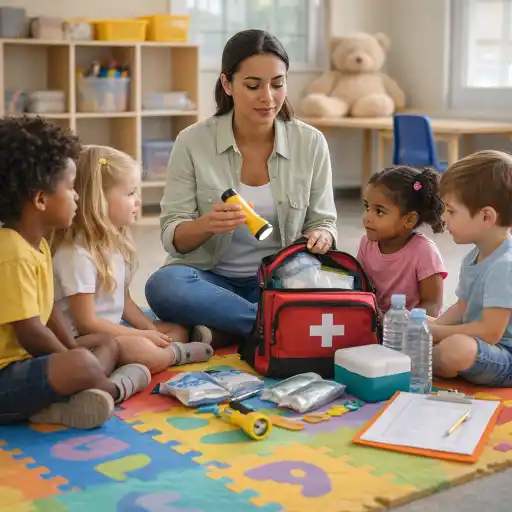
Supplies should reflect likely emergencies and the ages and needs of children served. Classroom go-bags and central kits may include water, shelf-stable food, first-aid supplies, hygiene items, flashlights, batteries, communication tools, and comfort materials. Include necessary medications and child-specific items according to applicable storage and authorization rules. Check expiration dates, restock after use, and keep written records in case digital systems are unavailable.
Trauma-informed preparation matters, too. Use calm, age-appropriate explanations and familiar routines, and avoid unnecessarily frightening simulations. A trusted adult’s steady presence can help children feel safer during practice and recovery.
How do training, drills, and recovery keep the plan useful?
A plan works only when staff can carry it out. Train employees and volunteers on their roles, response signals, evacuation or shelter procedures, attendance checks, first aid responsibilities, and family communication steps. Orient new staff promptly and revisit procedures when rooms, staffing, enrollment, or local hazards change.
Practice drills that reflect the program’s risks and applicable requirements. Before a drill, explain the purpose to children and families in developmentally appropriate ways. During practice, account for children and staff at the starting point, safe location, and return to the program.
After every drill or actual event, hold a brief review: What worked? Where did communication slow down? Were supplies, transportation, or staffing adequate? Record corrective actions, assign responsibility, and set a date to check that changes were completed.
Include recovery and continuity of operations. Consider how the program will support children and staff emotionally, protect records, communicate any closure or relocation, and resume care when it is safe. Preparedness is a cycle: assessment, planning, practice, response, and learning.
What are the most common planning gaps to avoid?
Plans are often weakened not by a lack of concern, but by outdated details or procedures that have never been practiced. Make the plan specific enough to guide action and simple enough for staff to use under pressure. The federal ACF child care preparedness checklist highlights coordination, continuity, recovery, communication, drills, and accommodations as important planning areas.
- ⚠️ One response for every hazard: Clarify which conditions call for evacuation, shelter-in-place, or lockdown, and who follows official alerts.
- Unassigned responsibilities: Name a primary and backup for each critical role, including attendance and family updates.
- Contact details that are out of date: Give families a routine way to update numbers, authorized pickups, and relevant health information.
- Digital-only records: Keep accessible printed rosters, emergency contacts, and essential care information for technology outages.
- Drills without follow-up: Log what happened, identify improvements, and verify that corrective actions are completed.
- Ignoring emotional safety: Use calm explanations, developmentally appropriate practice, and support after a stressful event.
Also avoid treating the plan as a one-time compliance task. Share relevant procedures with families, coordinate with local responders, and review the document at least when significant changes occur—and on a regular schedule chosen by your program. State requirements vary; check your state licensing agency for specific rules about plan content, training, and drills.
Conclusion: What should your emergency plan include?
A strong child care emergency preparedness plan combines a local risk assessment with clear procedures for evacuation, relocation, shelter-in-place, and lockdown. It assigns staff roles; explains communication and verified family reunification; addresses children’s individual health, access, and developmental needs; identifies supplies and backup records; and describes training, drills, recovery, and continuity of operations.
Start with one manageable step: review your current plan with staff and families, identify the most important gap, and assign a person and date to address it. Then practice, document what you learn, and update the plan as your program and community change. Preparation cannot prevent every emergency, but a current, practiced plan helps your team respond with greater clarity, coordination, and care.
Explore relevant ChildCareEd courses:
- Stay Alert! Steps for Emergency Prep Buy Now $25.00 — plan components, response actions, drills, communication, and special or medical needs.
- Creating an Emergency and Disaster Preparedness Plan Buy Now $16.00 — creating and implementing a plan, response, and communication.
- Responding to Emergencies Buy Now $16.00 — emergency planning and communication with emergency personnel.
- Emergency and Disaster Preparedness – Online Buy Now $55.00 — child care-focused emergency procedures and preparedness.
- Pediatric Blended First Aid & CPR/AED Adult, Child, Infant Buy Now
$85.00$80.00 — first aid and CPR/AED learning with hands-on skills verification.
- Stay Alert! Steps for Emergency Prep
- Emergency Preparedness and Response Planning Resulting from a Natural or Man-Made Event
- Emergency and Disaster Preparedness
- CDA Family Child Care Credential
- CDA Family Child Care Credential with Portfolio Review
- Emergency Preparedness and Response Planning Resulting from a Natural or Man-Made Event
- Texas Director Credential
- Creating an Emergency and Disaster Preparedness Plan
- Responding to Emergencies
- CDA Infants/Toddlers: Lesson Planning Made Easy
- ¿Cómo pueden los equipos de cuidado infantil practicar habilidades rápidas de primeros auxilios en situaciones reales?
- Capacitación en Salud y Seguridad Preventiva en Línea para Proveedores de Cuidado Infantil
- Lista para Guardería en Casa en California: Cómo Iniciar una Guardería en el Hogar
- Emergency Preparedness in Maryland Child Care: What to Have, Practice, and Document
- How do I open a day care in Nevada the right way?
- How do we handle a child care emergency in New York: policies, drills, and preparedness?
- How can I create a safe childcare environment for every age group?
- How can providers and families keep children safe while trick-or-treating?
- What Is the Difference Between MSDE Basic Health and Safety Initial Training and the Annual Update?
- What Daycare Certification Requirements Must You Complete Before You Can Start Working?
- Pediatric First Aid for Teachers: Blended or In-Person—Which Should You Choose?
- Pre-Service Training for Child Care: What Must You Finish Before Your First Day?
- Do You Have to Retake Emergency and Disaster Preparedness Training in Maryland?
- How Do You Fill Out LIC 279? A Step-by-Step Guide for California Family Child Care Applicants
- Evacuate, Shelter, or Lock Down? How to Respond to Different Child Care Emergencies
- How Can Child Care Programs Build Effective Emergency Preparedness?
- What Should Be Included in a Child Care Emergency Preparedness Plan?
