Fall materials can turn an ordinary classroom corner into a small laboratory where toddlers compare, carry, drop, and investigate. Explore practical, safety-minded ways to plan these invitations, and consider Enhancing STEM Education for Infants and Toddlers  Buy Now $16.00 to build your knowledge of early inquiry and integrate STEM into everyday teaching. For a ready-to-use planning aid, the Toddler Fall STEM Invitation Cards and Material Review Checklist can help your team prepare ideas and review materials with children’s safety in mind.
Why do fall loose parts invite meaningful toddler learning?
Loose parts are materials children can move, arrange, carry, combine, and use in more than one way. Autumn offers a natural variety: broad leaves, sturdy baskets, large gourds, fabric in seasonal colors, and oversized cardboard pieces. When toddlers pick up, drop, roll, stack, or transfer these objects, they are exploring physical properties through action—not simply keeping busy.
Repeated play supports early ideas about size, weight, space, motion, and cause and effect. A toddler may notice that a large leaf covers a smaller one, that a heavier object moves differently, or that a basket tips when too many pieces are placed on one side. These discoveries often appear first as gestures and repeated experiments. Providers can recognize the thinking in the action without expecting children to explain it verbally.
Loose parts also create opportunities for language, movement, and agency. Naming “big,” “small,” “under,” “over,” “fast,” and “slow” connects words to immediate experiences. Children make choices, test ideas, and return to an investigation at their own pace. This is a practical way to nurture #curiosity and early STEM habits while keeping play joyful and child-led.
How can educators choose seasonal materials with care?
Begin with a small collection, selected for the specific toddlers who will use it. Fall objects can vary widely in size, texture, durability, and safety. Consider children’s ages, mouthing behavior, motor skills, sensory preferences, and any individualized needs. In mixed-age environments, consider every child who could reach the setup, not only the intended group.
- Choose large, sturdy items that are difficult to break or swallow, such as broad fabric squares, robust baskets, large blocks, and oversized leaves.
- Inspect natural and recycled materials for splinters, sharp edges, mold, loose parts, dirt, coatings, and deterioration. “Natural” does not automatically mean safe.
- Avoid small seeds, acorns, tiny decorative pumpkins, loose lids, and other objects that may create choking risks for toddlers.
- Check whether materials can be cleaned and stored according to your program’s procedures.
- Set aside any item whose composition, condition, or safety is uncertain until it has been reviewed.
Screen objects and detachable components individually; repeated chewing, twisting, and dropping can change an item. Passing a size check alone does not assess sharpness, toxicity, cords, magnets, batteries, or durability. A consistent loose-parts review routine can help staff document concerns and decide whether an item should be cleaned, repaired, restricted, or removed. State requirements vary - check your state licensing agency.
What simple invitations explore size, movement, and cause and effect?
Offer one focused arrangement at a time and leave room for toddlers to decide what to do. The purpose is not to produce a particular result; it is to make a concept available for exploration. A small set of materials helps children notice contrasts without overwhelming the play space.
- 🍂 Big and small: Place a few large fabric leaves and sturdy containers on a mat. Toddlers can place, cover, uncover, and compare. Narrate: “The big leaf covers the little one.”
- Roll and stop: Offer a low, stable ramp and a few large, age-appropriate objects that roll or slide. Notice what travels farther, what slows down, and where objects stop.
- Fill and tip: Provide large baskets and soft, oversized materials. Children can transfer objects and see how a full or uneven basket moves.
- Leaf movement: Use a broad leaf or fabric square and a gentle fan of air from an adult’s hand or a breeze outdoors. Watch it flutter, fall, or travel.
- Stack and topple: Offer large, lightweight boxes or blocks. Toddlers can compare a wide base with a narrow one and observe what happens when a structure becomes tall.
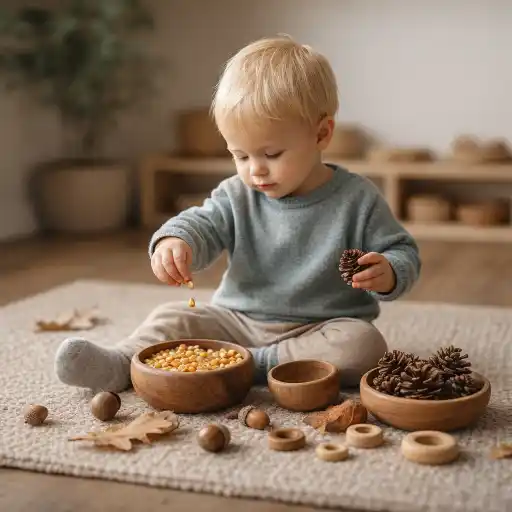
Keep ramps low and secure, clear the travel path, and make sure the objects are too large to present a choking hazard. Stay close enough to supervise actively and adapt the invitation when children’s play changes. For additional seasonal inspiration, see fall sensory activities for toddlers and preschoolers.
How can providers guide inquiry without taking over?
Observe first. Notice what a child selects, repeats, compares, or changes. Then offer a short description or one open prompt and allow time for the child to respond through action, words, gaze, or gesture. Toddlers often need space to repeat an experiment before an adult adds another idea.
- Describe what you see: “You put the large leaf on top.”
- Connect action and outcome: “You let go, and the ball rolled down.”
- Invite comparison: “This basket feels heavier. What do you notice?”
- Wonder briefly: “What might happen if we use the wide box?”
- Wait, then follow the child’s next move rather than demonstrating a preferred answer.
These small interactions strengthen vocabulary and help children attend to relationships between actions and outcomes. Accept nonverbal communication as meaningful participation; a child who watches carefully or repeats one movement is investigating too. Avoid turning play into a quiz or asking several questions in quick succession.
Keep documentation simple and objective: “Jordan rolled the large ball three times and watched it stop at the mat.” A photo, short note, or child’s words can help staff identify interests and plan a related next step. The guide to toddler sensory play as science inquiry also emphasizes noticing children’s repeated actions and extending exploration with thoughtful language.
How can teams make fall loose-parts play safe and inclusive?
Safety and exploration belong together. Before play, check the condition and size of the materials, the stability of furniture and ramps, the floor for slipping or tripping hazards, and the sightlines across the area. Keep pathways clear and position educators to see, hear, and respond to children. Active supervision means continually scanning, listening, anticipating, and moving close—not simply being present in the room.
Plan for foreseeable use. Toddlers may mouth, throw, carry, bang, or combine materials in ways adults did not anticipate. Decide which materials need close one-to-one proximity, when a setup needs adjusting, and how to remove questionable items immediately. In mixed-age settings, prevent younger children from accessing pieces intended for older toddlers.
- Offer larger tools or materials for children who benefit from easier grasping, and provide seated or standing access as appropriate.
- Make room for children to watch, point, use a tool, or explore from a comfortable distance; direct touch is not required.
- Use picture cues, gestures, and home-language vocabulary to support communication and participation.
- Keep quantities manageable, define a play area, and plan cleanup and storage before setting out materials.
- Remove damaged or questionable items from circulation, record the concern, and share it with the team.
Directors can make this routine easier by using a shared material-review checklist during preparation, rotations, and transitions between classrooms. For added professional learning, explore Building Early Science Foundations Buy Now $16.00, Tomorrow’s Einsteins: Infant and Toddler Science Buy Now $16.00, and Intentional Safety for Infants/Toddlers Buy Now $24.00. Review course details and confirm whether training meets your individual professional-development needs.
Conclusion: How can fall materials become toddler STEM invitations?
Fall loose parts can help toddlers investigate size, movement, and cause and effect when educators offer a few carefully selected materials, make space for repetition, and notice what children discover. Large leaves, baskets, boxes, and stable ramps can invite comparing, filling, rolling, stacking, and testing—everyday actions rich with early STEM learning.
Keep the central goal in view: provide engaging exploration while protecting children through thoughtful screening, active supervision, inclusion, and regular rechecks. Describe what happens, wait for children’s ideas, and use observations to plan what might come next. A simple seasonal invitation can be a meaningful learning experience when it is safe, responsive, and built around toddlers’ own curiosity.
- Positive Attention: Interactions and Supervision of Infants and Toddlers: For Workforce Solutions
- The ABCs of Behavior: Turning Challenges into Learning Opportunities
- Pediatric RSV First Aid & CPR/AED
- Baby Steps to Milestones
- CDA Infants/Toddlers: Classroom Setup
- Positive Attention: Interactions & Supervision for Infants & Toddlers
- Sensitive Periods in Montessori: Guiding Natural Learning
- 45-Hour Infant and Toddler Curriculum
- Enhancing STEM Education for Infants and Toddlers
- Mindful Supervision: Balancing Safety & Independence in Montessori
- CDA Certification en Español: Recursos y Consejos para Educadores Bilingües
- 😤💬 ¿Qué Le Digo a un Niño que Acaba de Morder a Otro?
- Recursos en Español sobre el Sueño Seguro del Bebé
- Cómo ser director de cuidado infantil en Maryland
- Que es Título 22 en California?
- ¿Cuáles son los pasos, requisitos y opciones en línea para la certificación de 90 horas en cuidado de Infantes/Toddlers en Maryland?
- Capacitación en Salud y Seguridad Preventiva en Línea para Proveedores de Cuidado Infantil
- Proporciones de Cuidado Infantil y Tamaños de Grupo por Edad en Virginia (Guía Rápida para Centros y Hogares)
- Lista para Abrir una Guardería en Casa en Georgia: Cómo Empezar
- Actividades de Otoño Fáciles para Preescolares esta Temporada
- Lista para Guardería en Casa en Texas: Cómo Iniciar una Guardería en el Hogar
- Cómo Trabajar en el Cuidado Infantil en Carolina del Norte: Requisitos y Pasos
- Cómo Trabajar en el Cuidado Infantil en California: Requisitos y Pasos
- Cómo Ser Maestra de Preescolar en Maryland
- Celebrando la amistad en el cuidado infantil durante el Día de los Mejores Amigos
- Canciones, juegos y preguntas de círculo para niños
- Cómo simplificar la capacitación para sus empleados de daycare
- Proporciones para guarderías en casa bajo el Título 22: Cómo la mezcla de edades cambia su capacidad en California
- What Are Loose Parts, and How Can Teachers Use Them Safely?
- How Can Fall Loose Parts Help Toddlers Explore Size, Movement, and Cause and Effect?
