Introduction
Reading aloud is one of the best moments in a preschool day. When we ask good questions, we help children think, learn words, and understand stories. This short guide gives child care providers easy, ready-to-use read-aloud questions and ways to use them so children build #comprehension and love books. You will also see simple examples you can use tomorrow.
Why it matters:
1. Young children grow language and memory when adults ask and listen. See ideas from ChildCareEd: How Can I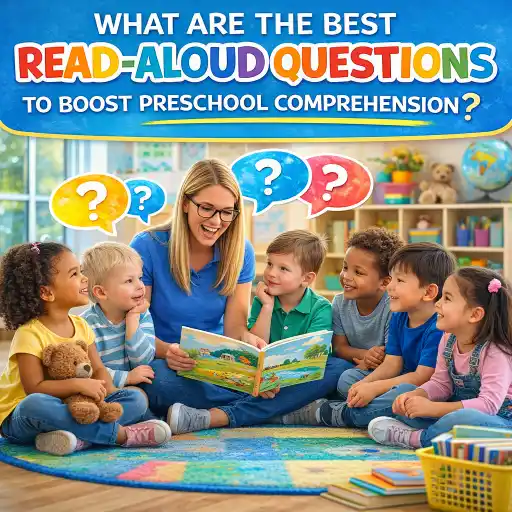 Make Storytime the Most Powerful Part of My Day?.
2. Asking questions turns storytime into a two-way conversation. That helps children practice words and thinking skills (dialogic and interactive read-alouds are strong methods — see Dialogic Reading and Interactive Read-Alouds).
Tip: keep short routines, use simple pictures, and remember state requirements vary - check your state licensing agency.
Key words you will see in this article: #readaloud #preschool #questions #vocabulary #comprehension
1) What questions should I ask before, during, and after a read-aloud?
Asking questions in three moments helps children predict, follow, and remember the story. Try a simple sequence:
- Before reading: get interest and activate background knowledge.
- During reading: check understanding and invite children to join the story.
- After reading: help children retell and use new words.
Examples you can use right away:
- Before: "What do you think this book is about?" (prediction)
- During: "What just happened?" or cover a word and ask the child to fill it in (completion) — this builds syntax and memory (Scholastic).
- After: "Can you tell me three things that happened?" or "How did the character feel?" (recall and feelings)
Why this order works:
- Before questions warm the brain and make the story easier to follow.
- During questions keep children engaged and let you teach 1–2 new words.
- After questions help move the story into play and centers (repeat the book later in a play area).
For more planning tips and read-aloud routines, see ChildCareEd: Reading Aloud in Child Care.
2) What types of simple questions work best for preschoolers?
Preschoolers need clear, short questions. Use types that match their age and language level. Here are easy categories and examples:
- Who? — "Who is that?"
- What? — "What is she holding?"
- Where? — "Where is the little dog?"
- When? (simple) — "Is it day or night?"
- Why? / How? — saved for older preschoolers or asked with choices ("Why is he sad? Because he lost his hat or because it rained?")
Use visual supports and choices:
- 🙂 Provide picture choices: show 2 pictures and ask the child to point.
- 🎯 Use props: a toy or puppet to act out the question.
- 🔁 Repeat and give wait time: wait 5–10 seconds for an answer.
Research shows that repeating books and using prompts like completion, recall, open-ended, WH, and distancing prompts supports learning — see Dialogic Reading. ChildCareEd also recommends planning 2–3 words to teach before you read (Reading Aloud in Child Care).
3) How can I use questions to build vocabulary and early literacy skills?
Questions are a natural way to teach words and ideas. Follow these steps during a read-aloud to boost #vocabulary and print knowledge:
- Pick 1–3 target words before you read (nouns, action words, or feeling words).
- Introduce a word with a short definition and an action or gesture.
- Ask a question that uses the new word so children hear it in context.
Example sequence:
- Introduce: "Enormous means very, very big — make your arms wide."
- During: "Which animal is enormous?" (point to pictures)
- After: "Show me something in the room that could be enormous."
Other quick literacy moves:
- 📚 Show the cover and title: Ask "What do you think the title means?" — this teaches book structure.
- 🔍 Point to print: occasionally point to words as you read to show print direction.
- ♻️ Reread: repeated readings let children move from listening to joining the story.
These steps are practice-based and match recommendations in ChildCareEd storytime guidance and evidence on complex text and vocabulary teaching (Massachusetts Literacy).
4) How do I make read-aloud questions inclusive for dual language learners and children with attention needs?
Make questions supportive and accessible. Use visuals, gestures, and choices so all children can answer. Try these classroom-friendly strategies:
- 🖼️ Visuals: show picture cards or props when asking WH questions (see free resources at ReadAloud.org).
- 🗣️ Repetition: repeat favorite books; children learning a second language benefit from repeated exposure (ChildCareEd).
- 🧩 Choice supports: give 2 picture choices instead of asking open-endedly; this lowers frustration.
- 🎧 Movement breaks: allow a short action between pages for kids who need movement to focus (teach them to return to the circle after one move).
- 🧵 Simple scaffolds: use pictorial WH cards or sentence stems: "I see ___" or "He is ___ because ___."
Speech and language resources can help you plan WH questions and visuals — see examples at The Pedi Speechie and printable cards ideas like And Next Comes L.
Conclusion: How can I start using these questions tomorrow?
1. Choose one short book and pick 1–2 target words.
2. Use the before/during/after question pattern and offer picture choices.
3. Repeat the same book across the week. Put it in a center and use follow-up play activities to keep the learning going (puppets, drawing, or retell with props).
Common mistakes and how to avoid them:
- ❌ Asking too many questions at once — instead, ask 1–2 quick prompts per reading.
- ❌ Using only yes/no questions — use open prompts or picture choices to encourage language.
- ❌ Skipping wait time — always pause 5–10 seconds so children can answer.
FAQ
- Q: How long should a preschool read-aloud be?
A: Keep it 10–20 minutes for most preschool groups; shorter for younger toddlers. Short, daily read-alouds beat one long session (ChildCareEd). - Q: What if a child doesn’t answer?
A: Offer a picture choice, a gentle prompt, or model the answer. Try again on the next read. - Q: Can I use questions with big groups?
A: Yes — use small group read-alouds when possible or give a single quick prompt for the whole circle and invite 2–3 children to respond. - Q: Where can I find more question cards and printables?
A: Free resources include ReadAloud.org and many WH card printables referenced above.
For more in-depth strategies and professional training, ChildCareEd offers courses like Reading Aloud and Storytelling  Buy Now $16.00 and Setting the Stage: Story Time Buy Now $25.00. These can help you plan lessons, choose books, and practice interactive techniques.
You are doing important work. Small, regular changes to your questions can make storytime the most powerful part of a child's day.
- Understanding Print Knowledge in Preschool
- Lesson Planning for Preschoolers
- Science of Reading Foundations in the Pre-K Classroom
- CDA Home Visitor Subject Area 3 Part 3 Birth to 5
- Reading Aloud and Storytelling
- Birth to Five CDA Credential with Portfolio Review
- Setting the Stage: Story Time
- Texas Director Credential
- What Are the Best Read-Aloud Questions to Boost Preschool Comprehension?
- ¿Qué preguntas aparecen en el examen CDA para preescolar?
- What fun literacy activities do Florida VPK classrooms need now?
- How can child care providers use the science of reading to boost early literacy in New York?
- How can preschool classrooms best support language development?
- How can we teach preschoolers to ask better questions and make predictions?
- How Can Take-Home Books Strengthen the Home-School Reading Bond?
- How Can Emergent Readers Support Vocabulary Growth?
- Why Are Repetitive Books Perfect for Building Reading Confidence?
- Why Do Simple Books Build Early Reading Confidence?
- How Can Printable Books Help Preschoolers Fall in Love With Reading?
- How Do Repetitive Sentence Patterns Build Early Reading Confidence?
- How Can Recipe Sequences Build Comprehension and Oral Language in Preschool?
- How Can Familiar Real-Life Processes Help Preschoolers Learn Sequence Words?
- How Can Predictable Ocean-Themed Text Build Reading Confidence?
- How Can Young Storytellers Make It Clear Who “He,” “She,” or “They” Means?
- What Should You Do When Children Disagree with a Storybook’s Ending?
- How Can You Help a Beginning Reader Say More Than the Sentence on the Page?
- What Are Educational Apps Replacing in Preschool—and What Should They Replace?
- A Child Has Memorized the Book: What Can You Teach Next?
