When children can decide what materials mean and how an activity unfolds, ordinary blocks, paint, and cardboard become powerful tools for learning. Explore practical ways to create these invitations in your program, and consider The Best Promotion is Play  Buy Now $24.00 for focused professional learning on play’s role in development and classroom practice. This course can help you strengthen how you plan for creativity, problem-solving, and cooperation while giving children room to lead.
What makes an activity open-ended?
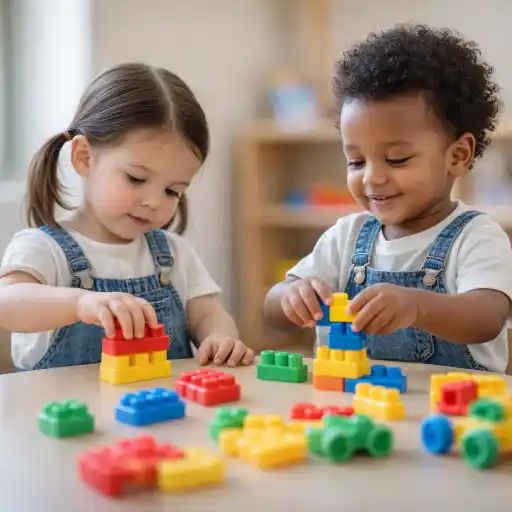
An open-ended activity has no single prescribed outcome or “right” way to participate. Children have meaningful choices about how to use materials, what ideas to pursue, and when their exploration is complete. A block might become a bridge, a phone, or part of a pretend grocery store; paint might become a map, an abstract design, or simply an experiment with color and movement.
Open-ended activities are not the same as leaving children without support. Educators intentionally select materials, organize the space, set clear safety limits, and stay available. The distinction is that adults prepare the conditions for learning without predetermining what children must make. NAEYC describes everyday materials such as blocks, paint, sand, water, playdough, and natural objects as resources that invite sensory, creative, and dramatic exploration (open-ended materials).
This approach can include art, building, pretend play, sensory exploration, and outdoor discovery. It can also connect to curriculum goals: children may compare sizes while building, narrate a shared story, or investigate what sinks and floats. The learning is intentional, even when the final product is not planned.
Why do open-ended activities matter for development?
When children generate their own plans, they practice flexible thinking, decision-making, persistence, and problem-solving. A structure that falls is not simply a failed project; it is an opportunity to reconsider the base, change materials, or try another design. A review of research on loose-parts play describes how exploratory, pretend, and construction play can engage cognitive processes such as reasoning, self-regulation, and problem-solving, while also noting that more direct research is needed (literature review on loose-parts play).
These activities also make room for language and relationships. Children explain their ideas, invent stories, negotiate roles, share resources, and work through disagreements. The American Academy of Pediatrics emphasizes that developmentally appropriate play can support children’s social-emotional, cognitive, language, and self-regulation skills (The Power of Play).
Open-ended play is valuable partly because it welcomes varied ways of participating. One child may build, another may observe before joining, and another may tell the group what to try. With responsive support, all can contribute. The goal is not to claim that one kind of activity guarantees a particular outcome, but to provide rich, repeated opportunities to practice developing skills through meaningful engagement.
What materials and invitations can providers offer?
Choose versatile, accessible materials that can be combined and used in multiple ways. You do not need expensive equipment. A small, thoughtfully arranged collection often invites deeper attention than a crowded shelf.
- 🎨 Art: Offer paper, washable paint, brushes, sponges, and age-appropriate collage materials without a sample to copy.
- Building: Combine blocks, cardboard tubes, boxes, fabric, and safe joining materials for structures and pretend settings.
- Nature: Provide inspected leaves, pinecones, stones, or twigs for sorting, arranging, storytelling, or sensory exploration.
- Sensory inquiry: Set out water, cups, scoops, funnels, or playdough with suitable tools and a defined play area.
- Story and dramatic play: Place a few props near books or in a play area so children can transform a story or invent one of their own.
Start with one or two invitations and observe what children do. Add a material or a gentle prompt when it can extend their thinking, not because every activity needs constant novelty. ChildCareEd offers additional open-ended activity ideas for preschoolers that can help educators turn simple materials into classroom invitations.
How can adults support learning without taking over?
The educator’s role is to prepare, observe, and respond. Begin by making materials easy to see and reach, with clear pathways and predictable places for cleanup. Watch before joining: notice what children are trying, what they say, and whether they appear engaged or frustrated. This observation helps you decide whether to wait, offer a tool, or provide a small scaffold.
Use comments and questions that keep ownership with the child. For example, describe an action—“You balanced the long block across two short ones”—or invite explanation: “Tell me about your plan.” Questions such as “What else could you try?” can extend thinking, but a pause may be more helpful when a child is concentrating. Following children’s lead does not mean avoiding teaching; it means making teaching responsive to their ideas.
Plan for different abilities, temperaments, languages, and sensory preferences. Offer adapted grips, larger materials where appropriate, picture cues, extra time, or an alternative way to participate. Keep small parts away from children for whom they present a choking risk, supervise active exploration, and inspect materials for damage or hazards. State requirements vary - check your state licensing agency.
To deepen your practice, explore Facilitating Learning in the Preschool Classroom Buy Now $35.00, which focuses on environments, interactions, materials, and authentic child-led learning experiences.
What common pitfalls can programs avoid?
Open-ended activities can lose their value when adults unintentionally turn them into a copying task. A finished sample, step-by-step directions, or frequent corrections may signal that one result is preferred. Demonstrate a technique when children request help or need access to a tool, then return the decision-making to them. Product-focused projects can have a place in a balanced program; they simply serve a different purpose from open-ended exploration.
- Too many materials: A crowded display can overwhelm children. Begin with a focused selection and rotate materials in response to interest.
- Too much adult talk: Repeated questions can feel like a quiz. Offer one genuine prompt, then listen and allow time.
- Mess treated as failure: Define the activity area, provide cleanup tools, and teach care for materials as part of the routine.
- Only finished products documented: Capture children’s strategies, words, revisions, and cooperation—not only display-ready work.
Families may wonder what children are learning when there is no identical craft to take home. Share a photo, a short child quote, or a specific observation: “The children tested three ways to keep the bridge standing.” This communicates the learning process clearly and respectfully. Directors can support consistency by giving staff time to review observations, discuss adaptations, and plan next steps together.
How can providers recognize and extend learning?
Observe the process rather than judging the product. Notice whether a child makes a plan, changes strategies, uses new words, persists after a challenge, or collaborates with peers. Keep documentation brief and useful: a photograph, a child’s words, and one note about a skill or possible next step can be enough. Across time, these notes help staff see interests and emerging abilities that may guide future invitations.
Use observation to make thoughtful adjustments. If children repeatedly build ramps, you might add vehicles or different surfaces. If an art area is drawing sustained interest, offer another tool or larger paper. If children are not engaging, consider whether the materials are accessible, familiar, culturally meaningful, and appropriate to their developmental stages—not simply whether the children need more direction.
Documentation also helps connect play with families and program goals. Describe what children practiced in concrete terms rather than making broad claims: “Ari compared the lengths of two blocks and adjusted the base after the tower tipped.” This shows the thinking within the experience and can invite families to share related interests from home. A reflective team can use these observations to keep activities responsive and inclusive.
Conclusion: Why are open-ended activities important?
Open-ended activities matter because they give young children agency, time, and materials to explore ideas in more than one way. In the process, children can practice creativity, language, cooperation, reasoning, motor coordination, and persistence. These experiences are most meaningful when educators create safe and accessible environments, follow children’s interests, and offer support without dictating the outcome.
For providers and directors, getting started does not require a major classroom redesign. Offer one manageable collection of materials, make it reachable, observe what happens, and extend play with a thoughtful prompt or adaptation. Document the strategies and words you notice, then share that learning with families and colleagues. The guiding question is not simply what children made, but what they explored, considered, and learned along the way.
For related professional learning, consider Theory of Learning Buy Now $24.00, which explores learning approaches and the role of play, or Open Heart, Open Art Buy Now $16.00 for a closer look at open-ended art and social-emotional development.
- CDA Home Visitor Subject Area 3 Part 3 Birth to 5
- CDA Home Visitor Subject Area 2 Part 3 Birth to 5
- Teacher & Me Playtime
- Bienvenido! Welcoming All Families
- 45 Hour School Age Methods and Materials
- CDA Bridge Bundle: Family Child Care without Portfolio Review
- Art from the Heart for Preschoolers: Open Ended Art Projects that Build Self-Esteem
- CDA Bridge Bundle: Infant/Toddler without Portfolio Review
- CDA Bridge Bundle: Preschool without Portfolio Review
- Professional Integrity in Child Care
- Inside the Child Care Resource Center: How to Maximize Support for Families and Educators
- Cómo Celebrar el Día Nacional del Kindergarten
- Questions to Ask Before Buying a Daycare
- Learning Through Creative Daycare Activities
- What Does Oklahoma’s 2026 Child Care Funding Mean for Providers and Families?
- How can we encourage scientific thinking through hands-on exploration?
- How Do You Explain Ego to a Child Without Making It Sound Like a Bad Thing?
- How Can We Celebrate Every Family and Create a Classroom Where Everyone Is Represented?
- How Can Child Care Providers Discuss Behavioral Concerns Without Blaming Families?
- How Can Child Care Providers Avoid Power Struggles with Young Children?
- How Can Child Care Leaders Help Staff Feel Heard Beyond the Suggestion Box?
- How Can Flag Design Help Children Explore Symbols, Patterns, and Individual Expression?
- How Can You Plan Patriotic Crafts Without Limiting Children’s Creativity?
- How Do Cut-and-Paste Activities Build Fine-Motor Control and Planning?
- How Can a Simple Watermelon Craft Build Fine-Motor and Language Skills?
- How Can Coloring Pages Spark Meaningful Historical Conversations About Juneteenth?
- What Should You Do When a Child Wants to Remove Their Contribution from Group Artwork?
- How Can Educators Respond When a Child Says Their Drawing Is “Nothing”?
