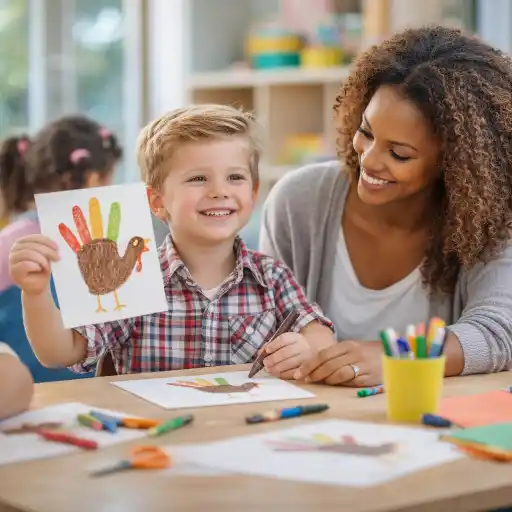
When every handprint turkey looks the same, the art may be festive—but children’s thinking can disappear behind the template. Learn how to make creative choices visible with simple observation and child-voice documentation, and build your assessment practice with ChildCareEd’s Preschool Assessments & Observations  Buy Now $24.00 course, which explores objective observation, developmentally appropriate assessment, and using what you notice to plan for individual children. For a deeper dive into open-ended art invitations and children’s self-esteem, also explore Open Heart, Open Art Buy Now $16.00.
Why does moving beyond the perfect craft matter?
Seasonal projects can be enjoyable, and teacher-guided activities have a place in the curriculum. The concern arises when children are expected to follow identical steps and produce matching results as the main form of art. In that situation, adults may see a tidy display, but have less evidence of what each child noticed, intended, tested, or changed.
Open-ended art shifts attention from the finished object to the child’s decisions. A child might choose a feather-shaped scrap instead of a handprint, mix unexpected colors, or decide that their turkey is actually a spaceship. Those choices provide authentic glimpses of planning, persistence, symbolic thinking, language, and emerging motor skills. NAEYC’s discussion of documenting process art describes how photographs, work samples, transcripts, and observations can help educators recognize learning across developmental domains.
This shift also communicates a powerful message: children’s ideas are worthy of attention, even when they do not resemble an adult’s model. Respecting individual meanings supports #agency and helps children see themselves as capable makers. A classroom gallery can celebrate differences rather than rank work by how closely it matches a sample.
What creative decisions should educators notice?
Observation begins with curiosity, not interpretation. Rather than deciding that a child is “making a turkey,” watch what the child actually does: which materials are selected, how tools are used, whether a plan changes, and how the child responds to a challenge. The goal is not to capture every action, but to notice meaningful moments that reveal the child’s process.
Consider documenting a few observable elements:
- Materials and tools the child chooses, combines, or avoids.
- Changes in plan, experimentation, or problem-solving strategies.
- Words, gestures, expressions, or interactions that communicate the child’s intention.
- Persistence, collaboration, independence, or requests for assistance.
- How the child revisits, extends, or explains the work.
Separate fact from inference. “Lina pressed the sponge into blue paint, made three prints, then switched to a brush” is observable. “Lina loves blue and is advanced in art” adds assumptions that the moment may not support. NAEYC’s guidance on observing, documenting, and assessing children’s learning emphasizes ongoing, purposeful assessment that is responsive to children’s development, language, and experience.
Look for patterns across time and settings rather than treating one artwork as a score. A brief note may point to a next invitation—such as offering different textures or more opportunities to dictate stories—without turning creative expression into a test.
How can child-voice art labels make thinking visible?
A child-voice label pairs an artwork with the child’s own words, preserving meaning that may not be obvious to an adult. After observing without interrupting, invite the child to share: “Tell me about what you have here,” “What would you like people to know?” or “Would you like me to write your words?” If the child is not ready to talk, allow time and respect that choice.
Write the child’s words accurately and distinguish them from the educator’s observation. For example: “I made a nest for the bird. It needs a soft place.” — Mateo, age 4. Add a short factual note if useful: Mateo selected yarn and fabric scraps, then tested how they held together with tape. This combination shows both the child’s interpretation and what the educator observed, without claiming more than the evidence supports.
A practical label can include:
- Child’s chosen title or exact words, recorded with permission.
- Date and, when useful, a brief context or educator observation.
- A learning connection grounded in what was seen, such as experimentation, descriptive language, or hand control.
- The child’s preference about name, display, or whether the work stays private.
NAEYC’s article on art, story, and process illustrates how recording children’s explanations can deepen educators’ understanding of mark-making, storytelling, and literacy. A thoughtful label honors #voice: it documents what the child said, rather than assigning an adult-made story to the image.
What is a manageable documentation routine for a busy classroom?
Documentation does not need to become another elaborate project. A repeatable routine can help staff notice learning while protecting time for interaction. Before an art invitation, identify one or two questions you are curious about—for example, “How do children test which materials stick?” or “What words do they use to describe their designs?” Then prepare a simple way to record what happens.
- Set up open-ended materials with more than one possible use, and explain any relevant safety expectations.
- Observe before stepping in; use a short descriptive comment or open question when it supports the child’s thinking.
- Capture one meaningful moment with a brief factual note, a child quote, or a photo when permitted.
- Label each record with the date and the context, and store it securely in the child’s portfolio or program system.
- Review notes with colleagues and use them to plan a responsive next step.
Keep records focused: one quote and one observation may be more useful than a long description full of assumptions. A quick note might read: “Noah tried two ways to attach the paper pieces. He said, ‘The tape is too slippery,’ then chose glue.” That entry can inform future material choices and document persistence and problem-solving.
Photographs and digital records require careful attention to consent, confidentiality, and program policy. Ask before photographing or displaying work when appropriate, use approved storage and sharing tools, and avoid including identifying information in public spaces. Make the routine accessible to the team so documentation reflects children’s learning—not only the moments one educator happened to witness.
How can directors use documentation for assessment and family partnership?
Art documentation becomes more valuable when educators return to it. Look across a child’s work samples, quotes, and observations for development over time: Does the child try new tools? Explain a plan? Use increasingly precise language? Persist when materials behave unexpectedly? These observations can contribute to a fuller, strengths-based understanding of the child, but they should be considered alongside other information and in context.
NAEYC notes that assessment should be ongoing and should inform curriculum, communication with families, and reflection on teaching. Its guidance on using observation to guide teaching underscores the value of watching and listening intentionally, then adjusting experiences in response. For directors, brief team conversations can help staff compare observations, check for assumptions, and agree on meaningful next steps.
Share documentation with families in ways that invite partnership. A concise caption might explain what the child tried and include the child’s own words, then ask families whether the interest appears at home. Where possible, provide translations or accessible formats, and protect the child’s privacy and preferences. Explain that the purpose is to make learning visible—not to judge the artwork’s beauty.
Keep assessment claims appropriately modest. A single art sample does not establish a developmental conclusion or diagnosis. Use multiple observations, consider the child’s languages and experiences, and follow program procedures when a concern needs further discussion. State requirements vary—check your state licensing agency.
Conclusion: What does it mean to retire the perfect handprint turkey?
Retiring the perfect handprint turkey does not mean eliminating seasonal themes or adult guidance. It means making room for children to decide what their work becomes, and recognizing that a meaningful art experience may result in a surprising, unfinished, or highly individual creation. The educator’s role is to prepare inviting materials, observe thoughtfully, and help preserve the child’s perspective.
Remember these practical takeaways:
- Prioritize children’s choices and process, not uniform display results.
- Record observable actions and the child’s own words; avoid guessing what artwork means.
- Use concise labels and secure documentation to connect creative decisions with learning.
- Review observations over time, share respectfully with families, and use evidence to plan next steps.
Small changes—a more open invitation, a careful question, a quote written on a separate label—can make children’s thinking easier to see and value. To strengthen assessment and observation skills, explore ChildCareEd’s Preschool Assessments & Observations Buy Now $24.00. For five relevant professional learning options, consider these English-language ChildCareEd courses:
- Preschool Assessments & Observations Buy Now $24.00
- Open Heart, Open Art Buy Now $16.00
- Art from the Heart for Preschoolers: Open Ended Art Projects that Build Self-Esteem Buy Now $35.00
- Assessing through Observation Buy Now $35.00
- Observations And Goal Setting in Childcare Buy Now $24.00
When children can make decisions and educators take time to document them, artwork becomes more than a seasonal decoration: it becomes evidence of children’s ideas, questions, and growth.
- CDA Preschool Credential with Portfolio Review
- CDA Family Child Care Credential
- CDA Bridge Bundle: Preschool
- CDA Bridge Bundle: Family Child Care
- Art from the Heart for Preschoolers: Open Ended Art Projects that Build Self-Esteem
- CDA Bridge Bundle: Infant/Toddler
- CDA Family Child Care Credential with Portfolio Review
- Texas Director Credential Renewal
- CDA Infant/Toddler Credential with Portfolio Review
- Texas Director Credential
- CDA Certification en Español: Recursos y Consejos para Educadores Bilingües
- 🌙 ¿Cómo afecta el tiempo frente a las pantallas el sueño y el comportamiento infantil? 😴
- 🔍 ¿Qué ves cuando observas a un niño aprender?
- 🩺 Cumplimiento de Salud e Inmunización en Cuidado Infantil de Nevada ✔️
- 🚌🌄 Ideas de excursiones atractivas en Nevada
- 🚌❤️ Ideas de excursiones en Illinois
- 10 Ejemplos de Cómo la Cultura Influye en el Desarrollo Infantil
- Requisitos de Cuidado Infantil en Nueva Jersey para Centros y Proveedores de Cuidado Infantil Familiar
- Proporciones de Cuidado Infantil y Tamaños de Grupo por Edad en Nueva Jersey (Guía Rápida para Centros y Hogares)
- Proporciones de Cuidado Infantil y Tamaños de Grupo por Edad en Virginia (Guía Rápida para Centros y Hogares)
- Lista para Guardería en Casa en Illinois: Cómo Iniciar una Guardería en el Hogar
- Consejos de Supervisión Activa para Salones de Preescolar y el Juego al Aire Libre
- Retraso del Habla en la Guardería: Cómo Pueden Ayudar los Proveedores
- Cómo Trabajar en el Cuidado Infantil en Carolina del Norte: Requisitos y Pasos
- Cómo Trabajar en el Cuidado Infantil en California: Requisitos y Pasos
- Celebrando la amistad en el cuidado infantil durante el Día de los Mejores Amigos
- Canciones, juegos y preguntas de círculo para niños
- ¿Todos los niños deben participar en el tiempo de círculo?
- How Can We Retire the Perfect Handprint Turkey and Document Children’s Creative Decisions?
