A familiar craft can do more than brighten the classroom wall: with thoughtful teaching, it can strengthen hand control, vocabulary, and children’s confidence. Try the Build a Watermelon Craft Buy Now $0.50 as a practical, low-cost starting point, and explore Art from the Heart for Preschoolers: Open Ended Art Projects that Build Self-Esteem Buy Now $35.00 for deeper guidance on making art experiences supportive and meaningful.
With a few intentional prompts, coloring, cutting, and gluing become opportunities for children to practice skills and communicate ideas—not just follow steps.
Why turn a simple craft into a learning experience?
Young children learn through active participation. During a cut-and-paste watermelon project, they coordinate eyes and hands, hold and control tools, make choices, and talk about what they are doing. These connected experiences can support fine-motor development and language while giving educators concrete opportunities to observe how children approach a task.
A structured craft can be valuable when its purpose is clear. The ChildCareEd overview of children and the arts describes how visual arts engage motor planning, perception, and communication. The goal is not to turn every art table into a formal lesson; it is to notice the learning already present and offer responsive support.
Keep expectations flexible. Some children may complete every step independently; others may need larger paper, adapted scissors, a pre-cut shape, or extra time. Children can participate meaningfully even when their finished watermelons look different. Emphasize exploration and effort rather than identical results, and let children’s choices remain visible in the final work.
How does the craft practice fine-motor skills?
Coloring, cutting, picking up small paper pieces, and applying glue all ask children to use hand and finger muscles with control. These tasks also involve coordinating the two hands: one may hold the paper steady while the other colors or cuts. Repeated, purposeful practice can help children become more confident using tools in classroom activities and daily routines.
Introduce the materials and demonstrate safe handling briefly, then allow children time to try. Scissor use is a learning process; offer supervision and tools that match children’s abilities. For children who are not ready to cut paper independently, invite them to tear paper, place pre-cut seeds, or point to where a piece should go while an adult assists.
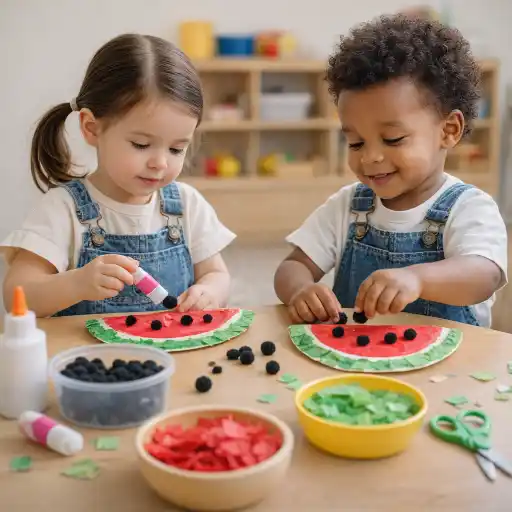
- Offer thick crayons or short markers that are easier for some children to grasp.
- Use child-sized scissors and sturdy paper, and remain close during cutting.
- Provide glue sticks or small, manageable amounts of glue.
- Let children choose whether to color, cut, arrange, or glue first.
Notice strategies rather than judging the finished picture: “You held the paper with one hand while you cut with the other.” This kind of specific feedback makes effort and developing coordination visible.
How can educators weave language into each step?
Craft time offers a natural reason to talk together. Use the watermelon theme to introduce words such as rind, flesh, seed, slice, red, and green. Pair words with objects, pictures, gestures, or children’s home languages. Children can listen, respond with a word or gesture, tell a story, or simply observe; language participation does not need to look the same for everyone.
Describe what children are doing and allow pauses for a response. Open questions invite more than a yes-or-no answer, while comments give children words they can use if they choose. The ChildCareEd article on open-ended art activities and teacher language similarly recommends describing actions and inviting children to explain their work.
- “What colors do you see on a watermelon?”
- “Tell me where you want to place the seeds.”
- “You chose a long green rind. What might you call this slice?”
- “I notice you pressed the glue stick gently. What happened?”
For children who are still developing spoken language, offer a choice between two colors, use picture cues, or model a short phrase they can echo or adapt. Listen attentively and build on what each child communicates.
How can you prepare the activity for different learners?
Thoughtful preparation helps the craft feel welcoming rather than frustrating. Before beginning, consider children’s ages, interests, motor abilities, sensory preferences, communication styles, and need for adult support. The resource Build a Watermelon Craft Buy Now $0.50 provides a ready-made coloring, cutting, and gluing activity; educators can adjust how much of the sequence each child completes.
Set out only the materials needed, keep them within reach, and explain one or two simple expectations. A calm workspace and predictable cleanup routine make participation easier. State requirements vary - check your state licensing agency for rules about materials, supervision, and age-appropriate tools.
- 🖍️ Offer a choice of crayons, markers, or adapted grips where useful.
- Prepare some shapes in advance so children can focus on arranging and describing.
- Provide extra time or a quieter space for children who benefit from a slower pace.
- Use visual steps or demonstrate one action at a time.
- Check that materials are safe and appropriate for the children in your group.
Adaptations do not diminish the activity. They create more ways for children to make decisions and contribute. Ask families or colleagues about strategies that have worked well, and observe whether each adjustment supports participation.
How can you avoid common craft-time pitfalls?
A craft with clear steps can support sequencing and tool practice, but over-directing may leave little room for children’s decisions. Avoid correcting every placement or completing a child’s work simply to make it look polished. Instead, offer assistance only when requested or when a child needs support to access a step, and use the smallest helpful prompt.
It can also be easy to focus on the finished product and miss what happened along the way. A child who places seeds in an unexpected pattern may be experimenting, telling a story, or expressing a preference. Ask about the child’s choices rather than assuming what the picture is meant to show.
- Pitfall: Expecting every watermelon to look alike. Try: Value individual choices and effort.
- Pitfall: Asking only “What is it?” Try: Describe a detail or invite the child to tell you about the work.
- Pitfall: Offering tools that are too difficult to manage. Try: Adapt the materials or simplify a step.
- Pitfall: Rushing cleanup. Try: Teach a short routine and allow time for children to help.
After the activity, jot down one observation, such as a new word, a tool the child tried, or a strategy used to solve a problem. These small notes can help staff plan what to offer next.
How can you extend the watermelon craft beyond the table?
Once the craft is complete, keep the learning alive through conversation and play. Invite children to compare their pictures, count the paper seeds, sort red and green materials, or dictate a caption. These extensions connect art with early mathematics, storytelling, and shared attention without requiring another elaborate project.
Documentation can make children’s thinking visible to families and colleagues. Photograph the process if your program’s policies allow, record a child’s own words, and add a brief note about the skill you observed. For example: “Jordan arranged the seeds in rows and described them as ‘tiny dots.’” This communicates more about learning than a display of finished work alone.
Use the experience to plan a next step. If children were interested in the seeds, offer counting or sorting materials. If they enjoyed describing colors, bring in a picture book or conversation about fruit. If tool use was challenging, provide more chances to draw, pinch, tear, and manipulate materials in playful ways. For further professional learning, the English-language courses Open Heart, Open Art  Buy Now $16.00, Language Development in Early Childhood Buy Now $16.00, and Building Vocabulary Buy Now $16.00 offer related perspectives on art and communication.
Conclusion: How can one craft support multiple areas of learning?
A simple watermelon craft can bring fine-motor practice and language-rich interaction into one engaging classroom experience. Children may color, cut, arrange, glue, name colors, describe choices, or communicate nonverbally; educators can adapt the process so each child participates in a meaningful way.
Keep the focus on children’s actions, ideas, and growing independence—not uniform results. Prepare accessible materials, model safe tool use, ask open questions, and document a small moment of learning. With these practical choices, a seasonal craft becomes more than a finished picture: it becomes a thoughtful opportunity to connect hands, words, and discovery.
Key ideas: #finemotor practice, #language growth, #creativity, #preschool learning, and #confidence can all be supported through intentional art experiences.
- Building Bridges for Dual Language Learners
- Building Bridges for Dual Language Learners: For Workforce Solutions
- Basic Health & Safety and Breastfeeding Awareness
- Language and Literacy Foundations in Pre-K
- Teach with Respect!
- Art from the Heart for Preschoolers: Open Ended Art Projects that Build Self-Esteem
- Texas Director Credential
- Building Bridges for Dual Language Learners
- Supporting Families and Caregivers in Language and Literacy
- Developing Skills Through Fall Crafts in Childcare
- How to boost fine motor skills: Holiday Edition
- DIY Snow Globes: The Fine Motor Craft That’ll Keep Kids (and Adults) Busy for Hours
- Confetti, Glitter, and Fine Motor Fun: Montessori Craft Ideas
- Increasing Fine Motor Skills in the Early Childhood Education Classroom
- Big Snowflakes, Bigger Milestones: Supporting Child Development Through Seasonal Activities
- CDA Certification en Español: Recursos y Consejos para Educadores Bilingües
- St. Patrick’s Day Activities for Kids: Fun, Educational, and Easy Ideas for Parents & Teachers
- Apoyo en Español para Capacitaciones Grupales Presenciales y por Zoom en Cursos Selectos
- Actividades de Otoño Fáciles para Preescolares esta Temporada
- Celebrando la amistad en el cuidado infantil durante el Día de los Mejores Amigos
- Canciones, juegos y preguntas de círculo para niños
- Superhero Activities for Preschoolers: Play, Create, and Learn
- Pool Noodle Sea Creatures: A Fun Ocean Craft for Preschoolers
- Easy Pool Noodle Sea Creatures for Ocean Theme Activities
- Can a simple friendship bracelet craft strengthen fine motor skills in your daycare?
- What fun, practical activities help build fine and gross motor skills in early childhood classrooms?
- How Can Child Care Providers Build One-to-One Correspondence with Small Objects?
- How Can a Simple Watermelon Craft Build Fine-Motor and Language Skills?
