When children know how to use, return, and respect classroom materials, everyday play becomes an opportunity to build independence and community. Supporting Children’s Independence  Buy Now $24.00 offers a focused, three-hour learning experience on autonomy, self-regulation, and practical classroom strategies; it can help you strengthen your approach while you explore the steps below.
Why does caring for classroom materials matter?
Helping children care for shared materials is about more than keeping shelves tidy. When a child returns a book, replaces puzzle pieces, or handles crayons gently, they are learning that their actions affect other people and the shared environment. These small acts can strengthen belonging, confidence, responsibility, and emerging self-direction.
Care is learned through supported practice. Young children are still developing attention, coordination, memory, and the ability to shift from one activity to another. Instead of assuming a child knows what “take care of it” means, educators can make the expectation visible, demonstrate it, and give children repeated chances to practice.
Classroom materials also have a practical role: they invite exploration, creativity, and learning. When children help preserve and organize them, the materials remain available for the next child’s play. This creates a natural connection between caring for objects and being considerate members of a group.
NAEYC’s article on fostering competence and responsibility highlights how ordinary routines can invite children to think, make plans, and contribute. The goal is not flawless compliance; it is meaningful participation, with adults maintaining responsibility for safety and supervision.
How can you make expectations clear and age-appropriate?
Begin with concrete, achievable expectations. “Be careful” may be too vague for a young child, while “Hold the book with two hands” or “Put the markers back in the cup” shows exactly what to do. Match the number of steps and the task’s physical demands to each child’s current abilities and provide support when needed.
Developmental readiness is not determined by age alone. Children differ in motor skills, communication, attention, sensory preferences, experience, and confidence. A toddler may place one block in a basket with an adult nearby; a preschooler may sort materials into labeled containers, check that marker caps are on, or return a set of books to a low shelf.
- Model how to carry, use, and return a material before expecting children to do it independently.
- Break a large task into one or two clear steps: “Put the animals in this basket.”
- Use child-sized, manageable containers and keep heavy or fragile items out of reach.
- Offer help, gestures, or extra processing time without treating support as failure.
For example, a teacher might show how to turn a book’s pages gently, then invite the child to try. If pages are torn, respond calmly and help the child place the book in a repair area. The focus stays on teaching the skill—not labeling or shaming the child.
How can the classroom environment encourage children to care for materials?
The room can make care easier—or harder. When materials are accessible, storage locations remain consistent, and containers are easy to use, children have a clearer path to success. Place everyday materials on low, stable shelves near the area where children use them. Use shallow baskets or trays so children can see the contents and return items without struggling with overfilled bins.
Picture-and-word labels can help children identify where things belong, including children who are not yet reading or who are learning more than one language. Photographs of the actual materials are often easier to match than abstract images. Put labels on both the container and its shelf, at a child’s eye level. The Texas Education Agency’s guidance on classroom organization and routines also points to accessible labels and visual supports as ways to help children work more independently.
- Keep similar materials together and give each item a consistent “home.”
- Limit the number of materials available at once when a center feels overwhelming.
- Check regularly for broken, incomplete, or unsuitable items.
- Use a clearly marked place for work in progress when a structure or project cannot be put away immediately.
Visual organization supports the #classroom community by reducing unnecessary confusion; it does not replace instruction. Teach children what labels mean, then refer to them during real play and cleanup.
How can routines and language turn care into a learned skill?
Build care into predictable moments—before changing centers, after art, at the end of play, or when a child finishes a book. NAEYC describes daily routines and classroom transitions as an important part of a supportive learning environment. Consistent cues give children a chance to anticipate what comes next and prepare to act.
Teach the routine explicitly rather than relying on reminders alone. Demonstrate the steps, practice together when children are calm, and gradually step back as their familiarity grows. Keep directions brief and specific: “The puzzle goes in its tray,” rather than “Everyone, take care of the room.” A short song, a visual cue, or a “finished” photo can help signal and guide the process.
Questions can encourage children to think instead of waiting for an adult to manage each action. Try “Where does the truck belong?” or “What could help keep the paint off the table?” Pause long enough for children to respond. Then describe what you noticed: “You checked the picture and put the cars back in their basket.” Specific feedback helps children recognize the strategy they used.
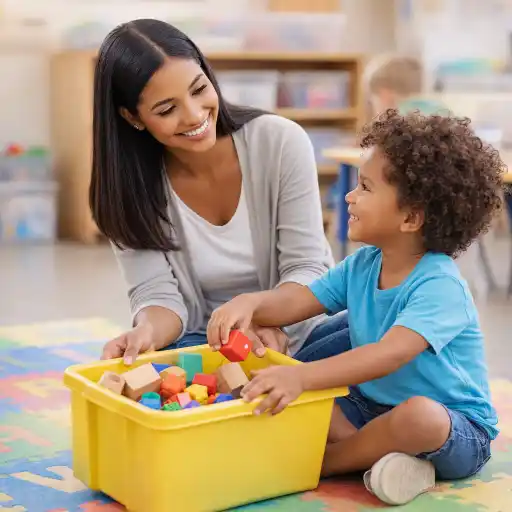
- Invite children to help create simple care agreements, such as “Books stay on the reading rug or shelf.”
- Assign and rotate practical roles, like book helper or block-area checker.
- Use two meaningful choices when a child needs a starting point: “Would you like to return the books or the blocks first?”
- 🧺 Join in when needed: working alongside a child can model cooperation and make a challenging task manageable.
Keep the routine supportive, not punitive. Children learn through repetition and encouragement, not through being made to feel ashamed for needing help.
How can you make material care inclusive and safe?
Every child should have a genuine way to participate, but participation does not require every child to do the same task in the same way. Consider mobility, communication, sensory preferences, attention, and motor skills. A child who cannot reach a shelf might sort materials at a table or point to the picture that shows where an item belongs. A child who dislikes touching wet materials might help carry a dry cloth or organize clean containers.
Pair spoken directions with photographs, gestures, simple words in children’s home languages, or communication tools as appropriate. Ask families what helps their child engage with shared belongings and what language they use for caring for things. These conversations can help staff avoid treating one cultural approach to independence or helping as universal.
Safety remains an adult responsibility. Children can help return toys, books, and art materials or wipe a defined area with an appropriate cloth under supervision. Adults should handle cleaning chemicals, disinfectants, bodily fluids, broken glass, sharp tools, hot liquids, and other hazardous items. Follow your program’s written procedures and applicable health and sanitation rules. State requirements vary - check your state licensing agency.
Equitable opportunities also deserve a team review. Notice who is regularly offered helper roles, who is left out, and whether tasks are genuinely accessible. A fair system communicates that each child is a valued contributor, whether the child completes a task alone, with a visual prompt, or alongside an adult.
How can educators respond to common challenges and track progress?
If a child mishandles, misplaces, or avoids materials, first consider what may be getting in the way. The task could be unclear, the container difficult to open, the room crowded, or the transition too sudden. A child may need a model, fewer items to sort, a shorter task, or more time. Changing the setup is often more effective than repeating an instruction or assuming the child is being careless.
When a material is misused, respond calmly and teach the next step: “The crayons are for paper. Let’s wipe the table and try again.” If a bin is spilled, invite the child to help restore the area with adult support. If an item is damaged, use a repair basket or explain how the group can care for the remaining materials. Avoid public comparisons, shame, or using access to materials as a punishment for needing help.
Observe progress over multiple opportunities. Look for small, meaningful changes: a child starts after seeing a picture cue, asks for help, returns one more item, or waits while a peer uses a shared material. Brief, factual notes are more useful than labels such as “careless” or “responsible.” For example: “After a reminder, Sam put the markers in the labeled cup and asked for help with the lid.”
For directors and teaching teams, recurring difficulties are a cue to review the system together. Are expectations consistent across adults? Are labels accurate and reachable? Is the task safe and developmentally appropriate? A short staff conversation and one practical adjustment can help children and educators feel more successful.
Conclusion: What is the most effective way to teach children to care for materials?
Children learn to care for classroom materials when adults make expectations concrete, model how to use and return items, and provide regular, supportive practice. Clear labels, accessible storage, predictable routines, inclusive adaptations, and specific encouragement work together to make responsibility understandable and achievable.
Start small: choose one busy center, teach a simple “use it, return it” routine, and watch for what helps each child participate. When something is not working, adjust the task or environment before blaming the child. With patient repetition, caring for shared materials becomes more than cleanup—it becomes a daily way for children to practice competence, consideration, and belonging.
Explore related professional learning:
- CDA Home Visitor Subject Area 3 Part 3 Birth to 5
- Student Success: Expectations & Independence
- Moving About the Classroom: Effective Transitions for Everyday
- Art from the Heart for Preschoolers: Open Ended Art Projects that Build Self-Esteem
- Bridging Intent and Response: Communication
- Creating Engaging and Meaningful Learning Experiences
- Diversity, Equity, and Inclusion in Education
- Moving About the Classroom: Effective Transitions for Everyday
- The Prepared Environment: Montessori Class Design
- Supporting Children's Independence
- CDA Certification en Español: Recursos y Consejos para Educadores Bilingües
- ❄️ ¿Qué actividades al aire libre funcionan bien para los niños de Illinois en cada estación? 🌷🍂
- Proporciones de Cuidado Infantil y Tamaños de Grupo por Edad en Nueva Jersey (Guía Rápida para Centros y Hogares)
- Consejos de Supervisión Activa para Salones de Preescolar y el Juego al Aire Libre
- Cómo Ser Maestra de Preescolar en Maryland
- Including Every Child: What Child Care Providers Should Know About the ADA
- Adapt the Activity, Not the Child: Simple Ways to Include Children With Special Needs
- Why Is My Preschool Classroom So Chaotic? 7 Classroom Management Fixes to Try
- How Can Child Care Providers Help Children Understand Classroom Expectations?
- Learning Through Choice: Why Do Classroom Choice Boards Work?
- Which Low-Cost Printables Make the Biggest Classroom Impact?
- How Can Classroom Environment and Arrangement Support Young Children’s Learning?
- How Can Child Care Providers Make Outdoor Learning Meaningful, Safe, and Inclusive?
- How Can Child Care Providers Design Learning Centers That Support Play and Development?
- How Can Providers Create an Inclusive Classroom for Every Child?
- What Are 10 Proactive Classroom Management Techniques for Early Educators?
- What Makes a Preschool Curriculum Meaningful, Inclusive, and Effective?
- What Should Providers Put in a Classroom Waiting Basket?
- Keep It Simple: Introducing Classroom Rules Preschoolers Can Remember
- What Are Effective Ways to Teach Children to Care for Classroom Materials?
