Does your classroom help children explore, connect, and regulate—or does it create unnecessary crowding and confusion? Intentional Classroom Setup for Child Care  Buy Now $24.00 training can help providers connect room arrangement with developmentally appropriate practice, inclusive design, and CDA Subject Area 1 knowledge. As you read, you will find practical steps for improving supervision, independence, engagement, and daily flow without requiring a complete renovation.
Why does classroom environment matter so much?
The physical environment is not merely a backdrop for teaching. It communicates expectations, influences relationships, and shapes how children use materials, move through the room, and participate in play. Head Start describes preschoolers as active learners who use materials and environmental opportunities to explore, solve problems, and understand their world. Responsive spaces also account for differing abilities, interests, developmental levels, cultural identities, and home languages (Resources for Preschool Learning Environments).
A thoughtfully arranged room can reduce unnecessary adult redirection while increasing meaningful choice. Children are more likely to select materials independently when shelves are accessible, labels are clear, and activity areas have recognizable boundaries. Teachers, in turn, can spend more time observing, extending play, and responding to individual needs.
- 🧭 Clear pathways support safe movement and active supervision.
- Defined centers help children understand what can happen in each area.
- Cozy spaces support emotional regulation and focused engagement.
- Accessible materials strengthen agency and problem-solving.
Research and professional guidance consistently emphasize that children need opportunities for movement, comfort, competence, and control. Arrangement should therefore be evaluated through children’s experiences, not only through adult preferences or visual appeal.
How should providers analyze space before moving furniture?
Begin with observation rather than immediate rearrangement. Sketch a simple floor plan and note fixed features such as doors, windows, sinks, closets, electrical outlets, and storage. Then observe the room during arrival, free choice, meals, transitions, and cleanup. Mark where children cluster, where queues form, where materials spill into walkways, and where adults naturally stand to supervise.
This process reveals the difference between usable space and empty-looking space. A wide area may be essential for movement, while a narrow corner may be ideal for a quiet reading nook. Consider the anticipated group size for each center and ensure that children have enough working space without blocking circulation.
- Identify high-traffic routes and potential pinch points.
- Protect long sight lines from primary supervision locations.
- Place messy activities near sinks and cleanup supplies.
- Use windows for nature observation, documentation, and daylight when appropriate.
- Keep emergency exits, heating equipment, and safety equipment unobstructed.
For infants and toddlers, environmental planning must also account for mobility levels, safe sleep areas, adult-child ratios, and separation between active play and crib spaces. Head Start recommends consulting licensing and building authorities during renovations or major changes. State requirements vary - check your state licensing agency before altering furniture placement, cot spacing, exits, or other regulated features.
How can learning centers promote engagement and independence?
Learning centers are most effective when they offer a manageable number of meaningful choices. Rather than displaying every available material, curate a focused invitation that reflects children’s interests and current learning goals. Blocks can support spatial reasoning and cooperation; dramatic play can strengthen language and social negotiation; art and sensory areas can invite experimentation; and reading spaces can nurture vocabulary and emergent literacy.
Arrange centers according to activity level. Place louder, more physically active areas—such as blocks, dramatic play, or large-movement activities—away from books, puzzles, and small-group instruction. Low, open shelves can define boundaries while preserving supervision. A rug, table, or change in flooring can also signal that an area has a particular purpose.
- Place frequently used materials at children’s eye level.
- Use picture-and-word labels to support independence and multilingual learners.
- Offer open-ended materials that can be used in multiple ways.
- Include culturally responsive books, dramatic-play props, images, and music.
- Rotate selected materials while preserving familiar favorites.
Environmental strategies can also encourage peer relationships. The CSEFEL resource on using environmental strategies to promote positive social interactions recommends limiting the number of simultaneously open centers, introducing cooperative materials, and positioning children to see and interact with one another. These changes can create more authentic opportunities for collaboration without constant adult direction.
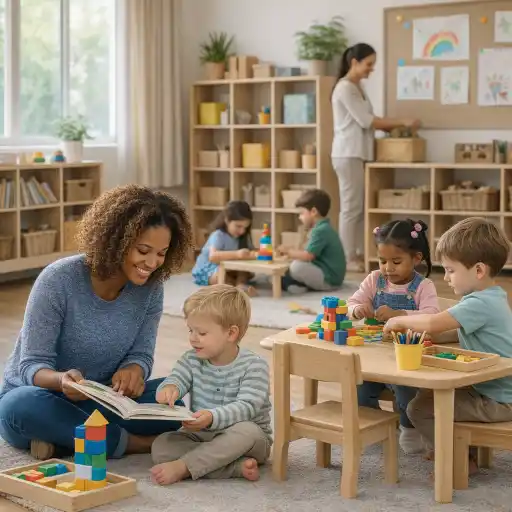
How can arrangement support safety, supervision, and inclusion?
Safety and inclusion are inseparable from arrangement. Teachers need to see and hear children across the room, reach materials quickly, and move efficiently during transitions. Tall furniture that blocks sight lines, crowded pathways, loose cords, unstable shelves, and inaccessible materials can compromise both safety and participation.
Use low, stable shelving and anchor furniture according to manufacturer and program guidance. Keep adult supplies in labeled mobile containers so teachers can join children’s play without leaving the group. Design quiet spaces that are calming but never fully hidden from supervision. For children who are sensitive to noise, light, or crowding, provide options such as soft seating, reduced visual stimulation, headphones when appropriate, or a small retreat area.
Inclusion also requires examining who is represented and who can participate. NAEYC’s developmentally appropriate practice guidance emphasizes meaningful choice, culturally responsive materials, and adaptations that support children with disabilities. Ask whether every child can reach, understand, manipulate, and enjoy the materials offered.
- Use multiple forms of representation, including objects, photos, symbols, and words.
- Provide varied seating and work surfaces.
- Leave sufficient clearance for mobility devices and adult assistance.
- Offer materials that reflect children’s families, languages, abilities, and communities.
- Collaborate with families and specialists when individualized adaptations are needed.
What common arrangement mistakes should programs avoid?
Many classroom problems are not caused by a lack of effort; they result from trying to include too much at once. Overdecorated walls, crowded centers, excessive toy choices, and furniture arranged only for adult convenience can overwhelm children and make supervision more difficult. A strong arrangement is not the one with the most materials. It is the one that makes learning, relationships, and routines easier.
- Mistake: Opening every center simultaneously. Better approach: Rotate a smaller selection of centers and observe how group size affects engagement.
- Mistake: Using tall shelves as barriers. Better approach: Choose low dividers that create definition without eliminating visibility.
- Mistake: Treating decoration as curriculum. Better approach: Display children’s work, documentation, relevant visuals, and materials that invite investigation.
- Mistake: Designing for one “typical” child. Better approach: Build in choices for varied sensory, communication, mobility, and regulation needs.
- Mistake: Changing the entire room at once. Better approach: Pilot one reversible change for two weeks and collect brief observations.
Directors can support improvement by scheduling team reflection. Ask staff what they notice about conflict, engagement, transitions, and supervision before and after a change. Invite children’s perspectives through conversations, drawings, photographs, or participation in labeling centers. Families may also identify cultural or accessibility considerations that staff have overlooked.
How can a program implement and evaluate changes?
Effective redesign is an iterative process. Start with the highest-impact concern: perhaps a blocked sight line, a congested cubby area, or a reading center that is too close to dramatic play. Make one manageable change, explain the purpose to staff and children, and observe its effects across several parts of the day.
Use a short evaluation tool rather than relying on impressions alone. Track whether children access materials independently, whether conflicts increase or decrease, whether transitions take less time, and whether adults can maintain supervision while engaging in teaching. Document children’s sustained involvement, peer interactions, and use of calm areas.
- Map the current environment and identify one priority.
- Check safety, accessibility, licensing, and supervision implications.
- Gather staff, family, and child perspectives where appropriate.
- Make one reversible adjustment.
- Observe for one to two weeks and record patterns.
- Retain, revise, or reverse the change based on evidence.
Professional learning can make this process more systematic. Providers may explore Classroom Designers ONLINE Buy Now $24.00 for guidance on age-appropriate materials and classroom design, Creating Environments that Nurture Growth and Community Buy Now $55.00 for inclusive community-focused planning, and Every Moment Matters: Schedules and Transitions Buy Now $55.00 for connecting space with routines and transitions. Course availability, approval, and applicability vary, so verify details for your setting and state.
Conclusion: What makes classroom environment and arrangement effective?
Effective classroom environment and arrangement begin with a simple principle: the room should actively support children’s development while making teachers’ work safer, more responsive, and more sustainable. Analyze how children move and engage, define centers without blocking supervision, offer accessible and culturally responsive materials, separate high- and low-energy activities, and create spaces for both collaboration and regulation.
The strongest improvements are intentional, observable, and adaptable. Rather than pursuing a perfect room, use evidence from children’s behavior and staff experience to guide small adjustments. A sketch, a two-week pilot, and a reflective team conversation can lead to meaningful improvements in independence, belonging, engagement, and safety.
When providers view the environment as a partner in teaching, everyday design decisions become powerful educational decisions. Begin with one change that will help children move, choose, connect, or feel more secure—and let observation guide what comes next.
Related training options:
- Classroom Arrangement: The Second Teacher Buy Now $25.00
- Spaces that Support Discovery Buy Now $24.00
- Access for All: Inclusion and the ADA Buy Now $16.00
- CDA Home Visitor Subject Area 3 Part 3 Birth to 5
- Bienvenido! Welcoming All Families
- Pediatric RSV First Aid & CPR/AED
- CDA Bridge Bundle: Family Child Care without Portfolio Review
- CDA Bridge Bundle: Infant/Toddler without Portfolio Review
- Classroom Setup for Child Care
- CDA Bridge Bundle: Preschool without Portfolio Review
- Creating Environments that Nurture Growth and Community
- Connections That Count: Building Relationships in Child Care
- Texas Director Credential
- Trauma-Informed Care: Why Your Classroom Isn’t Complete Without a Little Extra Empathy
- CDA Certification en Español: Recursos y Consejos para Educadores Bilingües
- 🔍 ¿Qué ves cuando observas a un niño aprender?
- 🩺 Cumplimiento de Salud e Inmunización en Cuidado Infantil de Nevada ✔️
- Proporciones de Cuidado Infantil y Tamaños de Grupo por Edad en Virginia (Guía Rápida para Centros y Hogares)
- Canciones, juegos y preguntas de círculo para niños
- How Teachers Can Arrange Classrooms for Better Learning
- What Makes a Great Home Daycare? 10 Things Parents Notice First
- Your Classroom Is Teaching Too: How the Environment Supports Children’s Learning
- How Can Child Care Providers Create Sensory-Friendly Learning Spaces for All Children?
- How Can Classroom Environment and Arrangement Support Young Children’s Learning?
- How Can Child Care Providers Design Learning Centers That Support Play and Development?
- How Can Child Care Providers Create Effective Learning Centers in Small Spaces?
- How Can Providers Rotate Classroom Materials Without Overwhelming Children?
- What Can Children’s Movement Patterns Reveal About Classroom Layout?
- How Can a Classroom Sound Map Reveal Unexpected Noise Hotspots?
- Does an Empty Classroom Space Need to Stay Empty?
- What Makes a High-Quality Child Care Classroom? 10 Things Providers Should Look For
- How Can One Floor Mat Offer Two Experiences for Crawlers and Walkers?
