When classroom challenges seem to arrive faster than you can respond, proactive management helps you prevent many problems before they begin. Explore Staying Positive: Guidance for Preschoolers  Buy Now $24.00 to deepen your understanding of positive discipline and social-emotional development while gaining practical strategies you can apply immediately; for a broader professional learning experience, consider Social Foundations and Responsive Classrooms Buy Now $24.00.
Why Does Proactive Classroom Management Matter?
Proactive classroom management is the intentional design of relationships, environments, routines, and teaching practices that help children succeed before challenging behavior escalates. It is not about controlling every movement or eliminating normal childhood conflict. Instead, it recognizes that young children are still developing language, impulse control, emotional regulation, perspective-taking, and social problem-solving.
Research-informed guidance emphasizes prevention, explicit instruction, responsive relationships, and consistent adult responses. The Preschool Behavior Support Self-Assessment identifies predictable environments, clearly taught expectations, positive acknowledgment, consistent responses, and data-informed decision-making as central practices. Similarly, the Center on PBIS describes early childhood support as a continuum that begins with nurturing relationships and high-quality environments, adds social-emotional instruction, and provides individualized intervention when needed.
This approach matters because repeated correction can consume instructional time and increase stress for children and adults. A proactive plan allows educators to spend more time teaching, playing, connecting, and noticing children’s competence.
How Can Educators Build Warm, Predictable Relationships?
Relationships are the foundation of effective guidance. Children are more likely to accept limits, seek help, and practice new skills when adults are dependable, respectful, and emotionally available. Head Start resources emphasize that young children learn best through responsive, back-and-forth interactions with trusted adults.
- Greet every child by name and make the arrival interaction personal.
- Join children’s play briefly, following their interests rather than directing every action.
- Acknowledge bids for attention, even when you cannot respond fully: “I hear you. I will help after I finish this.”
- Use a calm voice, open posture, and facial expressions that communicate safety.
- Repair after conflict: “That was difficult. We are safe now, and we can try again.”
Relationship-building must also reflect culture, language, temperament, disability, sensory needs, and family preferences. Some children seek close interaction; others need space before joining. Watch carefully, ask families what helps, and adapt without interpreting difference as defiance.
Specific feedback strengthens connection and teaches behavior simultaneously. Rather than saying only “Good job,” try, “You waited while your friend finished and then asked for a turn.” Such comments communicate that the educator notices effort, persistence, cooperation, and growth.
How Can the Physical Environment Prevent Problems?
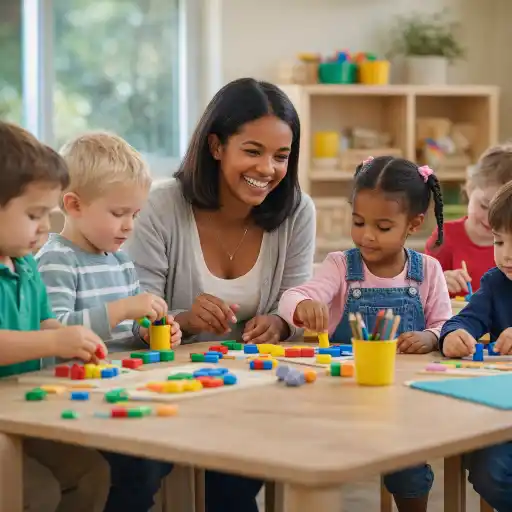
The classroom environment is an active teaching tool. Crowded centers, inaccessible materials, unclear boundaries, long waits, and open running paths can create challenges even when children understand expectations. Adjusting the setting is often more effective than repeating the same reminder.
- Define centers with rugs, shelves, signs, and picture labels.
- Store materials where children can reach, use, and return them independently.
- Provide duplicates or alternatives for highly desirable materials when possible.
- Reduce unnecessary waiting and alternate active experiences with quieter choices.
- Position adults strategically so supervision is close, active, and predictable.
- Review the room from a child’s perspective: What is confusing, crowded, tempting, or difficult to access?
Visual supports are especially helpful for preschoolers, dual language learners, and children who benefit from concrete information. Use photographs, drawings, symbols, gestures, choice boards, and first-then cards. Visuals should be placed at children’s eye level and taught explicitly rather than posted as decoration.
A brief environmental audit can reveal useful patterns. Observe where conflicts happen, which materials lead to grabbing, and when children leave activities. Then make one targeted change, monitor the result, and revise as needed. This strengths-based process treats behavior as information about the child-environment relationship.
How Can Teachers Teach Clear Expectations and Routines?
Young children cannot consistently follow expectations they have not been taught. Effective expectations are brief, positive, concrete, and observable. Limit classroom-wide rules to approximately three to five statements, such as “Use kind words,” “Hands are for helping,” “Use walking feet,” and “Care for our classroom.”
Teach each expectation through a repeatable instructional sequence:
- Say it: State the expectation in simple language.
- Show it: Model the behavior with your body, a puppet, or a photograph.
- Try it: Invite children to practice through role-play or a movement game.
- Notice it: Give specific feedback about what children did.
Expectations should be revisited throughout the day and connected to particular contexts. “Care for our classroom” might mean returning blocks to a labeled basket, while “Use walking feet” applies to indoor pathways but not necessarily the grassy outdoor area. This level of specificity makes expectations understandable and fair.
Routines should be equally teachable. Break complicated activities into visible steps, use consistent signals, and practice during calm moments. State requirements vary - check your state licensing agency when developing guidance policies, documentation procedures, or behavior plans.
How Can Educators Make Transitions Smoother?
Transitions require children to stop one activity, shift attention, remember multiple steps, regulate disappointment, and begin something new. Predictable transition systems reduce cognitive and emotional demands. NAEYC describes routines and transitions as essential elements of a supportive classroom, while Head Start offers planning tools that help teachers teach positive behavior during transitions.
- Give a five-minute and one-minute warning before a major change.
- Use a consistent auditory or visual cue, such as a chime, song, light signal, or picture card.
- Show the sequence: “Clean up, wash hands, then snack.”
- Assign meaningful jobs, such as carrying a book basket or checking the floor.
- Offer limited choices: “Would you like to put away blocks or puzzles first?”
- Keep children engaged with songs, animal walks, counting games, or cooperation challenges.
- Plan for individual needs, including extra processing time, movement, or a familiar transition object.
🧩 A first-then board can be especially useful: “First put away the cars, then choose a book.” The preferred activity should be realistic and clearly connected to completion of the necessary step.
Transitions are also opportunities to teach flexibility. When plans change, narrate the change calmly and show the updated schedule. “Outside time moved because it is raining. First we will do blocks, then we will check the weather again.” This helps children practice adaptability rather than experiencing change as a surprise.
How Can Positive Feedback, Choices, and Redirection Teach Skills?
Positive feedback makes successful behavior visible. Use comments that are immediate, specific, sincere, and focused on effort or social skill. “You kept the paint on the paper,” “You asked for help,” and “You waited safely” are more instructive than general praise.
Meaningful choices provide autonomy within safe boundaries. Offer two genuine options: “Would you like the blue cup or green cup?” or “Would you like to sit on the cushion or beside me?” Do not offer a choice when the outcome is non-negotiable or safety is at immediate risk; state the limit respectfully instead.
Redirection should teach a replacement behavior rather than merely stop an action. Use this brief sequence:
- Describe what you observe without labeling the child.
- State the safety limit.
- Name one acceptable alternative.
- Help the child practice it.
For example: “The blocks are being thrown. Blocks are for building. You can build on the rug or throw beanbags at the target.” The replacement should address the likely need whenever possible, such as movement, communication, sensory input, connection, or access to materials.
During escalation, use fewer words. Connect, name the feeling, set the limit, and teach after calm returns: “You are angry because the truck is being used. I will not let you hit. You can say, ‘My turn,’ or ask for help.” A calm space should support co-regulation and recovery, never humiliation or isolation.
How Can Observation, Teamwork, and Family Partnership Strengthen Management?
When a behavior repeats despite strong universal supports, move from assumptions to observation. The ABC framework examines the antecedent, behavior, and consequence:
- Antecedent: What happened immediately before?
- Behavior: What did the child do, described objectively?
- Consequence: What happened immediately afterward?
Record the time, location, activity, people present, adult directions, exact behavior, and response. Avoid labels such as “bad,” “defiant,” or “attention-seeking.” Data may show that a child throws materials when a preferred activity ends, leaves group time when language demands are high, or hits when a center is crowded. The resulting plan might include warnings, visual communication, shorter tasks, additional materials, or explicit teaching of “help.”
Adults must coordinate. Directors can create a brief guidance agreement with shared expectations, scripts, safety procedures, supervision roles, and documentation steps. Staff should rehearse common situations and discuss how to remain calm and consistent. Proactive management is difficult to sustain when educators are isolated or overwhelmed, so coaching and reflective support matter. For more on collaborative approaches to classroom management in early childhood settings, see this overview.
Families are essential partners. Begin conversations with strengths and objective observations:
- Strength: “Mia is deeply engaged in dramatic play and enjoys helping friends.”
- Fact: “Cleanup was difficult after dramatic play on three days this week.”
- Plan: “We will use a five-minute warning and a picture cleanup card. What helps at home?”
For a deeper framework, explore The ABCs of Behavior: Turning Challenges into Learning Opportunities Buy Now $55.00$45.00, Every Moment Matters: Schedules and Transitions Buy Now $55.00, and Classroom Management is Collaboration! Buy Now $16.00. These courses can extend professional knowledge and provide additional tools for daily practice.
Conclusion: What Are the Most Effective Proactive Techniques?
The ten techniques are interconnected: build responsive relationships; design an accessible environment; teach clear expectations; establish predictable routines; prepare engaging transitions; use specific encouragement; offer meaningful choices; redirect toward replacement skills; observe patterns with ABC thinking; and coordinate with colleagues and families.
Proactive classroom management is ultimately an investment in children’s competence and belonging. When adults plan for success, children gain repeated opportunities to communicate, regulate emotions, cooperate, solve problems, and participate confidently. Begin with one change this week, monitor its effect, and celebrate small gains. Consistent, respectful practice can make the classroom safer, calmer, and more joyful for everyone.
Additional Courses for Professional Learning
- Staying Positive: Guidance for Preschoolers Buy Now $24.00
- Social Foundations and Responsive Classrooms Buy Now $24.00
- Every Moment Matters: Schedules and Transitions Buy Now $55.00
- The ABCs of Behavior: Turning Challenges into Learning Opportunities Buy Now
$55.00$45.00 - Classroom Management is Collaboration! Buy Now $16.00
- Moving About the Classroom: Effective Transitions for Everyday
- CDA Home Visitor Subject Area 3 Part 3 Birth to 5
- Power of Art: Bldg Self-Esteem & Positive Behavior for ALL Abilities
- Birth to Five CDA Credential with Portfolio Review
- CDA Bridge Bundle: Family Child Care without Portfolio Review
- Classroom Setup for Child Care
- CDA Bridge Bundle: Preschool without Portfolio Review
- Texas Director Credential
- Every Moment Matters: Schedules and Transitions
- Classroom Management
- Going Head-to-Head with Challenging Behavior
- Coping Strategies for Back-to-School Anxiety
- Back-to-School Success: Essential Skills & Strategies for Childcare Professionals
- Slaying Metaphorical Dragons of Fear and Self-Doubt in Childcare Educators
- What Makes Me Special: An Overview of Autism and ADHD
- CDA Certification en Español: Recursos y Consejos para Educadores Bilingües
- Ready, Set, Kindergarten!
- 😫🧸 ¿Qué hacer cuando un bebé no quiere dormir la siesta en el aula?
- What's the latest news for child care providers in Alabama?
- How to Manage a Preschool Classroom with Confidence
- What Are 10 Proactive Classroom Management Techniques for Early Educators?
- What Fall Classroom Behavior Challenges Should Child Care Providers Avoid—and How?
