What if a child’s struggle is telling you that the activity—not the child—needs a redesign? With practical changes to space, materials, instructions, and participation, providers can make daily learning more accessible while preserving meaningful expectations. For deeper guidance, explore Inclusive Lessons for Preschoolers  Buy Now $16.00 to strengthen lesson planning and earn professional development training focused on inclusive activities.
Why does adapting the activity support genuine inclusion?
Inclusion is more than placing children in the same room. It means ensuring that each child has authentic opportunities to participate, communicate, build relationships, and demonstrate learning. A child may understand a concept but be unable to show it through the method an adult originally planned. When providers adapt the activity, they remove unnecessary barriers without removing the child’s dignity, agency, or opportunity to learn.
Research-informed guidance from Head Start describes Universal Design for Learning (UDL) through three principles: representation, action and expression, and engagement. In practice, this means offering information in more than one way, allowing flexible responses, and connecting activities to children’s interests and choices. UDL benefits the whole group, while individualized modifications remain available when a particular child needs additional support.
Thoughtful adaptation can also reduce frustration. A task that is too difficult may lead to withdrawal, avoidance, or behavior that communicates distress. A task that is appropriately challenging invites persistence and success. The goal is not to make every activity identical for every child; it is to create equitable access to the same meaningful experience.
How can the Space, Stuff, and Steps framework simplify planning?
A useful way to plan adaptations is to examine three elements: Space, Stuff, and Steps. This framework is easy to remember, inexpensive to implement, and practical for team discussions.
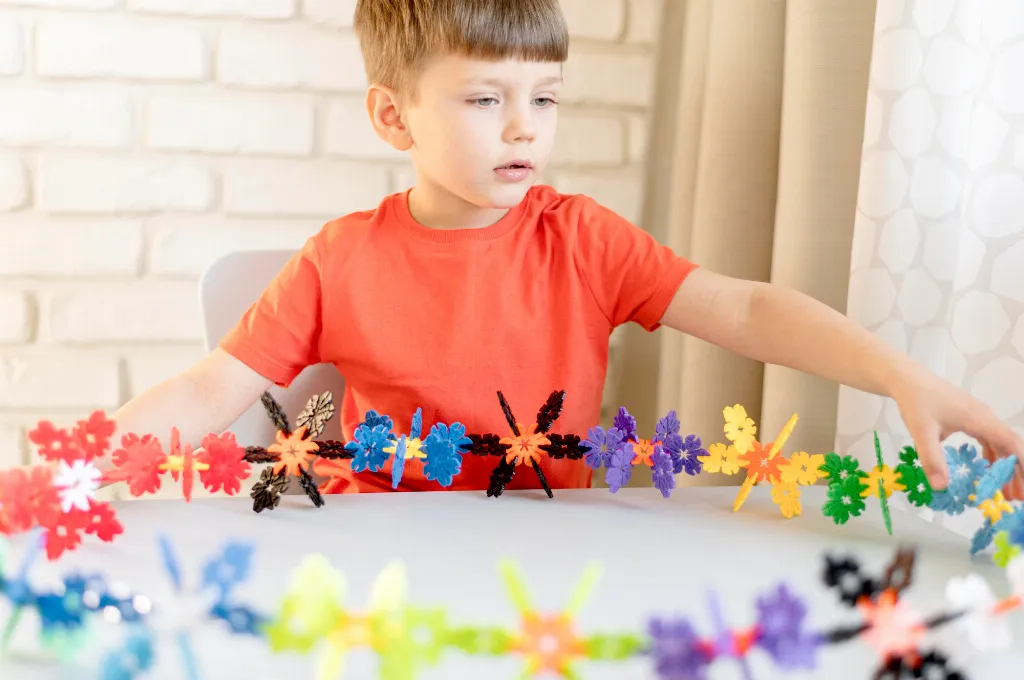
- Space: Clear pathways, reduce visual clutter, provide flexible seating, and offer a quieter area for children who need a sensory break.
- Stuff: Change the size, texture, grip, contrast, or placement of materials. Use thick crayons, larger manipulatives, trays, stickers, picture cards, or adapted handles.
- Steps: Break directions into one or two actions, model the task, complete it together, and then invite the child to try. Provide additional processing time.
For example, a collage activity may retain the goal of creating a design while changing the materials. One child may tear paper, another may use pre-cut shapes, and another may select pictures from a communication board. Each child is engaging in the same creative purpose through a usable pathway.
Before changing anything, observe. Notice when the child becomes stuck, what materials are difficult to manipulate, whether noise affects engagement, and how much adult prompting is needed. Adaptations should be responsive rather than based on assumptions or labels.
How can providers adapt materials and movement activities?
Motor differences should not automatically exclude children from art, construction, outdoor play, or sensory exploration. Small physical adjustments can make materials easier to access while preserving choice and challenge.
- Art: Tape paper to the table, use dot markers or stampers, provide thicker brushes, and stabilize containers so they do not slide.
- Construction: Begin with larger blocks, offer fewer pieces, and place materials on a tray within reach.
- Cutting and pasting: Offer stickers, pre-cut shapes, tearable paper, or spring-loaded scissors when appropriate and approved by the child’s team.
- Outdoor play: Use firm, accessible surfaces; create stations with different response options; and adapt games so children can participate at their own pace.
Adaptation should not mean doing the task for the child. Offer the minimum assistance necessary, then gradually reduce prompts when the child demonstrates readiness. For instance, a provider might steady a paper plate while the child paints, rather than taking over the painting. This approach supports independence and communicates confidence in the child’s abilities.
Peer participation matters as well. Cooperative materials—such as wagons, murals, partner games, or shared sensory bins—create natural reasons for children to interact. Teach peers to ask before helping and to recognize that friendship is different from acting as a caregiver.
How can communication and sensory supports change participation?
Children communicate in many ways, including speech, gestures, facial expressions, movement, pictures, signs, and augmentative or alternative communication (AAC). An inclusive activity does not require spoken language as the only valid response.
- Use short, concrete sentences and emphasize one idea at a time.
- Show while you tell by pointing, gesturing, or demonstrating.
- Offer choices such as “red or blue?” with objects or pictures available.
- Accept pointing, nodding, selecting, building, moving, or using a communication device as meaningful participation.
- Pause after questions and directions so the child has time to process.
Sensory supports should be individualized. Some children may need reduced noise, dimmer lighting, a predictable visual schedule, or a calm space. Others may seek movement and benefit from carrying books, pushing a basket, stretching, or standing during group activities. Avoid treating sensory tools as rewards or punishments; they are access supports that help children regulate and engage.
During story time, shorten the book, use props, pause to identify pictures, add motions, or let children act out a repeated phrase. During circle time, offer a chair, carpet square, standing space, fidget, or role such as page turner. Participation may look different across children and across days—and it can still be meaningful learning.
How can teams collaborate without making assumptions?
Families and specialists offer essential knowledge about a child’s strengths, preferences, communication, culture, routines, and successful supports. Collaboration is most effective when it is strengths-based and specific. Instead of saying, “She cannot participate in art,” share an observation: “She stayed with the group for four minutes, then pushed the brush away when the paper moved.” This gives the team a solvable problem.
- Ask families, “What helps your child join activities at home?”
- Review IFSP or IEP goals and recommended strategies when applicable.
- Invite therapists to demonstrate positioning, communication, feeding, or assistive technology procedures.
- Try one change at a time and document what happened.
- Share progress through brief, respectful notes rather than deficit-focused descriptions.
Directors can support consistency by creating an adaptation bank, scheduling short team huddles, and ensuring that substitutes know essential participation supports. Documentation might include the activity, adaptation, level of assistance, child response, and next step. This information helps educators distinguish between a strategy that needs more time and one that needs revision.
Providers do not need a diagnosis to make a reasonable, helpful change. At the same time, complex equipment, medical procedures, feeding plans, and mobility supports require guidance from qualified professionals. State requirements vary - check your state licensing agency.
What common mistakes should providers avoid?
Even caring educators can unintentionally create barriers when they focus on compliance rather than access. Reflection helps teams replace good intentions with effective practice.
- Waiting for a diagnosis: A child can benefit from visual cues, extra time, or adapted materials immediately.
- Lowering the learning goal: Change the pathway or response mode before changing the purpose of the activity.
- Using one adaptation for everyone: Observe whether the support actually improves access for this child in this context.
- Overloading the child: Too many visuals, prompts, or materials can increase confusion. Start with one clear support.
- Overprompting: Give wait time and opportunities for independent attempts.
- Separating the child unnecessarily: Adapt within the group whenever possible so the child remains part of peer experiences.
A practical weekly routine is to select one challenging activity, identify the barrier, choose one adaptation, and observe the result. Ask: Did participation increase? Did the child need less help? Did peers interact more naturally? If not, revise the activity rather than blaming the child.
Additional ChildCareEd learning options include Supporting Skill Development: Children with Special Needs Buy Now $24.00, Effective Approaches for Autism and Inclusion Buy Now $55.00, Planning for Every Child: Responsive Strategies in Action Buy Now $55.00, and Including All Children and the Americans with Disabilities Act Buy Now $35.00. Each addresses a different part of inclusive practice, from individualized planning to legal and environmental considerations.
Conclusion: How do we adapt the activity, not the child?
To adapt the activity rather than the child, begin by identifying the barrier—not judging the learner. Examine the Space, Stuff, and Steps; offer multiple ways to receive information, participate, communicate, and show understanding; and collaborate with families and specialists. Small changes such as a visual schedule, thicker tools, flexible seating, extra wait time, or a peer-friendly cooperative task can transform a child’s experience of belonging.
Inclusion is an ongoing design process. Observe, try, document, and refine. When educators preserve meaningful goals while changing the route to participation, children are more likely to experience competence, connection, and joy. The most powerful question is simple: “What can we change about this activity so the child can join?”
Quick FAQ
- Do I need special equipment? No. Many effective adaptations use ordinary classroom materials. Complex equipment should be selected with qualified specialists.
- Will adaptations make activities too easy? Not necessarily. They can maintain the same learning goal while changing the response method or level of physical access.
- How do I know whether an adaptation works? Record observable information such as time engaged, level of assistance, communication attempts, and peer interaction.
- Should a child always participate in the same way as peers? No. Equitable participation may involve different tools, positions, communication methods, or amounts of time.
- Where can I learn more? Review the Head Start UDL guidance and ChildCareEd’s inclusion-focused courses and resources.
- 45 Hour Child Growth and Development
- 45 Hour Preschool Methods and Materials
- 45 Hour Infant and Toddler Methods and Materials
- 45 Hour School Age Methods and Materials
- CDA Bridge Bundle: Family Child Care
- CDA Bridge Bundle: Family Child Care without Portfolio Review
- CDA Bridge Bundle: Infant/Toddler without Portfolio Review
- CDA Bridge Bundle: Preschool without Portfolio Review
- Texas Director Credential
- CDA Certification en Español: Recursos y Consejos para Educadores Bilingües
- ¿Cómo incluir a niños con necesidades especiales en cuidado infantil? Guía práctica y sencilla
- Team-Building Activities for Daycare: Helping Children Learn Together
- Lesson Plans for Toddlers: Simple Ideas for Early Learning
- How can I plan activities for school-age children in daycare?
- How Can Simple Cooking Activities Teach Skills in North Dakota Child Care Programs?
- How can we include children with physical disabilities in daily activities?
- How Can You Tell If an Activity Is Developmentally Appropriate?
- Early Intervention Strategies: What Can Teachers Do While a Child Is Waiting for Services?
- Adapt the Activity, Not the Child: Simple Ways to Include Children With Special Needs
- How Can Writing and Art Activities Help Children Name What They Appreciate?
- How Can Child Care Providers Plan a Balanced Summer Learning Routine for Young Children?
- How Can Child Care Providers Make Family-Themed Writing Activities More Inclusive?
- How Can You Make a Design Activity Accessible to a Child with Cerebral Palsy?
- How Can You Adapt an After-School Activity So a Child with Additional Needs Can Join?
- How Can You Adapt Classroom Activities for Mixed-Age Groups?
- How Can You Make a Classroom Cooking Activity Accessible to Children with Different Abilities?
- How Can One Preschool Activity Offer Three Meaningful Ways to Participate?
- How Do You Include Children With Different Abilities in Everyday Classroom Activities?
- How Can Child Care Providers Keep Indoor Play Manageable When Rain Lasts All Week?
