When an infant room is busy, a spare blanket or supply basket can end up in the wrong place—sometimes beside a crib or inside it. A clear storage plan helps your team find what it needs while keeping every sleep space clear; [ChildCareEd’s Keeping Them Safe: Infants & Toddlers  Buy Now $24.00] offers focused learning about reducing safety risks in infant and toddler settings. Explore the course to strengthen your practical knowledge, then use the simple room-organization steps below to support consistent daily care.
For an easy organizational starting point, ChildCareEd’s [Infant Room Labels Buy Now $0.75] can help staff identify predictable homes for everyday essentials—well away from sleep spaces.
Infants need an environment designed around their safety and care routines. The storage goal is not simply to make the room look tidy: it is to make supplies easy for adults to retrieve, keep hazards inaccessible, and ensure the crib contains only what current safe-sleep guidance recommends.
Why does infant-room storage matter for safe sleep?
In an infant room, organization affects how quickly and consistently caregivers can respond. When diapers, wipes, extra clothes, and feeding supplies have designated locations, staff spend less time searching and are less likely to set items temporarily on a crib, changing surface, or floor. A predictable arrangement can also help substitutes and staff working different shifts follow the same routines.
Storage is particularly important near sleep areas because ordinary objects can become sleep hazards if they are placed in or around a crib. Child Care Technical Assistance Network guidance on safe sleep, based on recommendations from the American Academy of Pediatrics, says to place infants on their backs for sleep, use a firm, flat surface with a fitted sheet, and place nothing else in the crib. That means spare blankets, pillows, toys, loose bedding, bags, and supply containers belong elsewhere—not on a mattress or within an infant’s sleep space.
A well-organized room also supports active supervision. Keep storage from blocking sightlines, limiting access to cribs, or narrowing walkways. The aim is a room that helps adults stay attentive while keeping supplies orderly and out of children’s reach when needed. Good systems protect both the sleep environment and the caregiving workflow.
- Keep a defined boundary between sleep spaces and supply storage.
- Make frequently used items easy for staff to reach without using the crib as a temporary shelf.
- Review how the setup works during busy routines, not only when the room is empty.
How should you organize everyday infant supplies?
Start by grouping items according to their use: diapering, feeding, clothing, cleaning, and staff-only materials. Place clean diapers, wipes, and other routine supplies in a designated adult-accessible area near the relevant care station, while following handwashing, sanitation, and supervision procedures. Store each infant’s personal belongings separately and identify them according to your program’s privacy practices.
Use ChildCareEd’s [Infant Room Labels Buy Now $0.75] as a practical tool for identifying everyday infant-room storage locations. Clear labels can make it easier for team members to return supplies to their proper places and help new staff or substitutes orient themselves. The labels support organization; they do not replace training, written care plans, or supervision.
Plan storage around real routines. Keep commonly used supplies near the activity they support, but avoid placing shelves, carts, or bins where they obstruct movement, visibility, exits, sinks, or access to cribs. Anchor furniture as appropriate and choose containers that are stable, intact, and easy to clean. Check that bins are not overfilled, so items do not spill into walkways or sleep areas.
- Give clean supplies, used items awaiting laundering, and cleaning products distinct locations.
- Keep medicines, cleaning chemicals, plastic bags, and other potentially hazardous materials secured according to program policy and licensing rules.
- Use short, specific wording such as “clean diapers” or “extra clothing,” rather than unclear abbreviations.
- 🧺 Return supplies to their labeled locations after each care routine instead of setting them on a crib or changing table.
What belongs in an infant’s sleep space—and what does not?
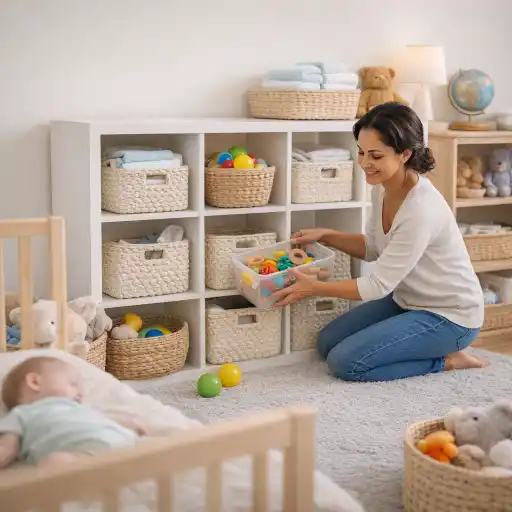
Extra items should be stored outside the crib and its sleep area. Do not use a crib rail, mattress, or nearby surface as a convenient holding spot for spare clothing, bottles, diapers, toys, paperwork, or supply baskets. Keep cords, strings, and bags away from infant access, and arrange equipment so staff can see and reach each infant safely. The U.S. Consumer Product Safety Commission’s crib guidance for child care providers can help programs consider crib safety and equipment practices.
Clear sleep spaces are not a matter of appearance or personal preference; they are part of a consistent safety routine. If a baby arrives asleep in a sitting device, follow program policy and current guidance for moving the infant to an appropriate sleep surface while maintaining supervision. Do not add objects to the crib to help a baby settle. State requirements vary - check your state licensing agency and follow your written safe-sleep policy.
- Before each use, make sure the sleep space is clear and the fitted sheet is secure.
- Store sleep-related supplies in a labeled cabinet or shelf outside the crib area.
- Maintain visibility and access for ongoing supervision and prompt response.
How can labels and room layout support safer routines?
Labels are most effective when they make the expected location of an item obvious. Choose consistent words and place labels where staff can read them quickly without obstructing supervision or creating a distraction. Use labels on adult storage areas—not as a reason to put supplies where infants can reach them. ChildCareEd’s Infant Room Labels resource Buy Now $0.75 offers colorful, readable labels for everyday essentials and can be a useful starting point for a consistent system.
Make the organization usable across shifts. During a quick staff walkthrough, show where supplies belong, which areas are staff-only, and how to report shortages or misplaced items. Keep individual care information in approved secure locations; labels should not display more private information than necessary. Review the setup after enrollment changes, room rearrangement, or feedback from staff.
- Use one familiar term consistently across labels, shelf maps, and staff instructions.
- Place high-use supplies near the routine they support, while preserving clear pathways and sightlines.
- Ask a colleague unfamiliar with the room to locate key supplies and identify anything confusing.
- Use brief opening and shift-change checks to confirm sleep spaces remain clear and supplies are returned.
What storage mistakes should infant-room teams avoid?
Common storage problems often arise during rushed moments. A caregiver may put a spare outfit on a crib rail, leave a supply basket beside a mattress, or temporarily place a blanket in the sleep space while preparing for nap. These shortcuts can blur the boundary between storage and sleep and make an otherwise safe setup less dependable. Establish a clear rule: cribs are for infants during sleep, not for storing or staging classroom items.
Another pitfall is creating a labeling system that does not match actual practice. If used items are routinely placed in a bin labeled “clean,” staff may misunderstand what is ready to use. Correct the process first, then make the label accurately reflect the contents. Avoid overly complex color systems or small print that staff cannot interpret quickly.
- Using a crib as a shelf: Return supplies to designated storage immediately.
- Mixing clean and used materials: Separate them clearly and follow sanitation procedures.
- Posting private details: Keep confidential child and family information in approved secure locations.
- Assuming labels are enough: Orient staff to the routine and verify that the storage process works in practice.
For further professional learning, ChildCareEd’s [Keeping Them Safe: Infants & Toddlers Buy Now $24.00] focuses on minimizing risks and supporting safer care environments for young children. The course is identified as supporting CDA Subject Area 1: Planning a Safe and Healthy Learning Environment; confirm any training-hour or approval requirements that apply to your role with your licensing agency.
Conclusion: How can you keep infant-room storage safe and sleep spaces clear?
Safe infant-room storage begins with a simple separation: supplies have designated storage locations, and sleep spaces remain clear for sleep. Organize everyday items by care routine, label locations consistently, secure hazardous materials, preserve clear pathways and sightlines, and train every staff member to return items to their proper place. Before each sleep period, check that the crib contains only the infant on a firm, flat surface with a fitted sheet, in accordance with current guidance and program policy.
These practices do not require a perfect room or an elaborate storage system. They require a predictable arrangement that works during real routines and regular checks that help the team catch drift. ChildCareEd’s Infant Room Labels can help establish clear homes for supplies, while Keeping Them Safe: Infants & Toddlers offers relevant professional learning to deepen safety knowledge. The central question has a practical answer: keep extra items stored away from the crib, make safe routines easy to repeat, and review your setup as children, staff, and needs change.
- Basic Health & Safety and Breastfeeding Awareness
- CDA Infant/Toddler Credential
- Pediatric RSV First Aid & CPR/AED
- CDA Bridge Bundle: Infant/Toddler without Portfolio Review
- CDA Bridge Bundle: Infant/Toddler
- 45-Hour Infant and Toddler Curriculum
- Creating Environments that Nurture Growth and Community
- Texas Director Credential
- Prevention of Sudden Infant Death Syndrome and Use of Safe Sleep Practices
- Safe sleep basics (and common mistakes to avoid)
- Recursos en Español sobre el Sueño Seguro del Bebé
- Proporciones de Cuidado Infantil y Tamaños de Grupo por Edad en Virginia (Guía Rápida para Centros y Hogares)
- Lista para Guardería en Casa en Illinois: Cómo Iniciar una Guardería en el Hogar
- How Can Nevada Child Care Providers Create Safe, Calm, and Well-Organized Learning Spaces?
- Celebrando la amistad en el cuidado infantil durante el Día de los Mejores Amigos
- What should child care providers learn in SIDS training?
- Canciones, juegos y preguntas de círculo para niños
- How Can Child Care Providers Introduce Simple Routines to Infants and Toddlers?
- Home Daycare Ideas That Make Your Space Feel Safe, Fun, and Professional
- What Do You Need to Open a Daycare at Home? Start With Your House, Not the Toys
- How Can Child Care Providers Create Effective Learning Centers in Small Spaces?
- How Can Infant Room Labels Support Safer, More Consistent Care?
- How Should Providers Review Loose Parts Before They Enter a Toddler Play Area?
- Can Every Toddler Reach and Recognize Their Own Storage Space?
- What Makes an Infant Play Area Easy for Staff to Supervise?
- Why Do Toddlers Keep Asking Where Their Belongings Go?
- How Can You Set Up an Infant Room So Substitutes Can Find What They Need?
- How Can Child Care Teams Manage Infant Sleep Spaces Safely During Staggered Arrivals?
- Infant Room Storage: How Can You Keep Extra Items Out of Sleep Spaces?
