A well-designed home daycare can help children feel secure, invite meaningful play, and reassure families that their children are receiving thoughtful care. Start with practical changes—and strengthen your planning with Classroom Setup for Child Care  Buy Now $24.00, which can help you earn professional development hours while improving arrangement, inclusion, and daily classroom practices.
A home daycare has a special advantage: it can feel warm and familiar while still functioning as an intentional learning environment. The goal is not to make your home look like a commercial center. Instead, create a space where safety, relationships, independence, and play are visible in the way rooms are arranged and routines are carried out.
Why does the home daycare environment matter?
The environment communicates expectations before a provider says a word. Clear pathways suggest that children can move safely. Low shelves communicate trust and independence. A comfortable reading area signals that quiet connection is welcome. Consistent visual cues help children understand what happens next.
Head Start describes learning environments as classrooms, caregiving areas, play spaces, and outdoor settings that are organized, developmentally appropriate, and responsive to children’s interests and cultures. This perspective is especially useful in family child care, where the home, community, and group socialization spaces may all contribute to learning.
Design also affects adults. When supplies are visible, labeled, and stored near the point of use, providers spend less time searching and more time engaging. When sightlines are open, supervision becomes easier. When family areas are clearly separated from care areas, professionalism and privacy are easier to maintain.
Think of your setting as a partner in teaching. It should support the children you actually serve—not an imaginary “perfect” group. Observe where children become frustrated, crowded, disengaged, or overly stimulated, then make one purposeful adjustment at a time. Since the environment is just one part of quality care, explore what makes a daycare provide high-quality care, including relationships, curriculum, and staff qualifications.
How can you divide a home daycare into purposeful zones?
Zones give children a mental map of the day. In a small home, zones do not require separate rooms; rugs, low shelves, furniture placement, and visual labels can define them.
- Welcome and belongings: Provide labeled hooks, cubbies, or baskets for coats and personal items.
- Reading and calm: Add a small rug, sturdy books, soft seating, and a limited selection of books.
- Creative work: Use a washable table with accessible paper, crayons, paint, and process-focused materials.
- Blocks and construction: Place blocks on a rug away from high-traffic pathways.
- Dramatic play: Offer open-ended props that reflect children’s homes, cultures, and interests.
- Movement: Preserve an open area for dancing, stretching, music, and indoor gross-motor play.
Keep noisy and quiet areas apart when possible. Avoid placing a reading nook beside a dramatic-play kitchen or a block area beside the nap space. The arrangement should support supervision without requiring children to remain still.
For infants and toddlers, separate active play from sleep and diapering areas, maintain clear sightlines, and keep materials at developmentally appropriate heights. A provider-focused resource on healthy learning environments similarly emphasizes calm spaces, accessible materials, safe movement, and predictable routines.
Which safety features make a home daycare feel trustworthy?
Professional appearance begins with dependable safety systems, not expensive décor. Walk through the home at a child’s eye level and inspect what a curious toddler could reach, pull, climb, open, or place in their mouth.
- Anchor shelves, dressers, televisions, and other heavy furniture.
- Lock medications, cleaners, pesticides, and personal items away from children.
- Cover unused outlets and manage cords so they cannot be pulled or wrapped around a child.
- Keep walkways clear and use gates where needed.
- Inspect toys for broken edges, loose parts, recalls, and choking hazards.
- Maintain working smoke and carbon-monoxide detectors, fire extinguishers, emergency contacts, and first-aid supplies.
- Post an emergency plan where adults can see it, while protecting children’s confidential information.
Active supervision is equally important. Position yourself to see and hear the whole group, scan continuously, listen for changes in sound, and count children during transitions. A beautiful room is not safe if the provider cannot monitor it effectively.
For infants, follow current safe-sleep guidance: place babies on their backs in individual cribs with firm mattresses and fitted sheets, and keep sleep spaces free of loose bedding and soft objects. State requirements vary - check your state licensing agency before purchasing equipment or finalizing room arrangements.
How can a home daycare feel fun without becoming overwhelming?
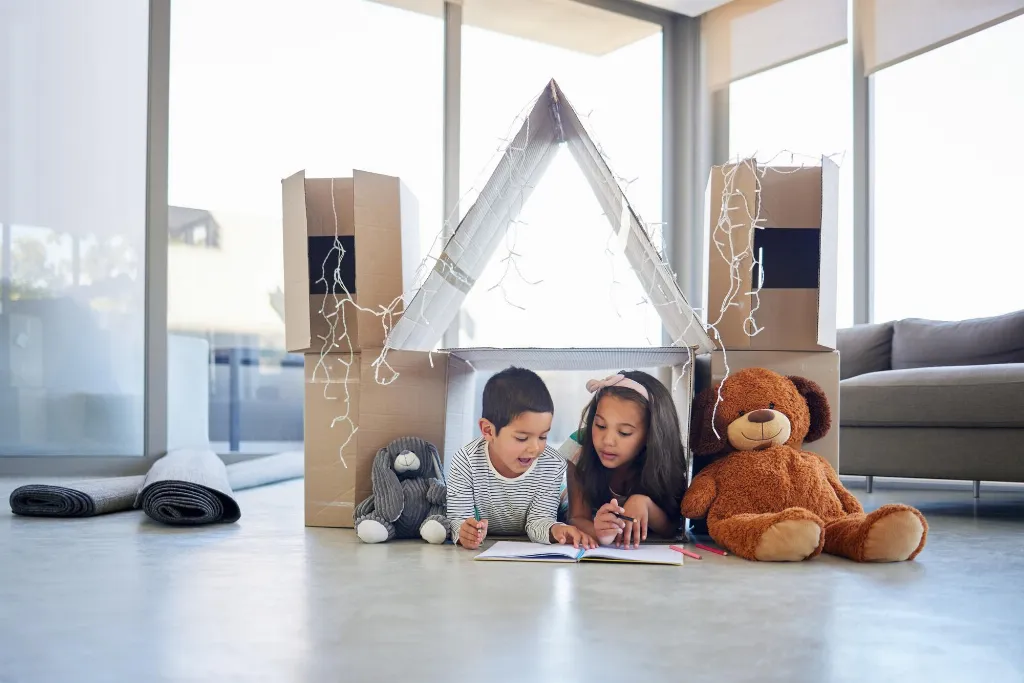
Fun does not mean filling every wall or shelf. Young children often engage more deeply when materials are limited, organized, and rotated. Choose open-ended items that can be used in multiple ways: blocks, scarves, cardboard tubes, play dough, large loose parts, puppets, books, and art materials.
Use children’s interests as the starting point. If children are fascinated by buses, create a transportation area with maps, boxes, tickets, and books. If they are exploring water, provide measuring cups, funnels, towels, and vocabulary such as full, empty, pour, and drip. This approach turns ordinary materials into intentional learning.
- Rotate a small number of materials weekly or when interest declines.
- Display children’s work at their eye level to create belonging.
- Use family photos, multilingual labels, and culturally familiar objects.
- Provide a quiet retreat for children who need reduced noise or stimulation.
- Offer daily opportunities for outdoor exploration, movement, and nature-based play.
- 🌱 Add natural elements such as pinecones, stones, leaves, plants, or sunlight—after checking that they are safe and appropriate.
Inclusive design may involve physical, social, and temporal modifications. Adjustable seating, picture cues, peer supports, shorter transitions, and varied sensory choices can help more children participate. The aim is not to create a separate “special” area, but to make the whole environment more accessible.
How can routines and presentation make a home daycare more professional?
Professionalism is experienced through consistency. Families notice whether arrival procedures are clear, information is communicated respectfully, and the environment is prepared before children enter. Children notice whether materials return to predictable locations and whether adults follow through calmly.
Create a simple daily rhythm that balances active and quiet experiences, child-directed play and small-group invitations, meals, rest, and outdoor time. Use photographs or picture cards to show the sequence. For infants, maintain flexibility around individual feeding, diapering, and sleep cues while preserving a calm group rhythm.
Small operational systems make a major difference:
- Use labeled bins and a closing checklist.
- Keep cleaning and sanitizing supplies secured but accessible to adults.
- Maintain attendance, allergy, medication, incident, and emergency records according to applicable rules.
- Send families a concise daily update about meals, rest, play, and notable moments.
- Establish written policies for illness, arrival, authorized pickup, communication, and emergency response.
- Schedule a monthly environment review and document improvements.
A neat space should still look lived in. Children’s constructions, paintings, family contributions, and active projects make the setting welcoming. Professional does not mean sterile; it means intentional, reliable, respectful, and prepared.
What common home daycare setup mistakes should you avoid?
Many providers begin with enthusiasm and purchase too much too quickly. The result can be crowded shelves, confusing choices, and difficult cleanup. Begin with the children’s developmental needs, available square footage, licensing expectations, and your supervision plan.
- Mistake: Prioritizing décor over supervision. Better: preserve clear sightlines and safe traffic patterns first.
- Mistake: Offering every toy at once. Better: rotate a manageable selection and teach children how to return materials.
- Mistake: Mixing family belongings with daycare supplies. Better: use labeled storage and defined boundaries.
- Mistake: Creating age-inappropriate sensory invitations. Better: consider choking, allergy, ingestion, and sanitation risks.
- Mistake: Treating all children alike. Better: adapt lighting, seating, timing, language supports, and materials.
- Mistake: Assuming a polished room equals compliance. Better: verify requirements with the licensing agency and maintain documentation.
Use a “test and revise” cycle. Watch how children move through the space, ask families for relevant input, and note patterns. If a shelf repeatedly becomes a climbing structure, the issue may be placement or accessibility rather than children’s behavior. If transitions are chaotic, the solution may involve a visual cue, more time, or fewer children moving at once.
For additional safety preparation, providers may explore Preventative Health and Safety Buy Now $24.00, which addresses indoor and outdoor concerns, illness prevention, and active supervision. Review course details and local requirements before enrolling.
Summary: What makes a home daycare feel safe, fun, and professional?
The strongest home daycare ideas are practical, responsive, and sustainable. Arrange the environment into clear zones, protect sightlines, secure hazards, and provide materials that invite meaningful play. Use predictable routines, accessible storage, inclusive representation, and calm communication to support children and families.
Remember that a safe, enjoyable, professional setting is built through ongoing observation—not a single decorating project. Start with one improvement: clear a pathway, create a cozy reading space, label a shelf, or establish a reliable arrival routine. Then observe how children respond and refine the space.
Ultimately, the question is not whether your home looks like a center. It is whether children can explore confidently, adults can supervise effectively, families can understand your systems, and every child can see a place for themselves. Thoughtful design makes that goal visible every day.
Helpful ChildCareEd courses
- Classroom Setup for Child Care Buy Now $24.00 — arrangement, inclusion, and the learning environment.
- Preventative Health and Safety Buy Now $24.00 — hazards, illness prevention, and active supervision.
- Playful Spaces for Infants & Toddlers Buy Now $24.00 — developmentally appropriate, inclusive play environments.
- Active Supervision: A Strategy That Works Buy Now $35.00 — practical supervision strategies for daily care.
- CDA: Stand With Respect and Professionalism Buy Now $24.00 — respectful relationships and professional practice.
Use training as one part of continuous improvement, and remember: state requirements vary - check your state licensing agency.
- 45 Hour Preschool Methods and Materials
- Adult Only CPR AED and Adult First Aid Blended
- Bienvenido! Welcoming All Families
- Potty Training Made Simple
- CDA Family Child Care Renewal
- CDA Home Visitor Credential Birth to 5
- Texas Director Credential
- 24 Hour Family Child Care Pre-Service Training ONLINE
- Every Moment Matters: Schedules and Transitions
- CDA Certification en Español: Recursos y Consejos para Educadores Bilingües
- ❄️ ¿Qué actividades al aire libre funcionan bien para los niños de Illinois en cada estación? 🌷🍂
- Cómo Abrir Una Quardería En Casa Sin Dinero?
- Cómo Iniciar el Proceso de Obtención de la Licencia de Cuidado Infantil
- Normas de Licenciamiento de Cuidado Infantil en Virginia para Centros Diurnos Infantiles y Hogares Diurnos Familiares
- Lista para Guardería en Casa en Illinois: Cómo Iniciar una Guardería en el Hogar
- Consejos de Supervisión Activa para Salones de Preescolar y el Juego al Aire Libre
- Best Daycare Field Trip Ideas in North Carolina
- In-Home Daycare Requirements in Illinois
- Summer Field Trips for Daycares in Texas
- Summer Field Trips for Daycares in Wisconsin
- Summer Field Trips for Daycares in Maryland
- Canciones, juegos y preguntas de círculo para niños
- Cómo simplificar la capacitación para sus empleados de daycare
- What are fun, practical school-age daycare activity ideas for teachers?
- Home Daycare Ideas That Make Your Space Feel Safe, Fun, and Professional
- What Makes a Great Home Daycare? 10 Things Parents Notice First
- What Certifications Do I Need to Open a Child Care Center? Owner vs. Director Requirements Explained
- Starting a Daycare in Pennsylvania: Family Home, Group Home, or Child Care Center—which Should You Open?
