Opening a home daycare begins with a safe, workable environment—not a shopping cart full of toys. Use this guide to evaluate your house, organize licensing steps, and build practical systems for children and families; the Family Child Care: Building, Premises, and Outdoor Safety course can strengthen your ability to identify hazards and create safer indoor and outdoor spaces.
Why should your house come before your supplies?
A home daycare is both a residence and a regulated early care setting. Before choosing dramatic-play centers or purchasing shelves of manipulatives, you need to determine whether the home can support safe supervision, sanitation, rest, meals, active play, emergency movement, and family privacy. A beautiful toy collection cannot compensate for blocked exits, unsafe storage, poor sight lines, or an outdoor area that children cannot use safely.
Starting with the house also protects your budget. Your available rooms, entrances, bathroom access, yard, storage, and household routines determine what equipment you actually need. The in-home daycare checklist emphasizes beginning with regulations, home preparation, emergency planning, and health and #safety systems before marketing the program.
- Identify the rooms children will use and the rooms that will remain off-limits.
- Map supervision zones, exits, bathrooms, food-preparation areas, and sleeping spaces.
- Consider how household members, pets, visitors, and personal belongings will affect the program.
- Delay major purchases until you know your licensed capacity and age groups.
This sequence makes the home purposeful rather than merely crowded. It also gives families confidence that your program is designed around children’s needs, not assembled at the last minute.
Which legal and licensing questions should you answer first?
Before opening enrollment, contact the agency responsible for child care licensing in your state or locality. Determine whether your planned care requires a license, registration, listing, zoning approval, or another permit. Rules may depend on the number of unrelated children, their ages, hours of care, and whether your own children count toward capacity. State requirements vary - check your state licensing agency.
Licensing commonly involves an application, background checks for the provider and other household adults, health documentation, training, fire or environmental inspections, and a review of the home. Some jurisdictions also require floor plans, written policies, proof of insurance, or local zoning clearance. FindLaw’s startup guidance and the ATSDR Choose Safe Places checklist both support contacting licensing, zoning, health, and environmental officials early.
- Ask for the current family child care regulations and application packet.
- Confirm capacity, age-mix, adult-to-child ratios, and supervision requirements.
- Ask which household adults require background checks or clearances.
- Clarify required CPR, First Aid, health and safety, mandated-reporter, and emergency training.
- Investigate zoning, fire, sanitation, insurance, and business-registration obligations.
Do not rely on a neighboring provider’s experience. Similar homes can fall under different rules because states and municipalities classify programs differently.
How can you evaluate the house as a child-care environment?
Conduct a child-height safety walk before buying equipment. Move through every proposed care area while looking for hazards a crawling infant or curious preschooler could reach: unlocked chemicals, cords, sharp edges, unstable furniture, uncovered outlets, accessible medications, hot surfaces, choking hazards, and windows or doors that children can operate.
Then evaluate the environment through the lens of active supervision. Can you see and hear children during play, meals, diapering, toileting, and rest? Are transitions manageable without leaving another group unattended? The Child Care Aware family child care checklist highlights continuous supervision, safe sleep, clean diapering areas, protected outlets, locked chemicals, safe toys, emergency drills, and secure outdoor spaces.
- Anchor heavy furniture and secure televisions and appliances.
- Install gates where needed and keep stairways clear.
- Lock medications, cleaning products, tools, weapons, alcohol, and personal documents.
- Install and test smoke and carbon-monoxide detectors; keep exits unobstructed.
- Use firm, properly equipped sleep surfaces for infants and follow current safe-sleep guidance.
- Inspect the yard for traffic, water, poisonous plants, debris, damaged equipment, and unsafe surfaces.
Remember environmental health as well. Older homes may require attention to lead, radon, asbestos, ventilation, water quality, or peeling paint. A home can feel comfortable to adults while presenting meaningful risks to young children.
What equipment is genuinely necessary at the beginning?
Once the house is safe and the age groups are clear, purchase equipment in priority order. Begin with items that support health, safety, care routines, and development. Choose durable, washable materials that can be used in more than one way rather than buying every themed product marketed to early educators.
- Safe sleep equipment appropriate to each child’s age and licensing standards.
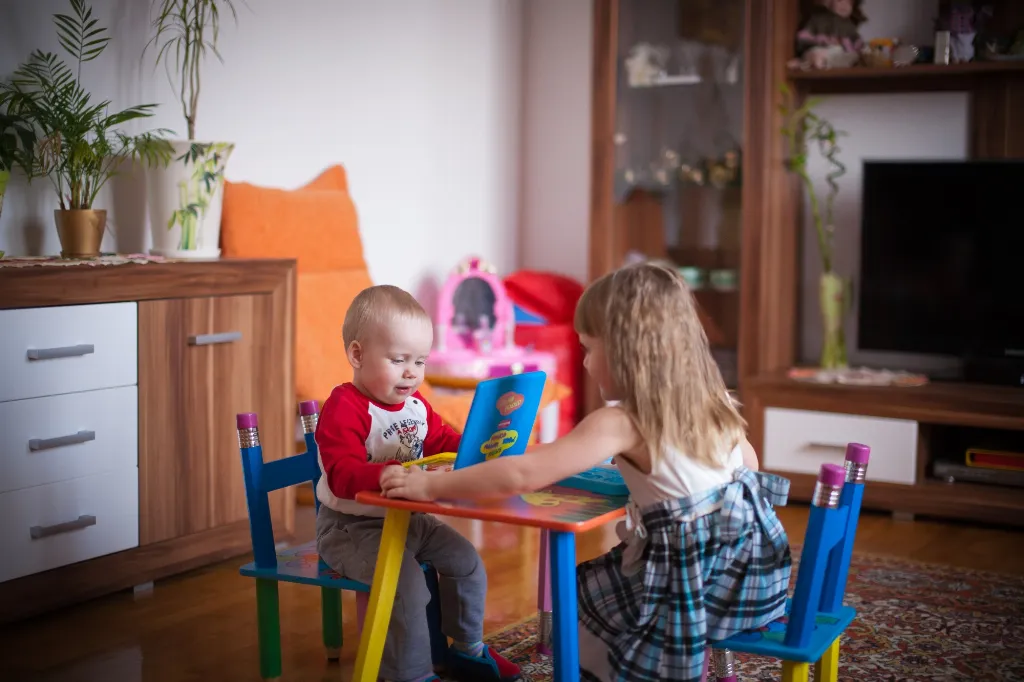
- Child-sized tables, chairs, mats, and storage that do not obstruct supervision.
- Diapering and handwashing supplies, covered waste containers, and sanitation materials.
- A stocked first-aid kit, emergency contact information, attendance records, and go-bag.
- Open-ended materials such as blocks, books, art supplies, dramatic-play items, and sensory tools.
- Outdoor equipment appropriate for the ages served, with safe surfacing and regular inspections.
Buy used items only after checking recalls, structural condition, cleanliness, missing parts, lead risks, and small-piece hazards. Avoid equipment that creates blind spots, requires constant adult rescue, or is inappropriate for mixed-age groups. A smaller collection arranged thoughtfully can support richer #development than a room packed with disconnected toys.
Plan for rotation. Observe children’s interests, then add or remove materials to extend play and reduce clutter. This approach saves money and keeps the environment responsive.
How do policies, emergency plans, and business systems complete the setup?
A home daycare is not ready when the rooms look attractive; it is ready when predictable systems protect children and guide adults. Develop a parent handbook covering hours, fees, late pickup, absences, illness exclusion, medication, meals, sleep, guidance, clothing, authorized pickup, communication, and termination. Use enrollment forms that capture emergency contacts, medical information, allergies, permissions, and required health records.
Create written emergency procedures for fire, severe weather, evacuation, shelter-in-place, lockdown, utility failure, medical emergencies, missing children, and reunification. The FEMA child care preparedness resource recommends identifying hazards, developing a plan, assigning responsibilities, communicating with families, practicing drills, and updating the plan. Keep emergency supplies and records accessible without compromising confidentiality.
- 📋 Maintain attendance, incident, medication, cleaning, drill, and inspection logs.
- Set calendar reminders for licenses, insurance, training, health forms, and equipment checks.
- Plan how children will be supervised when you need a break or substitute coverage.
- Separate business finances and track startup, operating, tax, food, utility, and insurance costs.
- Use an enrollment limit based on licensing capacity, room design, ratios, and your actual energy.
For business preparation, explore Business Planning: Family Child Care Buy Now $25.00. For broader health and safety knowledge, the Health and Safety Orientation  Buy Now $55.00 course addresses infectious disease prevention, safe sleep, medication, emergencies, hazardous materials, transportation, and child maltreatment reporting. Confirm with your licensing agency whether a course meets your specific requirement.
What common mistakes should new home daycare providers avoid?
New providers often begin with enthusiasm and underestimate the operational complexity of caring for several children in a private home. The most common mistake is purchasing supplies before confirming licensing limits and room requirements. Another is treating supervision as simply being nearby. Effective supervision requires watching, listening, positioning, scanning, anticipating, and interacting.
- Opening before approval: Complete required licensing, inspections, and clearances before accepting children.
- Over-enrolling: Count children by age and follow the applicable capacity and ratio rules.
- Ignoring household risks: Secure pets, firearms, pools, medications, tools, and adult visitors.
- Relying on memory: Document attendance, incidents, medication, cleaning, drills, and training.
- Using one routine for every child: Adapt schedules for development, culture, sleep, feeding, and disability-related needs.
- Postponing family communication: Explain policies before enrollment and revisit them respectfully.
Take a final inspection-style walk with a colleague or licensing specialist if available. Ask what a child can reach, where a child could disappear from view, how quickly everyone could exit, and whether a substitute could follow your procedures without guessing. Small corrections made before opening are less costly and less stressful than corrections made during a crisis or inspection.
Conclusion: What do you really need to open a daycare at home?
You need more than toys: you need a legally eligible home, a safe and supervised layout, appropriate equipment, required training, written policies, emergency procedures, accurate records, insurance and business planning, and a sustainable daily routine. Start by examining the house itself—its rooms, exits, hazards, traffic patterns, storage, outdoor area, and household boundaries—then purchase only what supports the children and capacity you intend to serve.
The strongest home daycares are not necessarily the most expensive. They are intentional, clean, predictable, developmentally responsive, and transparent with families. Use the step-by-step home daycare guide, consult your licensing agency, and build one reliable system at a time.
Which ChildCareEd courses may support your preparation?
- Family Child Care: Building, Premises, and Outdoor Safety — practical environmental and outdoor risk reduction.
- Health and Safety Orientation Buy Now $55.00 — foundational health, safety, emergency, and reporting topics.
- Business Planning: Family Child Care Buy Now $25.00 — planning for finances, operations, and marketing.
- Stay Alert! Steps for Emergency Prep Buy Now $25.00 — emergency plans, drills, communication, and documentation.
- A Watchful Eye: Supervision in Early Childhood Buy Now $16.00 — supervision strategies across ages and settings.
References consulted include ChildCareEd’s in-home daycare checklist and step-by-step guide; ChildCare Aware’s family child care checklist; ATSDR’s Choose Safe Places checklist; FindLaw and Nolo startup guidance; FEMA child care emergency preparedness materials; North Carolina, Nevada, Tennessee, Illinois, Maryland, California, and Texas licensing resources; and ChildCareEd health, safety, supervision, business, emergency, and CPR course descriptions.
- Adult Only CPR AED and Adult First Aid Blended
- Adult/Child CPR AED and Adult First Aid Blended
- CDA Family Child Care Credential
- CDA Family Child Care Credential with Portfolio Review
- Pediatric RSV First Aid & CPR/AED
- Potty Training Made Simple
- Texas Director Credential Renewal
- Texas Director Credential
- 24 Hour Family Child Care Pre-Service Training ONLINE
- ¿Cómo solicito la licencia para una guardería en California?
- Maryland Home Daycare Checklist: How to Start a Daycare at Home
- Lista para Abrir una Guardería en Casa en Virginia: Cómo Empezar
- Lista para Abrir una Guardería en Casa en Dakota del Norte: Cómo Empezar
- Lista para Guardería en Casa en Illinois: Cómo Iniciar una Guardería en el Hogar
- Lista para Guardería en Casa en California: Cómo Iniciar una Guardería en el Hogar
- Lista para Guardería en Casa en Texas: Cómo Iniciar una Guardería en el Hogar
- Capacitación Previa al Servicio para Proveedores de Cuidado Infantil en Dakota del Norte
- How to Open a Home Daycare in Virginia
- So You Want to Open a Child Care Center? Welcome to the Beautiful Chaos
- How can Minnesota child care centers market smartly and fill open spots fast?
- How can Michigan child care centers market themselves and fill open spots easily?
- How can Florida child care centers market smarter and fill open spots easily?
- How can Alabama child care centers market themselves and fill open spots easily?
- Starting an In-Home Daycare in Illinois: Requirements and Tips
- How Many Kids Can You Watch Without a License in Georgia?
- How Can North Dakota Providers Show Quality and Attract Families?
- How do I open a licensed group child care home in North Dakota?
- How Can You Start a Daycare With Little Money? 10 Ways to Lower Startup Costs
- What Do You Need to Open a Daycare at Home? Start With Your House, Not the Toys
