Children often reveal their richest thinking when adults pause, watch, and resist the urge to take over. With a clear focus and a few unobtrusive habits, you can protect children’s concentration while gathering useful evidence for responsive teaching; Observing & Assessing in Child Care  Buy Now $16.00 can help strengthen those practical skills. For deeper guidance on objective records, assessment methods, and planning, consider Tracking Progress, Shaping Futures: Observation & Assessment Skills Buy Now $55.00.
Why does uninterrupted observation matter?
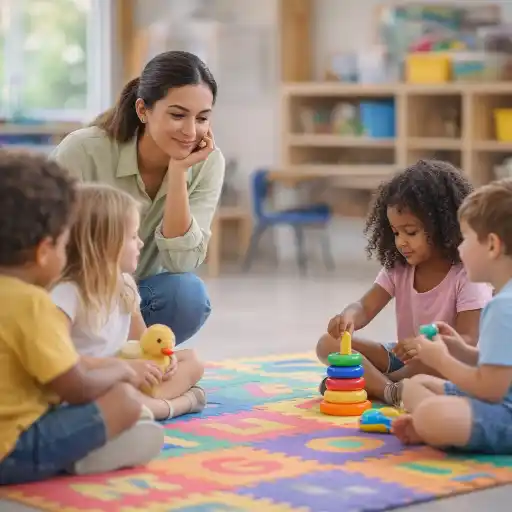
Play is not a pause from learning; it is one of the ways young children investigate ideas, practice relationships, regulate emotions, and communicate meaning. When an adult interrupts a child who is building, pretending, experimenting, or negotiating, the child may lose the thread of an experience just as important thinking is unfolding. Sustained play gives children time to meet a challenge, revise a strategy, and stay engaged long enough for an idea to become more complex.
For providers, uninterrupted observation also offers a more authentic view of children’s interests and capabilities. NAEYC identifies observing and documenting children as essential processes for planning, implementing, and evaluating learning experiences.
Respectful observation communicates that children’s ideas matter. The adult remains attentive and available; the role simply shifts from director to thoughtful witness. This stance supports children’s #agency, engagement, and confidence while keeping safety and belonging at the center.
How can you prepare to observe without taking over?
Begin with a focused purpose. You do not need to record every action. Choose one child, a small group, or an aspect of development you want to understand: language in dramatic play, persistence in construction, peer negotiation outdoors, or fine-motor coordination at the sensory table. A clear question helps you notice relevant evidence without becoming absorbed in note-taking.
Prepare any materials before play begins. A small notebook or clipboard can make quick documentation manageable; position yourself where you can scan the room and respond to safety needs. Observation must never interfere with active supervision, required ratios, or children’s privacy.
- Choose a vantage point that allows broad supervision without hovering.
- Note the date, time, setting, materials, and children involved when relevant.
- Select a method that fits your purpose: a brief jotting, anecdotal note, or work sample.
- Check program policies and family permissions before making photographs or recordings.
- ☕ Set aside time after play to reflect so documentation does not dominate the experience.
State requirements vary - check your state licensing agency. Any planned observation requiring a staff member to focus away from the group needs an appropriate supervision plan.
What should you record while children are playing?
Record what you can see and hear before adding an interpretation. Objective notes use specific actions and, when possible, children’s exact words. For example: “Maya placed two large blocks side by side, balanced a narrow block across the top, watched it fall, and said, ‘It needs a strong bottom.’ She chose four smaller blocks and tried again.” This captures planning, problem-solving, spatial reasoning, and language without labeling Maya as “advanced” or “frustrated.”
Brief notes are often sufficient to preserve a meaningful moment. Use a simple structure:
- Context: Where and when did the play happen?
- Action and words: What did the child do and say?
- Interaction: How did peers or adults respond?
- Reflection: What might you observe or offer next time?
Jottings can be expanded into anecdotal records later; detailed running records take more time and require adequate coverage.
Keep notes strengths-based and responsive to culture and language. Children communicate through gesture, movement, home languages, and quiet participation as well as spoken words. One observation is a snapshot, not a diagnosis or a complete picture of development.
When should you stay back, and when should you intervene?
Ask yourself: “Is my involvement necessary right now?” If children are safe, included, and engaged in a manageable challenge, pause. Give them time to look, try, disagree, revise, and try again. Silence can be an intentional teaching choice, not a lack of support.
Intervene promptly when there is imminent danger, repeated exclusion, escalating harm, or a child’s need for communication or emotional support. Start with the least intrusive response that meets the need:
- Observe and wait briefly while maintaining supervision.
- Move closer without speaking if proximity is enough.
- Offer a neutral acknowledgment: “You both want the blue truck.”
- Ask an open question: “How could you make room for both ideas?”
- Model or provide a specific scaffold only when children need it.
When extending play, preserve children’s ownership. Instead of directing, “Put the big block on the bottom,” try, “What might help the tower stay steady?”.
How can observations lead to better teaching decisions?
Observation becomes useful assessment when you interpret evidence carefully and use it to plan. After play, review the record: What strength, interest, or skill did you notice? What context may have shaped the moment? What small environmental change or learning opportunity could invite a next step?
Suppose Leo repeatedly builds roads with blocks, counts toy vehicles, and explains routes to peers. You might add maps, clipboards, signs, measuring tools, or books about transportation. This does not turn play into a formal lesson; it enriches an investigation that is already meaningful to the child. NAEYC recommends using observation to adjust teaching strategies and design learning experiences, rather than collecting records without acting on them.
Look across multiple occasions, settings, and forms of communication. A child may talk freely with a familiar peer but say little in a large group; another may show mathematical thinking through construction without explaining it aloud. Multiple observations help reduce conclusions based on one unusual day and support more equitable assessment.
- What interest, strength, or emerging skill is visible?
- What cultural, linguistic, environmental, or relationship factors may matter?
- What responsive next step will I try, and what will I look for afterward?
Share meaningful observations with families respectfully, protect confidentiality, and follow program procedures for storing and sharing records. The goal is partnership and responsive planning, not surveillance.
What common observation mistakes can you avoid?
Even experienced educators can feel pressure to prove that learning is happening. That pressure can lead to over-questioning, premature intervention, or paperwork that competes with supervision. A few deliberate safeguards help preserve children’s play and strengthen the quality of your notes.
- Do not equate quiet with disengagement. Watch for concentration, planning, and nonverbal participation.
- Do not ask a question after every action. Allow children’s ideas time to develop.
- Do not present an interpretation as fact. Replace “Sam was defiant” with specific actions and words.
- Do not document only challenges. Record joy, persistence, relationships, competence, and emerging skills.
- Do not sacrifice supervision for paperwork. Keep notes brief and arrange coverage for focused observation.
- Do not draw conclusions from one moment. Look for patterns across times, settings, and ways of communicating.
Uninterrupted play does not mean adults never speak. Children may invite you into their play, ask for help, or need support with safety and inclusion. Respond warmly, then return choices and problem-solving to the children when appropriate. The aim is responsive restraint: present, observant, and ready to help without taking over.
Conclusion: How can you observe without interrupting play?
Observe without interrupting by preparing thoughtfully, choosing a focused purpose, positioning yourself for active supervision, recording concise and objective notes, and pausing before you intervene. Stay ready to support safety, inclusion, communication, and emotional regulation, while allowing children’s ideas and play to unfold.
The practical cycle is simple: watch, document, reflect, plan, and watch again. Short notes can reveal powerful learning when they are grounded in what children actually do and say. With practice, careful observation helps you protect children’s concentration, understand their interests, and make teaching decisions that honor each child’s strengths.
Explore five relevant ChildCareEd courses
- Observing & Assessing in Child Care Buy Now $16.00 — practical foundations for observing and documenting development.
- Tracking Progress, Shaping Futures: Observation & Assessment Skills Buy Now $55.00 — objective documentation and using assessment information for goals.
- Preschool Assessments & Observations Buy Now $24.00 — methods for preschool observation and individualized planning.
- Observations And Goal Setting in Childcare Buy Now $24.00 — connecting observations with goals and curriculum.
- Privacy Matters: Documentation and Observation in Early Learning Buy Now $55.00 — ethical, confidential documentation practices.
- Pediatric Blended First Aid & CPR/AED Adult, Child, Infant
- Pediatric RSV First Aid & CPR/AED
- Pediatric In-Person First Aid & CPR/AED Adult, Child, Infant
- CDA Bridge Bundle: Family Child Care without Portfolio Review
- CDA Bridge Bundle: Infant/Toddler without Portfolio Review
- CDA Bridge Bundle: Preschool without Portfolio Review
- Emergent Learning & Development
- Creating Environments that Nurture Growth and Community
- Texas Director Credential
- Wellness in Action: Teaching Healthy Habits to Children
- 🌟How Can Playtime Build Bright Minds? The Power of Learning Through Play in Early Childhood
- 💛🧩 ¿Cómo puedo hacer que mi enseñanza sea inclusiva para los niños con autismo?
- 10 Ejemplos de Cómo la Cultura Influye en el Desarrollo Infantil
- Celebrando la amistad en el cuidado infantil durante el Día de los Mejores Amigos
- Canciones, juegos y preguntas de círculo para niños
- How Can Child Care Providers Support Healthy Child Growth and Development?
- How Can Child Care Providers Support Learning Through Play?
- How Can Child Care Providers Help Children Join Play Without Taking Over?
- How Can Teachers Build Early Literacy Without Screens or Worksheets?
- How Can You Observe Children Without Interrupting Their Play?
- How Can Child Care Providers Teach Children to Join Play Without Grabbing or Interrupting?
- How Can Listening and Movement Games Build Children’s Shape Recognition?
- How Can You Observe Children Without Interrupting Their Play?
- How Can Child Care Programs Protect Preschool Playtime When the Schedule Gets Crowded?
- When One Child Always Chooses the Same Pretend Play Role, What Should Educators Do?
- How Can You Support Safe Transporting Play Without Losing Your Learning Center?
- How Can Teachers Turn Everyday Play Into Learning Opportunities?
- How Can Child Care Providers Encourage Children to Stay Engaged During Independent Play?
- How Can Teachers Support Children Who Struggle to Enter an Ongoing Play Group?
- How Can Child Care Providers Use Outdoor Play to Strengthen Problem-Solving Skills?
