When children carry materials across the room, empty a shelf, and start again, they may be exploring a powerful pattern of play—not simply disrupting your setup. The Baby Play: Planning Infant and Toddler Activities course  Buy Now $16.00 can help you plan responsive, age-appropriate experiences while strengthening your understanding of infant and toddler learning. Read on for practical ways to honor children’s curiosity and keep your learning center safe, usable, and inviting.
Why does transporting play matter?
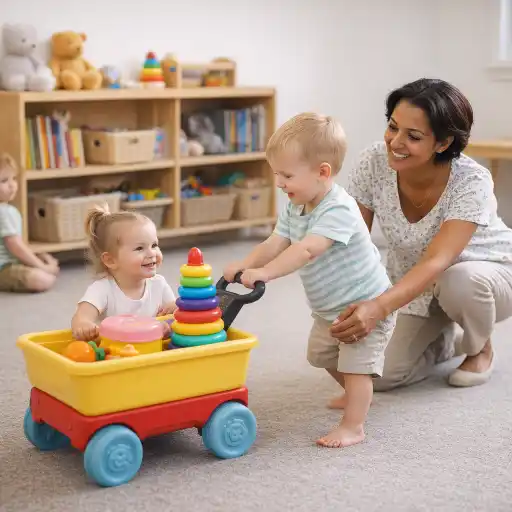
Transporting play is a repeated interest in moving objects or oneself from one place to another. A toddler may fill a basket with blocks, push a cart from the block area to dramatic play, or carry toys back and forth along the same route. The pattern can be easy to interpret as mess-making, especially when a carefully arranged center is emptied in minutes. Yet the repetition may be meaningful: children are investigating movement, distance, location, volume, object permanence, and how materials relate to one another.
As children carry, load, unload, and reorganize objects, they practice coordination and make decisions. They may compare how many items fit in a container, notice what happens when it is full, or plan a route through the room. Such play also creates opportunities for communication and social learning—children may negotiate over a cart, recruit a friend to help, or explain where their “delivery” is going.
Recognizing the possible learning behind the behavior can shift adult responses from repeated correction to thoughtful guidance. It does not mean every material should travel anywhere. It means looking for a safe, predictable way to make room for children’s inquiry while protecting shared resources and other children’s play.
How can you observe the pattern before changing the room?
Start by noticing what the child moves, where the objects go, what tools are used, and how the play changes over time. A brief, factual note can help distinguish a recurring interest from a one-time exploration. Record actions and words rather than labels: “Mila filled a basket with four blocks, carried it to the rug, emptied it, and returned for more” offers useful evidence; “Mila is disruptive” does not.
Look for the child’s intention and for the classroom conditions that shape the play. Is the child drawn to containers, wheels, pathways, or collecting? Does the activity become unsafe when the route is crowded? Are materials from one center needed by children who are using them for another purpose? These questions allow educators to protect the group’s needs without dismissing the child’s interest.
- Notice repeated actions, preferred objects, destinations, and routes.
- Consider what skills or ideas the child may be exploring, without treating one observation as a diagnosis.
- Check whether the environment offers a clear, safe place for carrying and unloading.
- Invite family perspectives when a child’s interests, home experiences, or familiar objects may inform planning.
Observation is not a demand to document every movement. A few well-chosen examples can guide a next step and make it easier for the team to respond consistently.
How can you make transporting play safer and more manageable?
Plan for movement rather than relying on repeated reminders after materials have spread across the room. Define a transport-friendly area or route with clear boundaries, a stable surface, and enough space for children to move without blocking exits or interrupting quieter play. Keep the arrangement visible to supervising adults and avoid placing items where they create trip hazards.
Offer sturdy, age-appropriate tools that fit the children’s abilities: large baskets, lightweight containers, push carts, or boxes with no sharp edges. Choose objects with close attention to age, mouthing behavior, and choking risk. Inspect materials regularly, remove damaged items, and follow cleaning and sanitation procedures. For mixed-age groups, a resource that is appropriate for older toddlers may not be safe for a younger child.
- Set a simple boundary: “You can carry these blocks to the marked rug; books stay in the library.”
- Limit how much travels at once by offering a small basket or one cart.
- Keep heavy, fragile, or center-specific materials out of the transport collection.
- Stay close enough to supervise and adjust the setup as children’s movement and play evolve.
- 🧺 Make returning materials part of the play routine, using picture labels or familiar storage spots.
Active supervision and clear expectations help preserve children’s agency while reducing foreseeable risks. State requirements vary - check your state licensing agency, and follow program policies for material safety and supervision.
What materials and boundaries preserve the learning center?
Children’s interest can be supported without making every classroom resource available for relocation. Create a designated “delivery” collection: a few large, durable objects, containers, and perhaps a cart or wagon suitable for the space. This gives children a legitimate outlet while keeping essential materials—such as books, puzzles, or specialized sensory items—available in their home areas.
Boundaries work best when they are concrete, consistent, and connected to the purpose of the materials. Instead of “Don’t take things,” try, “The blocks can travel to the rug; the puzzles stay on this table.” Explain the limit briefly, then show the child what they can do. A small sign, floor marker, picture label, or defined route can make the expectation easier to understand, especially for children still developing language.
Consider the needs of the whole group. If children are repeatedly taking materials that peers are using, add duplicate items where practical, provide turn-taking support, or offer a separate transport set. Ask staff to use the same language so children receive predictable guidance. The aim is not a perfectly untouched center; it is an environment where children can explore while other play remains possible.
Keep familiar materials in place long enough for children to develop ideas. Change the collection gradually, based on observation, rather than removing everything after a busy session. A carefully chosen boundary can reduce conflict and help children learn that materials have both a purpose and a place.
How can you extend learning without taking over?
Once you have prepared a safe opportunity, follow the child’s lead. Observe before adding questions or new materials. Then offer language, a tool, or a small challenge that builds on what the child is already doing. The goal is to enrich the investigation, not redirect it toward an adult-designed product.
Use descriptive words that connect with the child’s actions: “You carried the full basket across the rug,” “The truck is going under the table,” or “You brought three blocks back.” For children who communicate through gestures, sounds, or movement, respond to those cues as meaningful contributions. Allow time for children to repeat an action; repetition may be how they test a possibility, not evidence that they need a new activity.
- Offer a path, a second container, or a large object to carry if the child seems ready for another possibility.
- Wonder aloud: “Where could this basket go next?” or “What might fit in this box?”
- Invite peer participation without requiring it: “Would you like help with your delivery?”
- Notice emerging ideas about full and empty, near and far, heavy and light, or inside and outside.
After play, use one short observation and one possible next step to guide planning. For example: “Several children moved blocks from the shelf to the rug. Tomorrow, offer two baskets and a clear pathway.” A simple observation-to-planning cycle helps keep the experience meaningful and manageable.
What common pitfalls should providers avoid?
A frequent pitfall is treating all movement of materials as misbehavior. Some actions may need an immediate safety limit, but a blanket prohibition can close off meaningful exploration. Conversely, interpreting every action as beneficial does not mean allowing materials to be thrown, used in unsafe ways, or taken from peers without support. The provider’s task is to recognize the play intention and guide its safe expression.
Another common challenge is setting a boundary that is too vague. “Be careful” or “Keep the room tidy” does not tell a toddler what to do. State what is allowed, show the expected route or destination, and repeat the same brief language. Avoid changing the rule from adult to adult; inconsistent limits can make the room harder for children to navigate.
Finally, avoid overloading the area with too many transport props or rotating materials so quickly that children cannot return to their ideas. Begin with a small selection, observe what engages children, and adjust. Do not use tiny loose parts with children who may mouth them, and do not let supervision be compromised while staff focus on cleanup.
- Instead of stopping all carrying, identify which materials can move and where they can go.
- Instead of assuming a child’s motive, gather observations across time and contexts.
- Instead of making cleanup a punishment, teach a brief, predictable return routine.
These adjustments validate children’s curiosity while making the classroom more workable for educators and peers.
Conclusion: How can you support transporting play and protect the center?
When children repeatedly empty a learning center to carry materials elsewhere, respond with curiosity and a plan. Observe what they are exploring, create a safe and defined opportunity to transport selected materials, and use specific boundaries to protect resources that need to stay in place. Support the play with responsive language and a simple cleanup routine, then use what you noticed to plan the next invitation.
Transporting play does not require giving up classroom organization. With thoughtful observation, age-appropriate materials, active supervision, and consistent expectations, providers can honor children’s interests while maintaining a safe, usable learning environment. The practical goal is a room where children can move, investigate, and return to play—and where educators have a clear strategy for making that possible.
For further professional learning, explore these English-language ChildCareEd courses:
- Baby Play: Planning Infant and Toddler Activities Buy Now $16.00
- Playful Spaces for Infants & Toddlers Buy Now $24.00
- Meaningful Lesson Planning for Infants/Toddlers Buy Now $24.00
- Observing & Assessing in Child Care Buy Now $16.00
- Playing with a Purpose: Infant/Toddler Lesson Planning Buy Now $24.00
Additional references: open-ended toddler activities; observations and activity planning; Head Start guidance on infant and toddler learning environments; transporting schema examples; the transporting schema in play-based classrooms.
- CDA Certification en Español: Recursos y Consejos para Educadores Bilingües
- 💛🧩 ¿Cómo puedo hacer que mi enseñanza sea inclusiva para los niños con autismo?
- 😫🧸 ¿Qué hacer cuando un bebé no quiere dormir la siesta en el aula?
- Recursos en Español sobre el Sueño Seguro del Bebé
- 10 Ejemplos de Cómo la Cultura Influye en el Desarrollo Infantil
- Cómo Iniciar el Proceso de Obtención de la Licencia de Cuidado Infantil
- Regulaciones de Cuidado Infantil en Maryland para Centros y Hogares de Cuidado Infantil Familiar
- Proporciones de Cuidado Infantil y Tamaños de Grupo por Edad en Virginia (Guía Rápida para Centros y Hogares)
- ¿Cuál es la Diferencia Entre la Crianza Respetuosa y la Crianza Permisiva?
- Actividades de Otoño Fáciles para Preescolares esta Temporada
- Cómo Trabajar en el Cuidado Infantil en Wisconsin: Requisitos y Pasos
- Capacitación Previa al Servicio para Proveedores de Cuidado Infantil en Illinois
- Capacitación CDA gratuita en Illinois
- Celebrando la amistad en el cuidado infantil durante el Día de los Mejores Amigos
- Canciones, juegos y preguntas de círculo para niños
- Cómo simplificar la capacitación para sus empleados de daycare
- Why Do Children Repeat the Same Actions? Understanding Play Schemas and the 'Why' Behind Repetitive Play
- Why Do Children Repeat the Same Play—and Why Should Educators Let Them?
- Why Does a Toddler Need to Do It Again—and Again?
- How Can You Support Safe Transporting Play Without Losing Your Learning Center?
