Children often reveal their deepest thinking when adults pause, watch, and resist the urge to take over. Learning to observe without interrupting protects children’s concentration while giving providers meaningful evidence for responsive planning; the Observing & Assessing in Child Care  Buy Now $16.00 course can strengthen these skills and help you document development more confidently. For a broader professional foundation, explore Tracking Progress, Shaping Futures: Observation & Assessment Skills Buy Now $55.00, which focuses on objective documentation and using assessment information to individualize learning.
Why does uninterrupted observation matter?
Play is not a break from learning; it is one of the primary ways young children investigate ideas, practice relationships, regulate emotions, and communicate meaning. When an adult interrupts a child who is building, pretending, experimenting, or negotiating, the child may lose the thread of the experience just as important thinking is beginning. Uninterrupted play gives children time to encounter difficulty, revise their strategies, and remain engaged long enough for play to become complex.
This matters for providers because observation is most useful when it reflects children’s natural behavior. NAEYC describes observation and documentation as essential processes for planning, implementing, and evaluating learning experiences. Similarly, research on uninterrupted play emphasizes that the adult remains attentive and available; the role simply shifts from director to thoughtful observer.
Protecting play also supports children’s agency. A child who experiences adults as respectful witnesses is more likely to take risks, persist, and communicate ideas. The goal is not to become invisible at the expense of supervision, but to become a calm, responsive presence who intervenes when safety, inclusion, or meaningful support requires it.
How can you prepare to observe without taking over?
Begin with a clear purpose. You do not need to document everything a child does. Choose one child, a small group, or one area of development, and identify what you want to understand. You might focus on language during dramatic play, persistence during construction, peer negotiation outdoors, or fine-motor coordination at the sensory table.
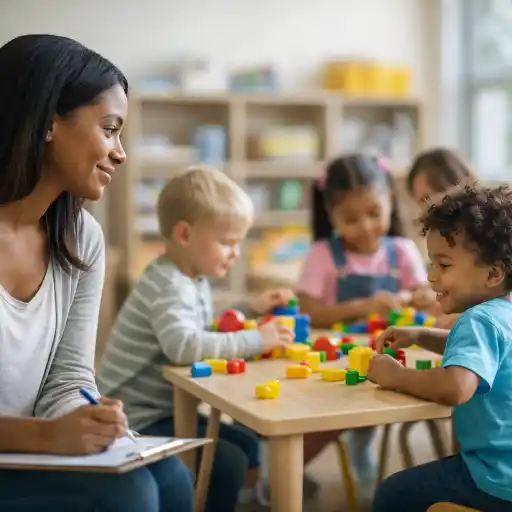
Prepare materials before play begins so note-taking does not pull you away from supervision. A small notebook, clipboard, or Quick Notes Observation Pad for Childcare Providers can make brief documentation practical. Keep your writing tool accessible, but position yourself where you can scan the entire environment and respond quickly if a safety concern arises.
- Choose a vantage point that allows broad supervision without hovering.
- Record the date, time, setting, materials, and children involved.
- Decide whether a brief jotting, anecdotal note, photograph, or work sample best fits your purpose.
- Review family permissions and program policies before taking photos or recordings.
- ☕ Schedule reflection time later so documentation does not dominate the play period.
State requirements vary - check your state licensing agency. Observation systems should support, not replace, active supervision and required staff-to-child ratios.
What should you write while children are playing?
Write what you can see and hear before writing what you think it means. Objective notes use concrete descriptions and, when possible, exact child language. For example: “Maya placed two large blocks side by side, added a narrow block across the top, watched it fall, and said, ‘It needs a strong bottom.’ She selected four smaller blocks and tried again.” This note provides evidence of planning, problem-solving, spatial reasoning, and language without labeling Maya as “advanced” or “frustrated.”
Short notes are often enough to preserve an important moment. A useful format is:
- Context: Where and when did the play occur?
- Action: What did the child do?
- Language: What did the child say?
- Interaction: How did peers or adults respond?
- Next possibility: What might you offer or observe later?
Quick notes should remain strengths-based and culturally responsive. Avoid assumptions about motivation, family life, ability, or behavior. NAEYC recommends using multiple sources and considering children’s language, culture, experiences, and familiar contexts. A single observation is a snapshot, not a diagnosis or a complete developmental judgment.
Use abbreviations that your team understands, but avoid shorthand that makes the note unclear later. The purpose of efficient documentation is to preserve evidence that can guide reflection, not to create an impressive volume of paperwork.
When should you stay back, and when should you intervene?
A helpful question is: “Is my involvement necessary right now?” If children are safe, engaged, and working through a manageable challenge, pause. Silence can be an intentional teaching strategy. Give children time to look, try, disagree, revise, and try again before offering a solution.
Intervene promptly when there is imminent danger, repeated exclusion, escalating harm, or a child’s need for communication or emotional support. Intervention does not require taking control. Move from least intrusive to more active support:
- Observe and wait briefly.
- Position yourself closer without speaking.
- Use a neutral acknowledgment, such as “You both want the blue truck.”
- Ask an open-ended question: “How could you make space for both ideas?”
- Offer a specific scaffold or model only when children need it.
When extending play, preserve children’s ownership. Instead of saying, “Put the big block on the bottom,” try, “What could help the tower stay steady?” Instead of correcting pretend play, add language or a nearby tool that deepens the investigation. NAEYC examples show how thoughtful questions and hints can support problem-solving without imposing an adult solution.
Remember that some children communicate through gesture, movement, home language, or quiet participation. Observation should include these forms of expression rather than privileging verbal answers or adult-style engagement.
How can observations become better teaching decisions?
Observation becomes assessment when you interpret evidence carefully and use it to plan. After play, review your notes and ask what the child demonstrated, what conditions supported engagement, and what might invite the next step. NAEYC recommends using observations to adjust teaching strategies and design learning experiences rather than collecting records without action.
Suppose you notice that Leo repeatedly designs roads with blocks, counts vehicles, and explains routes to peers. You might add maps, clipboards, signs, measuring tools, and books about transportation. You could plan opportunities for Leo to dictate a route, compare lengths, or collaborate with a peer. The observation does not turn play into a lesson; it helps you enrich an environment connected to the child’s interests.
Use several observations across contexts and times. A child may speak confidently with a familiar peer but use fewer words in a large group. Another may demonstrate mathematical thinking through construction without explaining it verbally. Multiple observations reduce the risk of making decisions from one unusual day.
Reflection can be organized around three questions:
- What learning, strength, interest, or need is visible?
- What contextual factors may have influenced the observation?
- What small change will I make, and what evidence will I look for next?
Share meaningful observations with families respectfully and protect confidentiality. Documentation should support partnership, not surveillance. Store notes securely and follow program policies for photographs, digital records, and information sharing.
What common mistakes can you avoid?
Even experienced providers can feel pressure to prove that learning is happening. That pressure may lead to over-questioning, interrupting, or documenting so intensely that supervision suffers. A few practical safeguards help.
- Do not confuse quiet with disengagement. Watch for concentration, planning, and nonverbal participation.
- Do not ask a question after every action. Let children’s ideas develop before adding language.
- Do not write interpretations as facts. Replace “Sam was being defiant” with observable details about what Sam did and said.
- Do not document only problems. Record competence, joy, persistence, relationships, and emerging skills.
- Do not sacrifice supervision for paperwork. Use brief notes, divide observation responsibilities, and complete detailed records when coverage allows.
- Do not treat one note as a conclusion. Look for patterns across people, settings, languages, and routines.
Another common mistake is assuming that uninterrupted play means adults never speak. Children may invite adults into play, request help, or need support with safety and belonging. Respond warmly, then return decision-making to the children whenever possible. The aim is responsive restraint, not emotional distance.
Conclusion: How can you observe without interrupting play?
Observe without interrupting by preparing thoughtfully, choosing a focused purpose, positioning yourself for active supervision, recording concise objective notes, and waiting before intervening. Protect children’s sustained engagement while remaining ready to support safety, inclusion, communication, and emotional regulation.
The strongest observation practice follows a cycle: watch, document, reflect, plan, and watch again. A Quick Notes Observation Pad can make the first step manageable, while targeted professional learning can deepen your judgment about assessment, bias, documentation, and responsive teaching. When adults respect children’s play as meaningful work, they gain better evidence and children gain the time, agency, and confidence to pursue their ideas.
- Birth to Five CDA Credential with Portfolio Review
- Pediatric Blended First Aid & CPR/AED Adult, Child, Infant
- Pediatric RSV First Aid & CPR/AED
- Pediatric In-Person First Aid & CPR/AED Adult, Child, Infant
- CDA Bridge Bundle: Family Child Care without Portfolio Review
- CDA Bridge Bundle: Infant/Toddler without Portfolio Review
- CDA Bridge Bundle: Preschool without Portfolio Review
- Emergent Learning & Development
- Creating Environments that Nurture Growth and Community
- Texas Director Credential
- 10 Ejemplos de Cómo la Cultura Influye en el Desarrollo Infantil
- Celebrando la amistad en el cuidado infantil durante el Día de los Mejores Amigos
- Canciones, juegos y preguntas de círculo para niños
- How Can Child Care Providers Support Healthy Child Growth and Development?
- How Can Child Care Providers Support Learning Through Play?
- How Can Child Care Providers Use Learning Styles Responsibly in Early Childhood Classrooms?
- How Can Child Care Providers Use Sensory Play to Support Young Children’s Development?
- How Can Child Care Providers Help Children Join Play Without Taking Over?
- How Can Task Cards Turn Free Play Into Purposeful Learning?
- How Can Child Care Providers Create Print-Rich Early Childhood Environments?
- How Can Teachers Build Early Literacy Without Screens or Worksheets?
- How Can You Observe Children Without Interrupting Their Play?
- How Can Child Care Providers Teach Children to Join Play Without Grabbing or Interrupting?
- How Can Listening and Movement Games Build Children’s Shape Recognition?
- How Can You Observe Children Without Interrupting Their Play?
- How Can Child Care Programs Protect Preschool Playtime When the Schedule Gets Crowded?
- When One Child Always Chooses the Same Pretend Play Role, What Should Educators Do?
- How Can Adult Standing Positions Accidentally Block Children’s Play?
- How Can You Support Safe Transporting Play Without Losing Your Learning Center?
- How Can Teachers Turn Everyday Play Into Learning Opportunities?
