A child hovering near a busy play area may need a bridge—not an adult to take control. The Supporting Social Learning: Creating Classrooms that Care Buy Now $35.00 course offers deeper strategies for building relationships, supporting peer problem-solving, and creating classrooms where children can participate with confidence. For a ready-to-use classroom tool, explore the Joining Play Social-Skills Story and Prompt Cards to help children practice what to say and do before real play moments arise.
Why does helping children join play matter?
Joining an established play episode is a sophisticated social task. A child must observe what peers are doing, interpret the activity’s rules, decide whether there is space for another participant, communicate an idea, and cope with whatever response follows. When providers treat this as a teachable skill rather than expecting children to “just join,” they create more equitable opportunities for connection.
Peer play gives children repeated practice with language, negotiation, flexibility, emotional regulation, and perspective-taking. The Hanen Centre notes that even typically developing children are not successful when entering peer play every time; persistence and trying another approach are part of the learning process. Children who have language, social-communication, sensory, or confidence-related differences may need more intentional support and more accessible ways to participate.
Play also remains children’s work and meaning-making. NAEYC describes playful learning as a spectrum that includes child-directed play, guided play, and structured games. Effective adult support preserves children’s agency while adding just enough structure to make participation possible.
- Notice when a child is watching, approaching, or communicating interest.
- Teach a small, repeatable joining routine.
- Offer roles, materials, visuals, or gestures that create an entry point.
- Support peers in making realistic space rather than requiring unlimited sharing.
How can educators observe before stepping in?
Observation protects against two common errors: interrupting too soon and assuming that a child’s behavior means disinterest. Pause and study the play episode before approaching. Ask yourself what the group is doing, how roles are organized, whether the activity has an open-ended role, and what the child near the group may already understand.
Look for evidence rather than labels. A child may be quietly studying the sequence of a game, waiting for a natural pause, or communicating through body orientation rather than speech. Another child may be ready to join but unsure how to enter without disrupting the group. Brief notes or a photo can help the team identify patterns over time.
Useful observation questions include:
- What activity or peer seems to attract the child?
- Does the child approach, imitate, offer materials, or remain nearby?
- What communication mode does the child prefer—words, gesture, sign, drawing, or a device?
- What happens immediately before the child leaves or becomes upset?
- Could the environment, group size, noise level, or materials be creating a barrier?
After observing, choose one small support. You might quietly offer a script, place an extra prop nearby, or ask a peer whether a helper role is available. Then step back. The goal is to make entry more possible, not to become the director of the interaction.
What steps can children use to join an ongoing play episode?
Children benefit from a predictable sequence that reduces the cognitive and emotional load of joining. Introduce the sequence during calm group times with puppets, photographs, or the Joining Play Social-Skills Story and Prompt Cards. Keep the language concrete and allow children to demonstrate each step in multiple ways.
- Look: Observe what the group is doing.
- Move closer: Walk or position yourself where you can see and hear.
- Listen and wait: Watch for a pause, role, or material that could support entry.
- Use a joining idea: Ask, “Can I play?” or offer a specific contribution such as, “Can I add this track?”
- Try another option: If the group is not ready, ask for a role, play beside the group, try again later, or choose another activity.
Short scripts are easier to remember than lengthy explanations:
- “Can I play?”
- “What are you making?”
- “Can I be the driver?”
- “Can I build next to you?”
- “Can I have a turn when you’re finished?”
Children should not be required to use spoken language. Pointing to a picture card, handing over a prop, using sign language, or communicating through assistive technology can all be legitimate joining strategies. Specific feedback should describe the effort: “You watched first and found a way to ask for a role.”
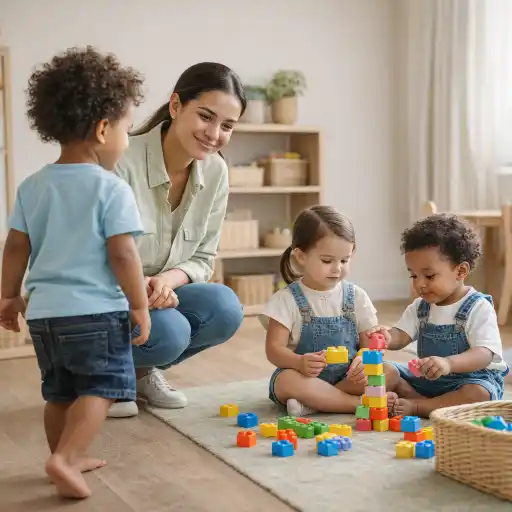
How can adults prompt without taking over?
Adult prompting works best when it is brief, responsive, and progressively less intrusive. Begin with the least support necessary. A glance toward the visual card or a quiet reminder may be enough. If the child needs more help, model one phrase or offer two realistic choices. Avoid speaking for the child when they can communicate independently.
Use a gradual prompt sequence:
- Pause and allow processing time.
- Point to the joining-play visual.
- Offer a short verbal cue: “Watch, then ask.”
- Model one possible phrase.
- Provide a role or material only when needed.
- Fade the prompt as soon as the child begins participating.
Guided play should preserve children’s ownership. Instead of rearranging the entire block structure, say, “I see two builders. Is there a job for a bridge tester?” Instead of telling peers exactly what to do, ask, “How could we make room while keeping your game going?” This approach aligns with the broader principle of extending play without replacing the child’s idea, as described in responsive play support.
Wait time is especially important for multilingual children, children with language delays, and children who process sensory or social information slowly. Accept home-language communication, gestures, imitation, and observation as meaningful participation. An adult’s restraint can be as powerful as an adult’s prompt.
How can classroom design and peer support make joining easier?
Environment and peer culture determine whether joining is realistic. Distinct, well-organized play areas help children understand what is happening and where to enter. The Hanen Centre recommends defined play spaces, intentional peer groupings, and meaningful roles for children who are often isolated. These supports reduce ambiguity without forcing interaction.
Consider the following design choices:
- 🧩 Keep popular centers spacious enough for a new participant and provide duplicate or complementary materials.
- Use picture labels, role cards, visual scripts, and timers.
- Begin with pairs or groups of three before expecting participation in a large group.
- Offer cooperative activities with authentic roles, such as cashier, builder, animal caregiver, or delivery helper.
- Protect uninterrupted play periods so children have time to observe, enter, and sustain interaction.
- Provide quieter areas for children who are overwhelmed by crowding or noise.
Peers also need direct teaching. Inclusion does not mean that children must surrender a toy or abandon an existing story. It can mean creating a manageable role: “You can be the customer,” “You can build beside us,” or “You can have the next turn when the timer rings.” Praise children who make space specifically: “You showed Eli where the animals go. That helped him join the story.”
Rotate helper roles so one child is not permanently positioned as the child who needs assistance. Use cooperative jobs—passing materials, watering plants, or collecting outdoor equipment—to create low-pressure relationships across the day.
How can providers avoid common mistakes and plan follow-up?
Well-intended intervention can unintentionally increase pressure. Avoid pushing a child into a group, publicly identifying them as needing help, or directing every move after entry. Joining should be supported as a process with many valid outcomes, including watching, playing beside others, contributing one material, or returning later.
- Forcing participation: Offer choices such as watching, helping, or trying one part.
- Over-questioning: Balance questions with descriptions and quiet observation.
- Taking over the play: Provide one prompt, then let children decide what happens next.
- Expecting spoken language: Accept visuals, gestures, home languages, sign, and communication devices.
- Ignoring repeated exclusion: Examine group dynamics, environment, accessibility, and peer teaching.
- Measuring only success: Track approaches, attempts, persistence, time engaged, and reduced adult prompting.
Use an observe–plan–prompt–reflect cycle. Record the activity, the child’s attempted entry, the support offered, the peer response, and the next reasonable step. Share strengths-based observations with families and invite their knowledge about preferred scripts, cultural expectations, communication styles, and successful play partners. State requirements vary - check your state licensing agency when changing supervision plans, groupings, schedules, or documentation procedures.
For deeper professional learning, the From Play to Planning: Building Culturally Competent, Child-Centered Curriculum  Buy Now $55.00 course can help providers connect observation, scaffolding, inclusion, and child-centered planning. The Language Development in Early Childhood Buy Now $16.00 course is another relevant option for strengthening language-rich interactions that support peer participation.
Conclusion: How can providers help children join play without taking over?
Children join play more successfully when adults make the social process visible, create accessible entry points, and protect children’s ownership of their ideas. Observe first, teach a short sequence, use visuals and scripts, support peers in making realistic space, and fade prompts as children gain confidence.
The central goal is not perfect social performance. It is growing participation: a child who watches with purpose, approaches safely, communicates an idea, persists after a first attempt, or remains engaged a little longer is developing. With consistent practice and responsive relationships, everyday play becomes a meaningful setting for #belonging, #communication, #inclusion, #agency, and #friendship.
Five courses to deepen classroom practice
- Supporting Social Learning: Creating Classrooms that Care Buy Now $35.00 — community building, relationships, dialogue, and problem-solving.
- The Best Promotion is Play Buy Now $35.00 — play environments that foster cooperation and social development.
- From Play to Planning: Building Culturally Competent, Child-Centered Curriculum Buy Now $55.00 — observation, scaffolding, inclusion, and planning.
- Language Development in Early Childhood Buy Now $16.00 — communication strategies that strengthen peer interaction.
- Social Foundations and Responsive Classrooms Buy Now $24.00 — positive guidance, social competence, and conflict resolution.
- CDA Bridge Bundle: Preschool
- Pediatric RSV First Aid & CPR/AED
- CDA Bridge Bundle: Family Child Care
- CDA Bridge Bundle: Family Child Care without Portfolio Review
- CDA Bridge Bundle: Infant/Toddler without Portfolio Review
- CDA Bridge Bundle: Preschool without Portfolio Review
- CDA Bridge Bundle: Infant/Toddler
- Texas Director Credential
- Access for All: Inclusion and the ADA
- Montessori Cultural Activities: Exploring the World Through Play and Learning
- CDA Certification en Español: Recursos y Consejos para Educadores Bilingües
- 10 Ejemplos de Cómo la Cultura Influye en el Desarrollo Infantil
- Proporciones de Cuidado Infantil y Tamaños de Grupo por Edad en Maryland (Guía Rápida para Centros y Hogares)
- Proporciones de Cuidado Infantil y Tamaños de Grupo por Edad en Virginia (Guía Rápida para Centros y Hogares)
- Cómo Trabajar en el Cuidado Infantil en Carolina del Norte: Requisitos y Pasos
- Celebrando la amistad en el cuidado infantil durante el Día de los Mejores Amigos
- Canciones, juegos y preguntas de círculo para niños
- How can we use play-based learning in preschool?
- What Does Bluey Get Right About Play and Parenting?
- How Can Child Care Providers Help Children Join Play Without Taking Over?
- How Can Child Care Providers Teach Children to Join Play Without Grabbing or Interrupting?
- How Can Child Care Providers Support Children Who Watch an Activity but Are Not Ready to Participate?
- Why Does a Toddler Need to Do It Again—and Again?
- How Can You Help an Autistic Preschooler Join a Group Game on Their Own Terms?
- Why Does a Child Become the Rule Keeper When an Adult Joins Play?
- What Is the Difference Between Parallel Play and Cooperative Play?
- How Can You Welcome a New Child After the Class Has Already Bonded?
- What Are the Best Ways to Support Cooperative Play in Preschool?
- What Are the Best Ways to Support Cooperative Play in Preschool?
- How Can Child Care Providers Encourage More Meaningful Conversations During Play?
