Every child develops through a distinctive combination of biology, relationships, culture, and experience—but educators still need practical ways to recognize progress and respond thoughtfully. For a comprehensive foundation, explore ChildCareEd’s The Science of Growing Up: Typical and Atypical Development  Buy Now $55.00, which can strengthen your understanding of milestones, developmental differences, and responsive practice while supporting professional learning goals.
Why does child growth and development matter in early care?
Child growth and development describe the changes children experience in their bodies, thinking, communication, relationships, emotions, and approaches to learning. These areas are interconnected rather than isolated. A child who gains mobility may explore more actively; expanded exploration can stimulate cognition, language, and social interaction. Similarly, responsive relationships support communication and self-regulation, while physical wellness supports children’s capacity to participate in play and learning.
NAEYC emphasizes that development is dynamic and reflects the interaction between biological characteristics and the environment. This perspective is especially valuable for providers because it replaces a one-size-fits-all model with intentional responsiveness. Children who experience adversity may benefit substantially from consistent, caring relationships in early learning settings, and high-quality care can contribute to resilience.
Understanding development helps professionals:
- Plan experiences that are appropriately challenging without being frustrating.
- Recognize individual strengths, interests, and support needs.
- Communicate with families using specific, respectful observations.
- Notice persistent concerns early and connect families with appropriate resources.
Developmental knowledge is not a tool for labeling children. It is a foundation for #responsive care, equitable participation, and meaningful relationships.
What developmental domains should providers observe?
Although domains overlap, organizing observations into broad categories helps teams notice the whole child. Physical development includes gross-motor skills such as crawling, running, and balancing, as well as fine-motor abilities such as grasping, drawing, and manipulating objects. Cognitive development includes attention, memory, reasoning, problem solving, early mathematics, and curiosity. Language and communication encompass gestures, receptive language, expressive language, emergent literacy, and bilingual or multilingual development. Social-emotional development includes attachment, emotional expression, self-regulation, empathy, and relationships with peers and adults.
The CDC describes milestones as skills most children demonstrate in how they play, learn, speak, act, and move. Its age-based checklists can help educators and families identify what to look for, but milestones are guides rather than rigid deadlines. Children develop unevenly, and context matters: culture, language, disability, temperament, health, and opportunity all influence how skills appear.
Providers can create a simple observation system:
- Physical: document movement, coordination, stamina, and self-help attempts.
- Cognitive: record persistence, strategies, classification, prediction, and problem solving.
- Language: note communication across all languages and contexts.
- Social-emotional: observe relationships, emotional regulation, and conflict resolution.
Do not interpret limited English production as limited thinking. Partner with families and qualified interpreters when needed so assessment reflects the child’s full linguistic repertoire.
How can play and relationships promote development?
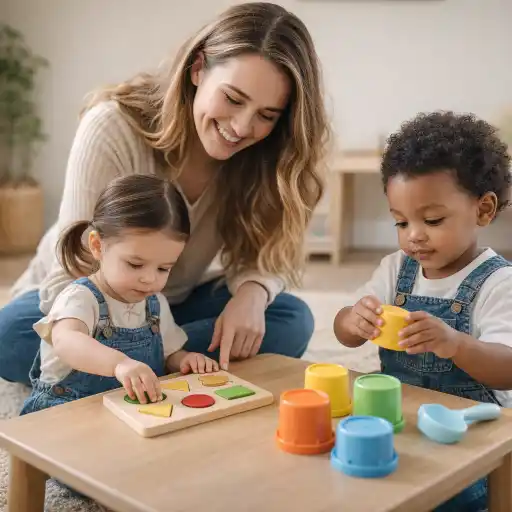
Play is a central context for development because it combines choice, active engagement, imagination, communication, movement, and problem solving. NAEYC identifies play as essential from birth through age eight, while Harvard’s Center on the Developing Child explains that playful interactions can strengthen executive-function skills such as attention, working memory, and self-control.
Adults support play most effectively when they balance participation with respectful restraint. Follow children’s interests, add language, model a strategy, or pose a thoughtful question without taking control of the experience. For example, during block play, an educator might say, “Your bridge is holding three cars. What could make it stronger?” This preserves the child’s agency while extending vocabulary, reasoning, and persistence.
Responsive relationships are equally important. Serve-and-return exchanges—responding to a child’s gaze, vocalization, gesture, or emotion—help children experience communication as meaningful. Predictable routines also reduce uncertainty and make it easier for children to engage.
- Offer daily indoor and outdoor opportunities for sustained play.
- Provide open-ended materials such as blocks, dramatic-play props, art supplies, and loose parts.
- Use songs, stories, gestures, and conversation throughout routines.
- Model emotional language: “You are disappointed because the tower fell.”
- Adapt materials and spaces so children with disabilities can participate meaningfully.
- 🌟 Protect uninterrupted play time instead of replacing it with excessive worksheets or adult-directed tasks.
When relationships and play are intentional, ordinary moments become powerful opportunities for #learning and growth.
How should educators observe, document, and assess children?
Observation is strongest when it is ongoing, purposeful, and connected to curriculum decisions. NAEYC recommends combining formal and informal methods while ensuring that assessment is developmentally, culturally, and linguistically responsive. A single snapshot rarely represents a child’s abilities; children may demonstrate knowledge differently depending on the setting, relationship, materials, or language being used.
Effective documentation describes what happened without judgment. Instead of writing “Jordan is behind in language,” record: “During outdoor play on September 7, Jordan pointed to the tricycle and said, ‘go,’ then responded to the teacher’s question by nodding.” Specific notes allow educators to identify patterns and plan next steps.
A practical cycle includes:
- Observe: select a meaningful context and watch without interrupting unnecessarily.
- Record: include the date, setting, exact words or actions, and relevant conditions.
- Interpret cautiously: compare multiple observations with family perspectives and developmental guidance.
- Plan: adjust materials, interactions, grouping, or environmental supports.
- Review: document whether the strategy increased participation or skill development.
Screening identifies children who may need closer evaluation; it does not diagnose or label. If a child is missing several expected skills, loses skills previously acquired, or prompts ongoing concern, share factual observations with the family and encourage consultation with the child’s health care provider. State requirements vary - check your state licensing agency.
How can programs build strong partnerships with families?
Families possess essential knowledge about children’s history, abilities, languages, interests, health, and routines. A respectful partnership treats families as collaborators rather than recipients of professional judgments. Begin conversations with strengths and concrete examples: “Amaya persisted with the puzzle for eight minutes today and invited a peer to help.” Then ask what the family notices at home and whether the behavior occurs in other settings. For ideas that can help programs build intergenerational connections, explore activities for celebrating National Grandparent’s Day with children and families.
Communication should be accessible and culturally responsive. Use the family’s preferred language, arrange interpretation when necessary, and avoid assumptions about parenting, independence, eye contact, play, or communication. A child’s home language is an asset that supports identity, relationships, and continued learning.
Directors can strengthen partnerships by establishing consistent systems:
- Share brief positive observations routinely, not only when concerns arise.
- Invite family goals into planning and assessment conferences.
- Offer simple activities that can be adapted to home routines.
- Explain the difference between monitoring, screening, evaluation, and diagnosis.
- Provide referrals without implying blame or certainty.
- Protect confidentiality and document communication appropriately.
When concerns arise, use a collaborative sequence: describe strengths, share patterns, listen carefully, identify a shared goal, and agree on a follow-up date. This approach honors families and makes early support more likely to feel constructive rather than alarming.
What common mistakes can providers avoid?
Even dedicated professionals can fall into habits that unintentionally limit children’s opportunities. The most common mistake is treating milestones as deadlines. Age-based guidance is useful for noticing patterns, but it should never be used to rank children or create anxiety. Another mistake is relying on one observation, especially when a child is tired, ill, unfamiliar with the adult, or communicating in a second language.
Additional pitfalls include confusing screening with diagnosis, documenting interpretations instead of observable behavior, and planning activities that focus narrowly on one domain. Whole-child planning is more effective: a cooking activity can support language, fine-motor coordination, social cooperation, early mathematics, and self-help skills simultaneously.
Use this quality-check before making a developmental decision:
- Have I observed the child across more than one day and context?
- Have I considered culture, language, disability, temperament, and opportunity?
- Did I describe behavior objectively rather than use labels?
- Have I invited the family’s perspective?
- Am I adapting the environment before assuming the child cannot participate?
- Have I followed program referral and confidentiality procedures?
Most importantly, do not wait for certainty before responding to a concern. Acting early can mean providing richer language opportunities, changing the environment, consulting a specialist, or helping a family access screening. Thoughtful action is not an accusation; it is an expression of #advocacy.
What should providers remember about supporting development?
Healthy child growth and development are supported through relationships, play, intentional environments, careful observation, and family collaboration. Providers do not need to predict a child’s exact developmental timeline. They need to notice carefully, respond warmly, plan thoughtfully, and seek additional guidance when patterns suggest that support may be beneficial.
Keep these takeaways visible for your team:
- Developmental domains are interconnected and should be supported together.
- Milestones are useful reference points, not rigid expectations.
- Play and responsive interaction build communication, self-regulation, thinking, and relationships.
- Documentation should be specific, ongoing, strengths-based, and culturally responsive.
- Screening is not diagnosis; persistent concerns warrant respectful follow-up.
- Families are essential partners in understanding and supporting every child.
Ultimately, the question is not whether every child develops in exactly the same way. The professional goal is to create conditions in which each child can participate, communicate, explore, and grow. Continued training—such as ChildCareEd’s 45 Hour Child Growth and Development Buy Now $399.00 course—can help providers deepen their knowledge and translate developmental principles into more intentional classroom practice. Check course details and confirm applicability with your state licensing agency before enrolling.
- 45 Hour Child Growth and Development
- CDA Home Visitor Subject Area 3 Part 3 Birth to 5
- Roots & Resilience: Understanding What Shapes a Child
- CDA Bridge Bundle: Family Child Care
- CDA Bridge Bundle: Family Child Care without Portfolio Review
- CDA Bridge Bundle: Infant/Toddler without Portfolio Review
- CDA Bridge Bundle: Preschool without Portfolio Review
- Texas Director Credential
- Engaging Families for Child Success
- Healthy Cooking for Picky Kids
- Empowering Early Childhood Education: NYAEYC
- Invest in Your Skills, Invest in Children: ChildCareEd Training for Michigan Providers
- The Family Day Care Chronicles: Tales of Laughter, Learning, and Unexpected Adventures
- CDA Certification en Español: Recursos y Consejos para Educadores Bilingües
- What Parents and Educators Need to Know About Child Safety
- 🔍 ¿Qué ves cuando observas a un niño aprender?
- Cómo usar tu certificación de 90 horas en Maryland para completar tu CDA
- ¿Cuáles son los pasos, requisitos y opciones en línea para la certificación de 90 horas en cuidado de Infantes/Toddlers en Maryland?
- Proporciones de Cuidado Infantil y Tamaños de Grupo por Edad en Maryland (Guía Rápida para Centros y Hogares)
- Proporciones de Cuidado Infantil y Tamaños de Grupo por Edad en Virginia (Guía Rápida para Centros y Hogares)
- Cómo Ser Maestra de Preescolar en Maryland
- How does the brain develop in early childhood?
- How Does the Brain Develop During the First Five Years?
- How can child care programs handle picky eaters without mealtime battles?
- How Do You Explain Ego to a Child Without Making It Sound Like a Bad Thing?
- What Makes a Great Home Daycare? 10 Things Parents Notice First
- How Can Child Care Providers Support Healthy Brain Development in Young Children?
- How Can Child Care Providers Support Healthy Child Growth and Development?
- Why Is Outdoor Play Essential for Healthy Child Development?
