When children build, pretend, move, and investigate, they are doing far more than staying busy—they are constructing knowledge. Strengthen your practice with Role of Play in Learning  Buy Now $16.00, a course that explores how play supports development and can help you earn training connected to CDA Subject Area 8 while improving everyday classroom decisions.
Why Does Learning Through Play Matter?
Learning through play recognizes that young children are active participants in their own development. Rather than treating play as a reward after “real” instruction, educators can use it as a meaningful context for language, mathematics, science, movement, creativity, and social-emotional growth. NAEYC describes playful learning as a continuum that includes child-directed play, guided play, and structured games. Each form can be valuable when it is responsive to children’s development and interests.
Play is especially powerful because it combines motivation with active thinking. Children test ideas, make choices, repeat actions, revise plans, and communicate with others. A toddler who fills and empties containers is exploring quantity and cause and effect. A preschooler who constructs a bridge is reasoning about balance, spatial relationships, and persistence. In dramatic play, children practice vocabulary, perspective-taking, negotiation, and emotional expression.
Research and professional guidance also emphasize that play supports the whole child. ChildCare.gov identifies structured and unstructured play as complementary experiences, while Harvard’s Center on the Developing Child connects playful interactions with executive-function skills such as attention, working memory, and self-control. These outcomes matter because they support participation in later learning and relationships.
For providers and directors, the central question is not whether play belongs in the curriculum. It is how the environment, schedule, adult interactions, and documentation can make learning visible without taking away children’s agency.
How Can Educators Balance Child-Led and Guided Play?
High-quality programs protect both child choice and intentional teaching. In child-led play, children decide what to explore, how to use materials, and when to change direction. Adults observe, remain emotionally available, and enter the play respectfully. This approach supports autonomy, imagination, and intrinsic motivation.
Guided play adds a learning intention while preserving meaningful choice. An educator might place photographs of bridges near the block area, add measuring tapes, or introduce words such as “support,” “longer,” and “stable.” Children remain active decision-makers, while the materials and adult prompts invite deeper investigation. NAEYC’s discussion of playful learning notes that guided play can support vocabulary and spatial learning when it is thoughtfully designed.
- Prepare: Identify one or two developmental or curricular goals.
- Invite: Offer open-ended materials connected to children’s interests.
- Observe: Notice children’s strategies, language, relationships, and persistence.
- Extend: Ask an open question, model a useful word, or add one new material.
- Release: Step back so children can continue directing the experience.
Common mistakes include interrupting too quickly, correcting every attempt, or turning imaginative play into a scripted lesson. Instead, use short interventions that expand possibilities. “What could make the tower stronger?” invites reasoning; “That is not how a tower is built” closes it down. Professional judgment is essential: some moments call for active support, while others require patient observation.
What Classroom Materials Invite Meaningful Play?
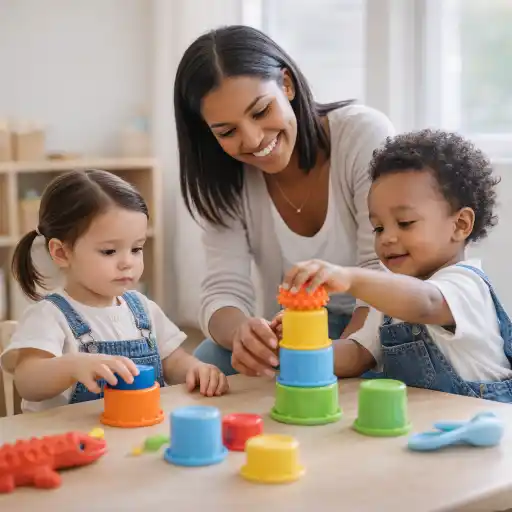
Materials communicate what children are expected to do. Single-purpose toys may offer brief entertainment, but open-ended materials can support sustained exploration and multiple forms of thinking. Blocks, cardboard, fabric, loose parts, containers, clay, art tools, books, puppets, and natural objects can become almost anything in children’s hands. For ideas on how a thoughtfully limited selection can encourage children to invent and sustain their own play, explore why fewer toys can mean more imagination.
The Virtual Lab School recommends selecting materials that are authentic, developmentally appropriate, connected to children’s interests, varied in possibility, and linked to learning goals. Authentic materials—such as menus, measuring cups, baskets, fabric, maps, or safe household tools—bridge children’s home and classroom experiences. Including family photographs, home-language labels, cultural artifacts, and dolls or figures representing diverse abilities can make the environment more relevant and welcoming.
- 🧱 Construction: Provide blocks, tubes, boxes, ramps, and clipboards for design and documentation.
- Dramatic play: Add role-specific props, blank paper, signs, telephones, and real-life tools.
- Investigation: Offer magnifiers, natural objects, water, sand, scales, and containers.
- Creative expression: Make paper, paint, clay, drawing tools, music materials, and recycled objects accessible.
- Language and literacy: Include story props, puppets, environmental print, and books connected to children’s play.
Rotate materials based on observation rather than a fixed calendar. If children are deeply engaged, add complexity without replacing the experience. If materials create frustration, simplify the choices, adjust the arrangement, or provide a model without requiring imitation. Safety remains nonnegotiable; state requirements vary—check your state licensing agency.
How Does Play Support Different Areas of Development?
Play rarely develops only one skill at a time. A pretend restaurant can involve oral language, counting, social negotiation, fine-motor coordination, cultural knowledge, and emotional expression. The provider’s role is to recognize these connections and plan environments that offer repeated opportunities for practice.
- Cognitive development: Building, sorting, predicting, and troubleshooting strengthen reasoning and flexible thinking.
- Language and literacy: Conversation, storytelling, signs, menus, labels, and songs expand vocabulary and communication.
- Social-emotional development: Collaborative play gives children practice with turn-taking, empathy, conflict resolution, and self-regulation.
- Physical development: Outdoor movement, climbing, carrying, manipulating tools, drawing, and molding materials build coordination and strength.
- Early mathematics and science: Measuring, comparing, counting, mapping, balancing, and testing cause and effect make abstract concepts tangible.
Active play deserves particular attention. Movement can help children refine coordination, connect with peers, solve problems, and return to learning with increased readiness. Singing, dancing, obstacle courses, transportation games, and outdoor investigations can be integrated into routines rather than reserved for a single “gross-motor” period.
Play also supports equity when educators provide multiple ways to participate. Adapt the size, texture, language, sensory intensity, and complexity of materials. Use visual supports, peer partnerships, assistive tools, and small-group options when appropriate. Children do not need to play in identical ways to experience meaningful learning.
How Can Directors and Providers Plan, Observe, and Assess Play?
Intentional planning does not mean scripting every minute. It means creating conditions in which learning is likely and using observation to decide what comes next. Begin with a concise plan: one learning intention, a few materials, possible adult language, and a method for recording evidence.
During play, document what children actually do rather than what adults expect them to do. Record exact words, strategies, interactions, and changes over time. A brief note might read: “Maya compared three tubes, said ‘this one is longer,’ and changed the ramp after the car stopped.” Such documentation provides evidence of mathematical language, comparison, problem-solving, and persistence.
- Choose one or two children to observe closely each day.
- Use photos, work samples, transcripts, or short anecdotal notes.
- Connect observations to developmental goals without forcing a single interpretation.
- Plan a next step: introduce vocabulary, adjust materials, invite collaboration, or offer a new challenge.
- Share specific examples with families and invite information about play at home.
Assessment through play should be responsive and culturally informed. Children may demonstrate knowledge through movement, home language, drawing, gesture, construction, or storytelling. Directors can support consistency by providing shared observation templates, protected planning time, and reflective team meetings. Avoid using play observations as labels or high-stakes judgments. Their greatest value is helping adults understand children more accurately and respond more effectively.
How Can Programs Avoid Common Pitfalls?
Programs sometimes struggle to implement play-based learning because of pressure to demonstrate academic progress, limited space, rushed schedules, or uncertainty about the adult role. These concerns are understandable. Play-based practice is not the absence of structure; it is a different form of intentionality that begins with children’s active participation.
Pitfall 1: Treating play as filler. Protect uninterrupted play blocks so children have time to develop complex ideas. Frequent transitions can prevent deep engagement.
Pitfall 2: Over-directing. Replace constant instructions with invitations, observations, and open-ended questions. Allow children to solve manageable problems before stepping in.
Pitfall 3: Equating expensive materials with quality. Thoughtfully selected recycled, natural, and household materials can be more flexible than highly specialized toys.
Pitfall 4: Ignoring culture and individual differences. Ask families about children’s interests, routines, languages, and play traditions. Do not assume that one theme or play style represents every child.
Pitfall 5: Confusing safety with unnecessary restriction. Conduct risk assessments, maintain active supervision, and teach safe use rather than eliminating every challenge. Children need opportunities to practice judgment within appropriate boundaries.
Directors can strengthen implementation by modeling reflective questions, scheduling collaborative planning, and recognizing educators’ observations as professional knowledge. Additional professional learning can help teams connect play with curriculum, inclusion, and assessment. Explore The Best Promotion is Play Buy Now $24.00, Early Mathematics Through Play Buy Now $24.00, and Play Safe, Think Big: Literacy Through Play for focused ideas that can be adapted to your setting.
Conclusion: What Does Effective Learning Through Play Look Like?
Effective learning through play is joyful, intentional, inclusive, and grounded in observation. Children receive meaningful time to choose, explore, repeat, collaborate, imagine, and revise their ideas. Adults prepare rich environments, connect play to developmental goals, ask thoughtful questions, and know when to guide and when to step back.
The goal is not to make every play moment look like a lesson. The goal is to create a classroom in which learning is visible because children are actively engaged in experiences that matter to them. When providers protect play and use professional knowledge to extend it, they support language, cognition, movement, relationships, creativity, and self-regulation together.
- Protect sustained periods of child-directed play.
- Use guided play to connect interests with intentional learning goals.
- Select open-ended, culturally responsive, developmentally appropriate materials.
- Observe specific behaviors and use evidence to plan next steps.
- Partner with families and reflect with colleagues.
Learning through play is therefore not a compromise between rigor and joy. It is a powerful way to make rigorous learning accessible, meaningful, and developmentally appropriate for every child.
- Beyond the Classroom: Connecting Families to Essential Services
- From Play to Planning: Building Culturally Competent, Child-Centered Curriculum
- The Best Promotion is Play
- Play, Learn, Grow
- Creating Engaging and Meaningful Learning Experiences
- Staff Supervision, Observation & Feedback
- Texas Director Credential
- Access for All: Inclusion and the ADA
- Families, Communities, and Classrooms: Working Together for Children
- CDA Certification en Español: Recursos y Consejos para Educadores Bilingües
- 🌟How Can Playtime Build Bright Minds? The Power of Learning Through Play in Early Childhood
- 10 Ejemplos de Cómo la Cultura Influye en el Desarrollo Infantil
- Proporciones de Cuidado Infantil y Tamaños de Grupo por Edad en Maryland (Guía Rápida para Centros y Hogares)
- Proporciones de Cuidado Infantil y Tamaños de Grupo por Edad en Virginia (Guía Rápida para Centros y Hogares)
- Actividades de Otoño Fáciles para Preescolares esta Temporada
- Canciones, juegos y preguntas de círculo para niños
- What Makes a Great Home Daycare? 10 Things Parents Notice First
- Is My Preschooler Ready for Kindergarten? Milestones Beyond ABCs and 123s
- How Can Child Care Providers Support Healthy Brain Development in Young Children?
- How Can Child Care Providers Nurture Critical Thinking in Young Children?
- How Can Child Care Programs Build Meaningful School Readiness?
- How Can Child Care Providers Support Healthy Toddler Development?
- How Can Child Care Providers Create Effective Learning Centers in Small Spaces?
- How Do Children Learn Through Play?
- How Can Providers Show Families the Learning Behind Play?
- How Can Child Care Providers Support Children Who Watch an Activity but Are Not Ready to Participate?
- What Should a 3-Year-Old Be Learning at Preschool?
- What Are the Social-Emotional Milestones From Birth to Age 5?
- How Can Child Care Providers Support Kindergarten Emotions on the First Day of School?
