Storytelling is a simple, powerful way to teach young children. In North Dakota classrooms, you can use stories to build strong relationships, grow vocabulary, and support early reading. Try small changes that fit your daily routine and your group. Use #storytelling in your #NorthDakota room to boost #language and #literacy for #children.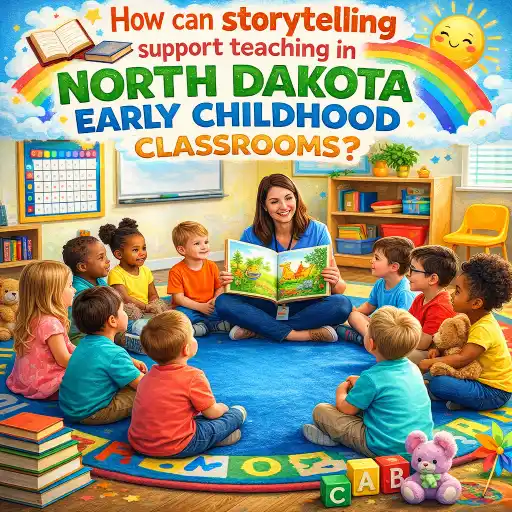
Why does storytelling matter in North Dakota early childhood classrooms?
Why it matters: Storytelling helps children learn words, remember events, and practice feelings. When you tell a story with feeling, children hear new words and ways to talk. Research and practical guides show reading aloud and storytelling support early learning and social skills. See ideas in How Can I Make Storytime the Most Powerful Part of My Day? and tips in Storytime Superpowers.
- Builds vocabulary and listening skills. Every read-aloud adds new words.
- Grows social–emotional learning. Books help children name feelings and practice empathy—see resources like Using Literature to Help Children Manage Strong Emotions.
- Supports school readiness. Story routines help kids handle transitions and follow directions; research on readiness supports habits of mind that carry into kindergarten (Parent Perspectives on Kindergarten Transition).
Keep short, predictable routines and make storytime a warm place for sharing. State requirements vary - check your state licensing agency.
How can I use storytelling to boost language and literacy for children?
Use stories with clear goals. Pick one focus like new words, sequencing, or predicting. Follow three talk moments: before, during, and after the book. For step-by-step ideas, ChildCareEd explains practical routines in How can storytelling be used as a teaching tool? and offers training in Reading Aloud and Storytelling  Buy Now $16.00.
- Before: Show the cover and ask one prediction question.
- During: Pause to point out pictures, repeat a key phrase, and use character voices.
- After: Ask children to retell main events or act them out.
Practical tips to boost learning:
- 👍 Use your voice as a tool—changes in pitch and pace help attention.
- 🎭 Add actions or simple gestures, so children move while they listen.
- 🧩 Ask open questions (prediction, feeling, connection) to build thinking.
- 📚 Repeat favorite books across days to deepen word learning and memory.
Track wins by counting participation and listening for new words during play. For assessment ideas, narrative and retell checks are useful; see research on narrative assessments (Narrative assessment methods).
What hands-on activities and materials work well in my classroom?
Hands-on props make stories come alive. Use simple, low-cost materials so every child can join. ChildCareEd offers free activity guides like the Montessori Story Basket Activity Buy Now $0.00 and printable kits such as Story Stones. These tools support sequencing, memory, and speaking.
- 🟠 Story Stones: Place picture stones in a bag. Children pull stones and tell the story in order.
- 🎒 Montessori Story Basket: Put 3–5 small objects that match a short tale; children retell using items (Montessori Story Basket Activity Buy Now $0.00).
- 🧸 Puppets and Felt Boards: Puppets invite quiet children to speak and act out feelings (CSEFEL has scripted stories and book guides at CSEFEL tools).
- 🎭 Drama & Role Play: Turning stories into short skits builds cooperation and imagination (see Dramatic Play ideas).
- 📱 Thoughtful Digital Use: If you use e-books, choose ones that invite interaction; pair them with talk and props (storytelling guide).
Rotate materials and keep a cozy reading nook. Include books and stories that reflect local Native cultures and family languages; resources on respectful Indigenous storytelling and library engagement can help plan culturally responsive choices (Native Stories, Native Peoples).
To support seasonal themes that build vocabulary and engagement, add carefully chosen fall children's books to your collection — see our recommended fall selections to enhance literacy and seasonal learning (fall children's books).
How can directors and providers support staff, meet North Dakota training needs, and avoid common mistakes?
Directors can make storytelling part of your program plan. ChildCareEd is an approved training sponsor in North Dakota and offers free courses and certificates that count for state training (Free ECE Units Online in North Dakota). For a central list of professional-development courses, certificates, and training pathways—including safety, teaching methods, and culturally responsive caregiving—see our childcare training page. State requirements vary - check your state licensing agency.
Simple steps for programs:
- Assign focused training: Have staff take one short course (example: Reading Aloud and Storytelling) and share practical ideas in staff meetings (course page Buy Now $16.00).
- Build a coaching cycle: Observe one storytime per week, give positive feedback, and set one small goal.
- Keep records: Save certificates (ChildCareEd issues them) so you can document staff progress for licensing.
- Invite families: Share story ideas and bilingual books; family engagement boosts learning (Family Engagement Strategies).
Common mistakes and how to avoid them:
- 🔴 Reading without interaction — fix: pause, ask a question, add a sound.
- 🔴 Too-long books for young children — fix: choose short, repetitive books and break reading into segments.
- 🔴 Relying only on pictures or screens — fix: tell oral stories, use props, and invite children to retell.
- 🔴 Skipping follow-up — fix: build a simple retell or drawing activity after the story.
FAQ (quick):
- Q: How often should I do storytime?
A: Daily is best—even 10–15 minutes helps. - Q: How to include multilingual children?
A: Read in the home language, use gestures and pictures, and invite families to share books. - Q: What training helps teachers improve storytelling?
A: Start with ChildCareEd’s free guides and the Reading Aloud and Storytelling course (course Buy Now $16.00). - Q: How do I know if it’s working?
A: Track child participation, listen for new words in play, and ask children to retell events.
Conclusion
Storytelling is a low-cost, high-impact teaching tool you can use today in your #NorthDakota program. Use short routines, hands-on props, predictable talk moments, and staff training to make storytime a powerful part of each day. For ready-made activities and courses, explore ChildCareEd resources like How can storytelling be used as a teaching tool?, the Montessori Story Basket Activity Buy Now $0.00, and the Reading Aloud and Storytelling Buy Now $16.00 course. Small changes—one puppet, one prediction question, one retell—add up to big learning for young children.
Try these activity ideas (easy to set up): Try these teacher-friendly steps: Key reasons it matters in your program:
- Science of Reading Foundations in the Pre-K Classroom
- CDA Home Visitor Subject Area 3 Part 3 Birth to 5
- Reading Aloud and Storytelling
- 45 Hour Preschool Methods and Materials
- Moving About the Classroom: Effective Transitions for Everyday
- Setting the Stage: Story Time
- Play, Learn, Grow
- Positive Attention: Interactions & Supervision for Infants & Toddlers
- Diversity, Equity, and Inclusion in Education
- Moving About the Classroom: Effective Transitions for Everyday
- CDA Certification en Español: Recursos y Consejos para Educadores Bilingües
- Can Continuing Education in North Dakota Directly Impact Child Outcomes?
- 👶 ¿Cuáles son las proporciones y grupos requeridos en Dakota del Norte? 🏫
- 10 Ejemplos de Cómo la Cultura Influye en el Desarrollo Infantil
- Lista para Abrir una Guardería en Casa en Dakota del Norte: Cómo Empezar
- Cómo Trabajar en el Cuidado Infantil en Carolina del Norte: Requisitos y Pasos
- North Dakota Early Childhood Workforce Registry: What Child Care Providers Need to Know
- How can North Dakota programs climb the Bright & Early ND steps before the July 2026 update?
- How Do Art Activities Support Cognitive Growth in North Dakota Preschoolers?
- How can storytelling support teaching in North Dakota early childhood classrooms?
- How can North Dakota early childhood programs teach children about nature and wildlife?
- Why is outdoor education essential for children growing up in North Dakota?
- How can North Dakota child care programs support children with autism?
- How can music and movement strengthen early childhood programs in North Dakota?
- How can small North Dakota programs use mixed-age strategies when ratios are tight?
- How Can North Dakota Providers Show Quality and Attract Families?
- How can we turn playtime into learning time in North Dakota child care?
- How Can Simple Cooking Activities Teach Skills in North Dakota Child Care Programs?
