Addition practice is more engaging when children can move, explore, and make choices instead of sitting through a long sequence of problems. Early Mathematics Through Play Buy Now $24.00 helps child care providers connect number concepts with hands-on experiences, routines, and play, strengthening practical classroom strategies and professional knowledge. Read on to see how a simple set of addition task cards can turn practice into an active, purposeful experience.
Why does active addition practice matter?
For young children, addition is not simply a symbol such as 3 + 2 = 5. It describes an action: two groups come together, and the child figures out how many there are altogether. When children move between cards, gather materials, talk through a strategy, or record a result, they encounter this idea through more than one mode of learning.
Active practice can also make repetition feel less like drilling. Repeated encounters with manageable problems give children a chance to notice number relationships and build confidence, while movement and choice help sustain interest. The What Works Clearinghouse recommends teaching number and operations along a developmental progression, monitoring what children know, and making time for mathematics every day. Task cards can support these aims when they are part of thoughtful teaching rather than a substitute for it.
For providers and directors, a prepared card activity offers a flexible structure for centers, small groups, and brief practice periods. It gives children a clear starting point and gives educators an opportunity to observe how they approach a problem.
- Children can revisit addition problems at an appropriate pace.
- Educators can notice strategies, persistence, and misconceptions.
- Cards can be paired with counters, blocks, fingers, or drawings.
How do task cards make addition active?
Task cards turn a collection of addition problems into a sequence children can physically navigate. In a “write the room” activity, cards are placed around the space; children travel to a card, solve its problem, and record the answer beside the matching number on a sheet. At a table or center, cards can be placed in a basket for children to choose, solve, and check.
The Task Cards - Addition resource Buy Now $2.49 includes 24 addition cards, a recording sheet, and an answer key. The cards can be printed and cut apart, then reused with protective sleeves or lamination if desired. This ready-to-use format can reduce preparation while giving teachers options for independent practice, small groups, centers, and early finishers.
Movement is useful when it serves the math, not simply as an extra activity. Help children make the mathematical thinking visible: point to each addend, model combining two sets of counters, and invite the child to explain how the total was found. The task card provides the prompt; your responsive questions and materials deepen the learning.
- 🧮 Set cards at child height and leave a clear, supervised path between them.
- Place manipulatives near the cards for children who need concrete support.
- Offer a quiet tabletop option for children who prefer less movement.
How can educators connect cards with meaningful math?
A printed equation can be a useful prompt, but children should have a way to make its quantities concrete. For a problem such as 4 + 2, a child might build four blocks, add two more, and count the combined group. Another child might use fingers, a drawing, or a number path. These approaches connect the written problem with quantity and action.
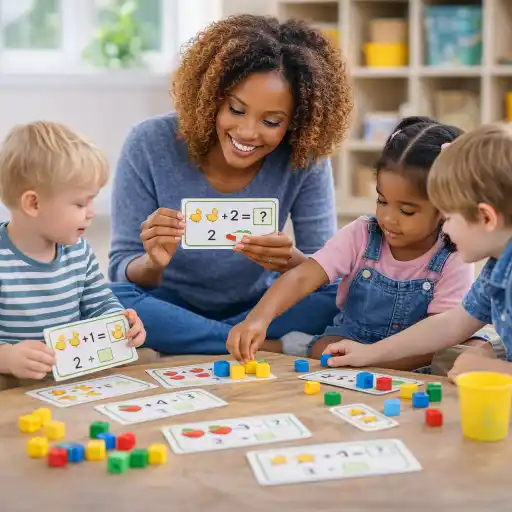
- Start with quantities that match children’s current understanding.
- Pair written problems with concrete objects or visual representations.
- Value a child’s strategy and explanation, not just the final answer.
How can you organize a task-card activity?
A predictable routine lets children focus on the addition rather than wondering what to do next. Before an activity, introduce the cards and recording sheet, demonstrate one problem, and show children where materials belong. If children are new to the routine, complete a few problems together before inviting more independent work.
- Choose a manageable number of cards for the session; children do not have to complete all 24 at once.
- Place cards at a center or in visible locations around the room, keeping pathways accessible.
- Show children how to find the matching number on the recording sheet and record an answer.
- Provide counters or other appropriate manipulatives and model checking work respectfully.
- Observe how children solve problems, then adjust the number, materials, or adult support.
Use the answer key as a support for checking—not as the main purpose of the activity. When an answer differs, invite the child to reconstruct the problem with objects and recount. This makes an error a useful clue about the child’s current strategy instead of a reason for embarrassment.
For additional preparation in play-based math, Math Foundations in Early Childhood  Buy Now $16.00 explores strategies for integrating hands-on mathematics into child care practice.
How can task cards be inclusive and developmentally appropriate?
One set of cards will not fit every child in the same way, and that is expected. Offer different ways to engage with the same problem: a child might point to a choice, build the addends, explain orally, draw a representation, or write an answer. A child who benefits from movement can visit cards around the room; another may work comfortably at a quieter station.
Adjust support without making children feel publicly ranked. Reduce the number of cards or use smaller quantities for children still developing one-to-one counting. Provide large, easy-to-handle manipulatives when fine-motor demands are a barrier. For children ready for a greater challenge, ask them to explain two strategies or create a related addition story.
Keep active supervision central to the plan. Make sure cards and materials are accessible without blocking walkways, and choose manipulatives appropriate to the ages and abilities in the group. Small objects may pose choking risks for young children. State requirements vary - check your state licensing agency.
- Offer choices in response mode: build, draw, speak, point, or record.
- Use a brief demonstration and clear, consistent directions.
- Allow children to work with a partner when collaboration supports participation.
- For broader strategies, explore No Such Thing as Boring Math Buy Now $24.00.
What common pitfalls should providers avoid?
Task cards are most effective when they support mathematical thinking, not when they become a race to finish. Avoid treating the number of completed cards as the sole measure of learning. A child may solve fewer problems while showing careful reasoning, asking useful questions, or gaining confidence with a new strategy.
Another common pitfall is asking children to work only with written equations before they understand the quantities involved. Keep counters, blocks, fingers, or drawings available. If a child appears stuck, pause and observe: the child may need a clearer model, fewer items, more time, or a different way to participate. Resist supplying the answer too quickly.
Movement activities also need thoughtful organization. Too many cards in a crowded area can create confusion, while a path that crosses a busy classroom may distract children or compromise supervision. Start with a small number of cards in an uncluttered, visible arrangement, then adapt based on children’s responses.
- Do not equate speed with understanding or confidence.
- Do not require every child to use the same strategy or response format.
- Do not let task cards replace conversation, play, or adult scaffolding.
- Review whether the activity is accessible, safe, and appropriately challenging.
Conclusion: Why do task cards work well for active addition practice?
Task cards work well for active addition practice because they give children a concrete prompt, a reason to move or choose, and repeated opportunities to represent and explain addition. Used thoughtfully, they support fluency while helping educators observe how children combine quantities and which strategies make sense to them.
Start with a few cards, demonstrate the routine, and provide manipulatives and more than one way to respond. Keep the activity playful, inclusive, and focused on children’s reasoning—not on finishing first. To build a broader foundation for integrating math into play and daily routines, explore Early Mathematics Through Play Buy Now $24.00.
- Early Mathematics Through Play
- Pediatric RSV First Aid & CPR/AED
- Emergent Learning & Development
- Play with Purpose: Supporting Children with Autism
- Creating Engaging and Meaningful Learning Experiences
- Texas Director Credential
- Montessori Cultural Activities: Exploring the World Through Play and Learning
- Families, Communities, and Classrooms: Working Together for Children
- Moving About the Classroom: Effective Transitions for Everyday
- 🌙 ¿Cómo afecta el tiempo frente a las pantallas el sueño y el comportamiento infantil? 😴
- 👧 ¿Cómo iniciar y abrir una guardería en Texas? Lo que necesitas saber
- Qué capacitación se requiere para ser director de cuidado infantil en Texas?
- ¿Cuáles son las habilidades principales que toda maestra de guardería necesita?
- ¿Cómo puedo usar escenarios de juego de roles de primeros auxilios en mi aula?
- Capacitación en Salud y Seguridad Preventiva en Línea para Proveedores de Cuidado Infantil
- Lista para Abrir una Guardería en Casa en Virginia: Cómo Empezar
- Lista para Guardería en Casa en Illinois: Cómo Iniciar una Guardería en el Hogar
- Lista para Guardería en Casa en Texas: Cómo Iniciar una Guardería en el Hogar
- Cómo Ser Maestra de Preescolar en Dakota del Norte
- Capacitación Previa al Servicio para Proveedores de Cuidado Infantil en Dakota del Norte
- Cómo simplificar la capacitación para sus empleados de daycare
- How Can Task Cards Encourage Independent Learning?
- What Makes Task Cards a Teacher’s Time-Saving Favorite?
- How Can “First, Then” Language Reduce Power Struggles in Early Childhood Classrooms?
- How Can You Make Addition Practice More Engaging Without Losing the Learning Goal?
- How Can Familiar Objects Make Addition Concrete for Young Children?
- How Can Familiar Household Words Help Children Complete CVC Words?
- Why Do Task Cards Work Well for Active Addition Practice?
- What Do Missing-Number Problems Reveal About a Child’s Math Strategy?
