Sorting can turn ordinary classroom materials into lively conversations that help preschoolers notice, name, and connect new words. Try the Sorting Mat – Fruits or Vegetables Buy Now $1.49 as a starting point, inviting children to name foods, describe colors and shapes, and explain which items they would group together. Build on their comments with new words and welcome familiar names from their home languages. For focused professional learning on how children acquire words and how classroom activities can strengthen vocabulary, explore ChildCareEd’s Building Vocabulary course  Buy Now $16.00. Read on for practical ways to keep sorting conversational and carry new vocabulary into play, stories, and everyday routines.
Why does sorting support vocabulary development?
When children group objects or pictures, they must attend to features, compare examples, and decide what belongs together. Naming those features—rough, striped, tiny, rolling—gives them meaningful reasons to hear and use words. Categorizing also helps children connect individual labels to broader ideas: a robin and a duck are both birds, while a bus and a bicycle are forms of transportation.
Vocabulary learning is not simply memorizing labels. Children need repeated encounters with words in meaningful situations, with opportunities to understand and use them. Sorting brings together several helpful conditions: concrete materials, adult modeling, peer conversation, repetition, and active decision-making. As highlighted in ChildCareEd’s discussion of word sorting and vocabulary, children can compare, classify, and explain relationships among words while taking part in a playful task.
Sorting conversations can also reveal what a child already understands. A child may place a spoon with kitchen tools because it is used at meals, or group it with metal objects because of its material. Both explanations give educators a chance to introduce precise vocabulary and learn how the child is organizing information.
- Children practice naming, describing, and comparing.
- They connect new words to familiar objects and ideas.
- They build reasoning as they explain or revise a grouping rule.
- Educators gain natural opportunities to observe communication.
Which sorting categories are most useful for teaching new words?
Choose categories that fit children’s interests and current understanding. Start with visible, concrete features, then move toward less obvious relationships. Color, size, and texture are accessible starting points; categories such as tools, habitats, or types of community helpers invite children to learn more specific names and concepts.
Materials need not be elaborate. Classroom toys, picture cards, clothing, nature items, and pretend-play props can all become sorting materials. Use a small set at first so the language stays central rather than getting lost in managing too many pieces. As children gain confidence, invite them to sort the same materials in a new way.
- By attributes: smooth/rough, large/small, soft/hard, spotted/plain.
- By category: animals, foods, clothing, vehicles, classroom tools.
- By function: things we wear, things that roll, things used for building.
- By setting or relationship: farm/zoo animals, things found outdoors/indoors, items used together.
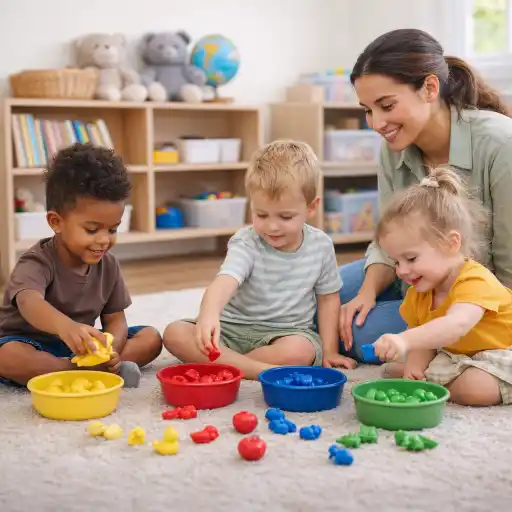
As described in this guide to preschool sorting activities, hands-on objects let children explore attributes before educators ask them to work with more abstract representations. Pair each group with a clear label and say the target words naturally: “These are smooth stones. This one feels rough.” Avoid assuming a single classification is always correct; an object can belong to different groups depending on the rule.
How can educators make the conversation do the teaching?
The adult’s language turns a sorting task into an opportunity for vocabulary growth. Model a word in context, pause to let children respond, and extend their ideas without taking over. Instead of asking only, “Where does this go?” invite children to notice and explain: “What do you see?” “How are these alike?” “What could we call this group?” These prompts support both word understanding and expressive language.
Use precise, varied words while keeping explanations child-friendly. If a child says “big,” you might respond, “Yes, it’s enormous—much larger than the little one.” Pair a new word with an object, gesture, photo, or action so children can connect its sound and meaning. Then repeat it later during a book, routine, or play center. Repetition across contexts helps children encounter the word in more than one situation.
- Introduce a few target words before the activity and model them aloud.
- Use open-ended prompts and allow quiet thinking time.
- Expand children’s phrases: “car” can become “a shiny red car.”
- Invite children to explain, demonstrate, point, or act out their choices.
- Return to the same words in stories, routines, and pretend play.
Word learning can be especially meaningful when children use a category in a sentence: “The rabbit and the goat are farm animals.” You might extend that thought with a gentle question: “What do they have in common?” Celebrate the thinking and communication, not only a predetermined answer.
How can a sorting activity work for different learners?
Children vary in how they communicate, how familiar they are with the materials, and how much support they need to participate. Adjust the activity’s demands while keeping its central purpose—building connections between words and meanings—within reach. For a child who is still learning the category vocabulary, use two groups, real objects, and clear picture labels. For a child ready for more complexity, introduce a second sorting rule or invite them to invent a category.
Multilingual children bring valuable knowledge in their home languages. Welcome family-provided words, connect labels across languages when appropriate, and use visual cues so children can participate even as they are learning English. Children may show understanding through speech, pointing, matching, signing, drawing, or using an augmentative communication system. Allow extra processing time and accept these varied responses as meaningful participation.
- Reduce the number of objects or choices when the task feels overwhelming.
- Offer larger cards, pre-cut pieces, adaptive tools, or a pointing option.
- Pair spoken words with photos, gestures, objects, or simple demonstrations.
- Invite home-language vocabulary and family knowledge into the activity.
- Extend learning with a new rule, child-generated examples, or sentence making.
Playful variety helps maintain engagement: 🧺 let children become classroom helpers as they sort dramatic-play items into “things we serve” and “things we wear.” The task can be adapted again at cleanup, on a nature walk, or during a read-aloud. That flexibility makes vocabulary practice part of the day rather than a one-time lesson.
How can providers observe progress and avoid common pitfalls?
Assessment can be brief and woven into play. Notice whether a child recognizes an item, names it, describes an attribute, follows a category rule, explains a choice, or uses a target word in a new sentence. A concise, objective note can guide the next activity: “Sorted animal pictures by habitat and named three independently; used ‘feathers’ after adult modeling.” Focus on growth and the support that helped, not just correct placement.
Several common missteps are easy to avoid. Too many categories can make the task confusing; unfamiliar words can turn it into guessing; and correcting every response can discourage experimentation. A child’s unexpected grouping is an invitation to ask about their rule. If the category is unclear, model the intended concept and offer another try without framing the first attempt as failure.
- Keep the first sort manageable and add complexity gradually.
- Teach unfamiliar words with objects or images before asking children to classify them.
- Make conversation and word use more important than completing a worksheet.
- Give children time to think, and acknowledge multiple ways to communicate.
- Document a small number of observable language behaviors over time.
Directors can support consistent practice by helping staff select a few shared target words, use simple observation notes, and revisit vocabulary during centers and family communication. If activity materials or routines are subject to local rules, state requirements vary - check your state licensing agency.
Conclusion: What makes sorting a strong vocabulary activity?
Sorting builds preschool vocabulary when children encounter meaningful words, handle or examine examples, talk about relationships, and revisit terms in other parts of the day. Start with categories children can see and understand, model precise language, and invite children to explain their thinking. Then adapt the materials and response options so every child has a way to take part.
The goal is not a perfect set of piles; it is a richer understanding of words and how ideas connect. With brief, repeated, playful experiences, providers can nurture language, reasoning, and confidence together. For a deeper professional foundation, explore ChildCareEd’s Building Vocabulary Buy Now $16.00 course. Additional learning may be useful through Science of Reading Foundations in the Pre-K Classroom Buy Now $16.00, Language Development in Early Childhood Buy Now $16.00, Building Bridges for Dual Language Learners Buy Now $16.00, and Early Mathematics Through Play Buy Now $24.00.
- CDA Preschool Credential
- Building Equity: Inclusionary Practices in Preschool
- From Tantrums to Triumphs: Equipping Preschoolers with Self-Regulation Skills
- CDA Bridge Bundle: Preschool
- Art from the Heart for Preschoolers: Open Ended Art Projects that Build Self-Esteem
- CDA Preschool Renewal
- Texas Director Credential
- Building Vocabulary
- Classroom Tools for Emergent Literacy
- 45 hour Growth and Development Birth-age 12 ONLINE
- Preschool Arithmetic Activity
- Pumpkin Spice and Sensory Delight: Easy Autumn Sensory Bins for Early Learners
- Celebra El Cumpleaños de Dr. Seuss En Tu Guardería Con Actividades Fáciles y Divertidas!
- Cómo Celebrar el Día Nacional del Kindergarten
- Easy Ways to Add STEM to Your Preschool Classroom
- How can we bring a farmers market and fresh fruit activities to preschoolers in California?
- How Do Art Activities Support Cognitive Growth in North Dakota Preschoolers?
- How can friendly-monster crafts teach children about feelings?
- How can preschool classrooms effectively support early math skills?
- How can we help children identify and express emotions in child care?
- How can child care providers teach children to name and manage emotions?
- How can we build emotional vocabulary through books and play?
- How Can We Teach Young Children to Care for the Environment?
- STEM for Preschoolers: Fun Activities That Encourage Curiosity
- Count It, Sort It, Find It! Fall Math Games for Preschoolers
- What No-Prep Activities Can Busy Early Childhood Teachers Use Tomorrow?
- How Can STEM Activities Turn Everyday Preschool Play Into Powerful Learning?
- How Can Printable Activities Save Teachers Hours of Prep Time?
- What Should a 3-Year-Old Be Learning at Preschool?
- What Questions Keep a Preschool Science Conversation Going?
