“When is it time to go outside?” and “What happens after lunch?” are invitations to help children make sense of their day. A few predictable routines, thoughtful words, and accessible visuals can turn time from an abstract idea into something children experience and anticipate. For practical ideas you can use with preschoolers, explore Every Moment Matters: Schedules and Transitions  Buy Now
$55.00$45.00; the course offers strategies for planning predictable routines and smoother transitions while you build on the simple approaches below.
Why does learning about time begin with everyday experiences?
For young children, time is initially less about clock faces and more about familiar events: arriving, washing hands, eating, playing, resting, and reuniting with family. Repeated experiences help children notice that events happen in an order and that some activities signal what comes next. The Illinois Early Learning Project explains that schedules, stories, songs, and classroom activities all offer natural opportunities to explore sequence.
This learning matters beyond knowing what comes after snack. When children anticipate routines, they can take part more confidently, follow simple directions, and communicate about what they have done or expect to do. Predictable routines can also help children feel more secure, while still allowing adults to respond to individual needs and changes in the day. A schedule is a support for participation—not a promise that every day will unfold identically.
Sequencing also connects to language and early literacy. Retelling a classroom event—“First we planted a seed, then we watered it”—uses the same broad skill children need to organize a story. Providers can strengthen this connection without setting aside a special lesson: ordinary care routines already provide rich, meaningful practice.
- Make order visible through real classroom activities.
- Use familiar events to give time words concrete meaning.
- Notice that children may show understanding through speech, gestures, pictures, or actions.
How can sequence words become part of the daily conversation?
Choose a small set of terms and use them consistently in context: first, next, then, last, before, after, now, and later. Narrate actions as they happen: “First we put the cups on the table. Next we bring the plates.” Short, specific statements are easier to connect to what children can see than long explanations delivered well in advance.
Then pause and invite children to contribute. Ask, “What do we do after we rinse?” or “What happened first in the story?” Open-ended prompts invite children to recall, predict, and explain. If a child answers with a word or gesture, respond by expanding the idea: “Yes, the towel is next. After we dry our hands, we can sit for snack.” This models language without turning the exchange into a quiz.
Use the same words across routines, play, songs, and books. Picture books about events in order, action songs, and children’s retellings all offer natural contexts for practice. The Illinois Early Learning Project recommends connecting sequence vocabulary with daily schedules and familiar processes, and inviting children to discuss what happens first, next, and last.
- Keep directions manageable: “First put away the blocks; then choose a book.”
- Give children time to process and respond.
- Pair spoken language with a gesture, object, or picture when helpful.
- 📸 Take photos of a familiar classroom routine and invite children to describe or arrange them.
Which simple routines and activities make sequence meaningful?
Start with routines children experience repeatedly and can observe directly. Handwashing, preparing for outdoor play, setting the table, snack, cleanup, and planting seeds all have clear steps. Familiarity lets children focus on the order rather than trying to understand an entirely new task at the same time.
Try a short “how we do it” activity with three or four steps. Photograph children putting on coats, for example, or draw the steps involved in watering a classroom plant. Invite children to put the pictures in order, act them out, or dictate a short explanation for a class book. For younger children or those new to sequencing, begin with two images; add steps as they become comfortable.
Play extends learning without making it feel like a drill. Songs with repeated movements, finger plays, story retelling, simple obstacle courses, and pretend play all involve patterns and order. Children might narrate a pretend café order—take the order, prepare the food, serve it—or decide which block should be placed next in a tower. These experiences build language and reasoning alongside the ability to organize events.
- Ask children to describe their morning, afternoon, or bedtime routines, recognizing that family practices differ.
- Use “first, then, last” cards during a real classroom task.
- Invite small groups to retell a familiar story or act out its events.
- Keep the activity playful and responsive to children’s interests.
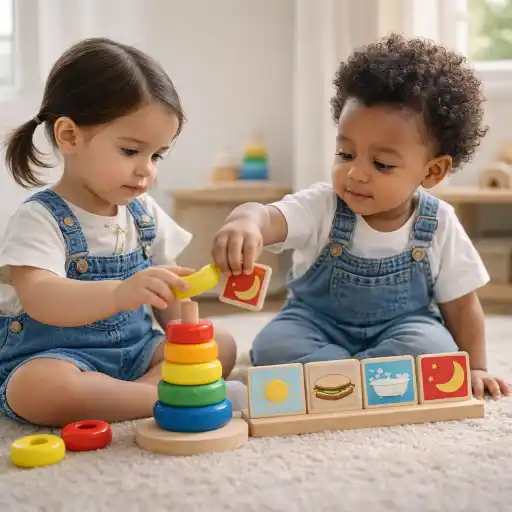
How can visual schedules and transition cues help children anticipate what comes next?
A visual schedule makes the day’s order visible. It may use photographs, drawings, objects, or simple symbols to show major activities such as arrival, play, meals, outdoor time, rest, and departure. Place it where children can see it, use images they recognize, and teach the group how to check what is happening now and what comes next. For a particular multi-step routine, a short photo strip or “first-then” board may be more useful than a full-day display.
Transitions are important teaching moments: children are asked to finish one activity, prepare for another, and manage a change in attention. Pair a consistent cue—a song, brief warning, gesture, or picture—with clear language: “First we clean the paintbrushes; then we wash our hands.” Whenever possible, allow children time to complete or pause their play, and avoid creating long periods of waiting.
Keep visuals flexible and accurate. If rain changes outdoor plans, acknowledge the change, update the schedule, and explain what will happen instead. Children learn both that routines can be counted on and that adults will help them navigate changes. NAEYC identifies routines and transitions as essential parts of a supportive early childhood environment.
- Use real photographs or familiar images and keep the display uncluttered.
- Review the schedule before and after transitions rather than posting it and leaving it unused.
- Offer an individual “now and next” support if a child benefits from fewer steps.
- Use the same simple cues across the teaching team when practical.
How can providers adapt support and recognize children’s progress?
Children do not all show their understanding in the same way or at the same pace. One child may explain a sequence in a sentence; another may point to the next picture, use a home-language word, sign, communicate with a device, or demonstrate the action. These are all meaningful ways to participate. The goal is to understand what support helps each child make sense of order—not to require one particular response.
Adjust the number and format of steps to make participation accessible. Use two picture choices instead of six, begin with real objects before moving to illustrations, provide larger cards, or model the first step together. Children ready for greater challenge might explain why one action comes before another or create a sequence for a familiar classroom job. Invite families’ knowledge of routines and language while respecting differences among households.
Observe children during ordinary activities instead of relying only on a worksheet. Brief notes can guide your next teaching move. Notice whether a child identifies what comes first or last, predicts a next step, uses sequence words, or retells an event—with or without support. A child who communicates the order through action may understand more than a verbal response alone suggests.
A common pitfall is expecting mastery after one demonstration or focusing only on correctly arranged cards. Repeated, low-pressure practice is more useful. Keep visuals and language supportive, not a measure of compliance. State requirements vary - check your state licensing agency when connecting professional learning or classroom practices to regulatory requirements.
Conclusion: What are the simplest ways to help children understand time and sequence?
Young children learn daily time and sequence through repeated experiences they can see, talk about, and take part in. Providers can make this learning practical by naming the order of familiar routines, using a small set of time words consistently, adding clear visual cues, and turning stories, songs, and play into opportunities to predict and retell.
Begin with one routine, such as handwashing or cleanup. Model a few steps, invite children to show or tell what comes next, and adapt the support to each child’s communication and developmental needs. Use schedules as flexible guides and explain changes calmly. With repetition and responsive teaching, everyday moments can help children feel more prepared for what comes next—and more capable of describing their day.
For further professional learning, explore these English-language ChildCareEd courses:
- Moving About the Classroom: Effective Transitions for Everyday
- CDA Home Visitor Subject Area 3 Part 3 Birth to 5
- CDA Home Visitor Subject Area 2 Part 3 Birth to 5
- CDA: Stand With Respect and Professionalism
- Setting the Stage: Story Time
- CDA Bridge Bundle: Family Child Care without Portfolio Review
- CDA Bridge Bundle: Infant/Toddler without Portfolio Review
- CDA Bridge Bundle: Preschool without Portfolio Review
- Positive Attention: Interactions & Supervision for Infants & Toddlers
- Texas Director Credential
- Canciones, juegos y preguntas de círculo para niños
- How can child care programs use safe diapering and toileting procedures to protect children and stay compliant?
- How can responsive caregiving during feeding, diapering, and rest improve infant care in group settings?
- How Can We Teach Young Children to Care for the Environment?
- How Can Child Care Programs Help Children Transition from Summer to Structured Routines?
- Types of Curriculum in Early Childhood Education: Which Approach Fits Your Classroom Best?
- Teaching Math to Young Children: Why Counting to 20 Doesn’t Mean They Understand 20
- How Can Child Care Providers Use Positive Discipline to Teach, Connect, and Guide Young Children?
- How Can Day vs. Night Sorting Help Children Understand Time and Routine?
- How Can Child Care Providers Turn Everyday Routines into Learning Opportunities?
- How Can You Create Daily Classroom Schedules That Prevent Behavior Disruptions?
- Why Do Predictable Routines Matter After a Child Experiences Stress?
- How Can You Create a Daily Routine That Helps Preschoolers Feel Secure?
- How Can You Plan Rest Time When Children in Your Care Need Different Things?
- How Can Child Care Programs Make Handwashing Possible During the Busiest Part of the Day?
- How Can You Reorient a Returning Teacher When Classroom Systems Have Changed?
- How Can AI Help Make Classroom Instructions Simpler and Clearer for Young Children?
- Why Do Some Parents Rarely Respond to Child Care Communication?
- How Can Simple Daily Practices Help Young Children Understand Time and Sequence?
- What Are Effective Ways to Help Children Remember Multi-Step Classroom Routines?
