When children forget the second or third step of a routine, the result can be frustration for them and repeated reminders for staff—but the skill can be taught. Build predictable, manageable sequences with clear cues, practice, and visuals, and consider Every Moment Matters: Schedules and Transitions  Buy Now
$55.00$45.00 for practical professional learning on designing supportive routines. For strategies focused on teaching children to complete classroom transitions, explore Moving About the Classroom: Effective Transitions for Everyday Buy Now $35.00; both courses can help you translate the ideas below into everyday practice.
A child who forgets a step is not necessarily ignoring an adult. Multi-step routines draw on language, attention, working memory, sequencing, and self-regulation—all developing capacities. Providers can reduce the memory burden while deliberately helping children become more confident and independent participants.
Why can multi-step routines be hard to remember?
Consider the routine “put away the blocks, wash your hands, and come to the table.” A child needs to notice the instruction, understand each action, retain the sequence, move from one action to the next, and resist distractions along the way. Noise, fatigue, emotional stress, unfamiliar words, or a sudden change can make any part of the process more difficult.
Children’s skills are also uneven. A child may manage three familiar steps at arrival but lose track of a new sequence during an exciting play period. A child learning English may understand the actions better when they are demonstrated. Another child may need extra processing time or a visual reminder. These differences offer useful information about teaching supports; they are not proof of unwillingness.
Predictable routines matter because they make expectations easier to understand and support children’s participation. NAEYC describes routines and transitions as essential parts of a supportive early learning environment. When the sequence is manageable and familiar, children can put more attention toward relationships, play, and learning instead of guessing what adults expect.
- Notice when the sequence becomes difficult: which routine, time, or step?
- Check that the child heard and understood the direction before adding more reminders.
- Consider language, sensory, motor, emotional, and environmental factors.
Keep #expectations responsive to development and the individual child. Success is not measured by how quickly every child completes the same number of steps; it is reflected in growing understanding and participation.
How can adults make each step easier to understand?
Start by making the individual actions concrete. “Put your cup on the tray” tells a child what to do and where; “get ready” leaves more room for interpretation. Use a calm voice, short phrases, and familiar verbs. Move close enough to be heard, gain the child’s attention without requiring eye contact, and give time to process before repeating the instruction.
Teach the sequence at a level where the child can experience success. Begin with one or two related steps, then add a step as familiarity grows. Words such as “first,” “then,” and “last” make order explicit. If a child is still learning the routine, give one step, allow the child to complete it, and then cue the next one rather than expecting the entire sequence to be held in mind.
Model what the sequence looks like, then practice together. Responsive Classroom’s interactive modeling approach includes explaining and demonstrating a procedure, inviting children to notice and practice it, and giving feedback. The same idea works well for early childhood routines: demonstrate cleanup or handwashing during a calm moment, let children rehearse, and describe what they did.
- Use one observable action per step and avoid combining unrelated instructions.
- Pause several seconds after giving the direction; processing time is part of the support.
- Use a brief prompt, gesture, or demonstration if a child is stuck.
- Offer specific encouragement: “You put the blocks away; now you’re checking the next step.”
This approach builds #memory through supported repetition without turning the routine into a test or a demand for perfect compliance.
How do visual cues and playful practice help routines stick?
Pictures, photographs, objects, and gestures allow children to revisit a sequence without relying entirely on spoken directions. A short photo strip for handwashing, for example, can show the sink, soap, rinsing, and drying in order. Images from the actual classroom may be easier to interpret than generic symbols because they show familiar places and materials.
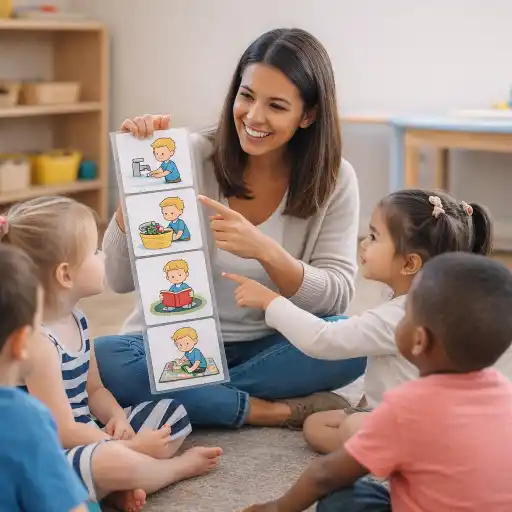
Introduce the visual rather than simply posting it. Point to the current picture, name the action, and show how to mark a step as finished—perhaps by turning over a card or moving a marker. Keep sequences brief and uncluttered. A whole-day schedule is helpful for broad activities, while a small routine strip is better for the steps within cleanup, arrival, or getting ready to go outside.
Everyday play can provide low-pressure practice with sequencing and listening. Try “Follow the Leader,” “Simon Says,” a simple obstacle path, or a movement game with two actions before adding a third. Make practice enjoyable and stop before it becomes tiring. Invite children to take turns leading a familiar sequence, with adult guidance as needed.
- Pair spoken cues with a photograph, gesture, object, or demonstration when useful.
- Place routine visuals where children can see and use them at the point of action.
- 🧩 Rehearse a familiar three-picture routine together, then let children check each step.
- Gradually reduce adult prompts while keeping a visual available if it remains helpful.
As a child begins using a sequence independently, notice the process: checking a picture, remembering what comes next, or returning to the routine after a distraction. Those small actions mark meaningful progress toward #independence.
How can routines be adapted for different learners?
Scaffolding means adjusting support so the child can participate, then revising it as skills develop. One child may need a two-step version and a picture cue; another may benefit from a verbal direction broken into phrases, a quiet space, or an adult model. A child who is learning English might use gestures, familiar objects, repeated key words, or home-language support alongside classroom vocabulary.
Adaptations should support participation in the shared classroom routine, not make a child feel singled out. Consider a portable picture strip, an object cue, a “first–then” board, extra processing time, or an opportunity to complete one item at a time. Offer appropriate choices within the routine—“Would you put away the cars or the animals first?”—while keeping the overall expectation understandable.
Observe patterns and share neutral, specific notes with colleagues and families: which step was difficult, what support was offered, and how the child responded. Families may know familiar words, cues, or routine approaches that can help children connect experiences across settings. If difficulties persist despite thoughtful adjustments, consult the director and family about possible additional support. Providers observe and adapt; they do not diagnose. State requirements vary - check your state licensing agency.
- Reduce the number of steps temporarily if the sequence is overwhelming.
- Consider access to materials, background noise, timing, and physical demands.
- Use culturally and linguistically familiar cues where they support understanding.
- Recognize attempts and partial completion as useful information for next steps.
Inclusive routines are consistent enough to be recognizable and flexible enough to meet children where they are.
What routine-teaching pitfalls should teams avoid?
Repeatedly giving the same long instruction—especially more loudly—usually does not make it easier to remember. It may add stress without clarifying the words, reducing the number of steps, or addressing distractions. Likewise, expecting children to use a visual schedule independently before teaching what its pictures mean sets them up for confusion.
Teams can help by agreeing on shared language and cues for recurring routines. A consistent “first, then” phrase or cleanup song gives children familiar signals across adults, while leaving room for responsive interactions. Directors can support staff by identifying routines that regularly require many reminders and planning together how to simplify and teach them.
A missed step is also not automatically intentional refusal. Check whether the child understood, had time to process, could access the materials, and knew what came next. If frustration rises, reduce language and support regulation; return to teaching once the child is ready. Avoid shaming, comparing children, or using a checklist as punishment. Self-monitoring tools, when appropriate, are for learning and feedback—not for withholding participation.
- Do not stack several unrelated directions into one sentence.
- Do not treat a posted chart as instruction; model and practice its use.
- Do not expect identical pace or prompt levels from every child.
- Review whether adult cues, the routine, or the environment needs adjustment.
Small team changes can make a repeated classroom moment clearer for children and less demanding for staff.
Conclusion: What helps children remember multi-step routines?
Children are more likely to remember classroom routines when adults teach them with short, connected steps, clear language, modeling, repetition, and accessible cues. Start with a routine that often feels confusing, decide what the child needs to know first, and practice the sequence together. Add pictures or objects when they help, allow time to respond, and recognize progress specifically.
Adjust the level of support to each child, collaborate with families and colleagues, and revisit routines when the environment or children’s needs change. The goal is not flawless performance; it is growing confidence, comprehension, and participation. With consistent, compassionate teaching, daily routines can become meaningful opportunities to develop #sequencing, memory, and autonomy.
- 45 Hour Child Growth and Development
- Moving About the Classroom: Effective Transitions for Everyday
- CDA Bridge Bundle: Preschool
- Pediatric RSV First Aid & CPR/AED
- CDA Bridge Bundle: Family Child Care
- CDA Bridge Bundle: Infant/Toddler
- Emergent Learning & Development
- Behind the Scenes: Baby Routines ONLINE
- 45-Hour Infant and Toddler Curriculum
- CDA Certification en Español: Recursos y Consejos para Educadores Bilingües
- ❄️ ¿Qué actividades al aire libre funcionan bien para los niños de Illinois en cada estación? 🌷🍂
- Consejos de Supervisión Activa para Salones de Preescolar y el Juego al Aire Libre
- How Do You Create a Neurodiversity-Affirming Classroom?
- Including Every Child: What Child Care Providers Should Know About the ADA
- Preschool Classroom Rules: How to Teach Expectations Without Constant Reminders
- How Can Child Care Providers Support Memory Development in Young Children?
- How Can Preschool Routines Create Calmer, More Independent Classrooms?
- How Can Child Care Providers Support Families from Diverse Cultural Backgrounds?
- How Can Visual Daily Schedule Cards Turn Classroom Chaos into Calm?
- How Can Providers Create an Inclusive Classroom for Every Child?
- How Can Child Care Providers Create Classroom Rules That Children Understand and Use?
- How Can Photos Help Children Remember Classroom Routines?
- How Can You Support an Autistic Child in a Preschool Classroom?
- Keep It Simple: Introducing Classroom Rules Preschoolers Can Remember
- How Do Visual Routines Support Independence at Home?
- How Can Teachers Support an Autistic Child in a Preschool Classroom?
- What Are Simple Ways to Support Memory and Recall in Young Children?
- How Can Kindergarten Rules Support Children Who Need Different Levels of Help?
- How Can You Help Children Transition From Free Play to Teacher-Led Activities?
