When children ask whether it is time for breakfast, outdoor play, or bed, they are building an understanding of sequence, predictability, and time. Day-versus-night sorting turns these abstract ideas into a concrete, playful investigation; for deeper support with predictable classroom practices, explore Every Moment Matters: Schedules and Transitions  Buy Now $55.00, which offers practical strategies for planning routines and smoother transitions.
Why does day-and-night sorting matter in early childhood?
Young children typically understand time through lived experiences before they understand clocks, minutes, or calendars. Morning arrival, breakfast, sunlight, outdoor play, dinner, darkness, and sleep create meaningful anchors. Sorting pictures connected to those experiences helps children notice recurring patterns and construct a beginning #time vocabulary.
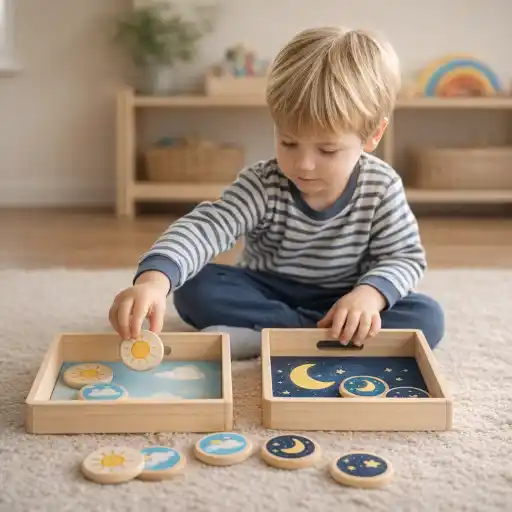
The activity also integrates several developmental domains. Children observe visual details, compare categories, explain their reasoning, and practice fine-motor control while moving or gluing cards. The Day or Night Sorting Mat Buy Now $1.49, for example, pairs familiar images—such as a sun, playground, moon, bed, and owl—with two time-of-day scenes.
Most importantly, sorting should not communicate that every event belongs exclusively to day or night. Families and communities have different schedules; some adults work overnight, and children may nap during the day. Present the categories as common patterns rather than rigid rules. Ask, “When might this happen in your home?” Respectful discussion makes the activity more inclusive and more accurate. Because sleep patterns can vary, educators may also find it helpful to learn about children’s sleep cycles and ways to support healthy sleep.
- ☀️ Builds observation and comparison skills.
- 🌙 Connects natural cycles to familiar routines.
- 🧩 Strengthens classification, language, and fine-motor development.
How should providers introduce the concepts of day and night?
Begin with real observations rather than a worksheet. At arrival, invite children to look outside: “What do you notice in the sky? How does the light look?” Later, compare a photograph of the morning with one of the evening. Use simple, repeated language such as “during the day,” “at night,” “before,” “after,” “first,” and “next.”
Do not assume that children understand the difference because they can repeat the words. Check meaning through conversation and action. Show a picture of pajamas and ask, “What might happen before we put these on?” Then invite children to act out the sequence. Concrete experiences support the gradual development of abstract concepts.
For preschoolers, limit the initial set to a few highly familiar images. Introduce less obvious examples—such as a streetlight, moon visible in daylight, or a family meal—after children have established the basic distinction. Explain that the sun can sometimes be seen when the moon is also visible and that weather can change how the sky looks.
Use the activity as a shared inquiry, not a test. Helpful prompts include:
- “What clues helped you decide?”
- “What usually happens before bedtime?”
- “Could this happen at another time, too?”
- “How is your routine similar to or different from a friend’s?”
How can sorting connect time concepts to classroom routines?
A sorting lesson becomes more powerful when children see its connection to the actual classroom day. After sorting, place the cards beside a simple picture schedule. Compare “day” images with arrival, meals, play, and outdoor experiences, then connect “night” images with home routines such as dinner, bathing, stories, and sleep. The goal is not to reproduce a family’s entire schedule; it is to help children recognize order and anticipation.
Visual schedules make sequence visible for nonreaders and children who benefit from additional structure. The ChildCareEd guide on visual schedules recommends placing clear images at child eye level and reviewing changes with children. This approach supports #independence because children can check what comes next rather than relying exclusively on adult reminders.
Build brief references into transitions: “First we clean up, then we wash hands.” Use a consistent cue, offer a reasonable warning, and allow enough time for children to finish safely. NAEYC identifies routines and transitions as central to a supportive classroom, while the Virtual Lab School distinguishes a schedule—the broad plan—from routines—the repeated steps used to complete it.
Keep the schedule flexible. A rainy day, substitute teacher, or special visitor provides an authentic opportunity to say, “Our usual plan changed. Let’s look at what happens next.” Children learn that routines provide security without requiring adults to pretend that every day is identical.
Which playful extensions deepen learning?
Repetition across different modes helps children make connections. After a picture sort, offer dramatic-play props such as pajamas, a flashlight, a breakfast menu, a moon, or a sun hat. Children can create a pretend morning and evening routine, using sequence words as they play. Props should reflect different families and cultures rather than suggesting one universal routine.
Try a movement game in which children move like a daytime activity or a nighttime animal. Invite them to freeze when they hear “night” and stretch when they hear “morning.” For sequencing, provide three or four photographs of classroom events and ask children to arrange them from first to last. Life-skills sequencing activities similarly connect time order with independence, language, critical thinking, and fine-motor practice.
Books, songs, and observation journals can extend the investigation. Children might draw the sky at arrival and again before departure, then compare the pictures. A simple class chart can record whether the sky appears bright, cloudy, or dark. Avoid presenting these observations as a science experiment proving that darkness always means nighttime; instead, use them to encourage careful noticing.
For a stronger science connection, ask what changes and what stays the same: light, shadows, animal activity, temperature, and human routines. ChildCareEd’s Basic Science in Early Childhood Buy Now $25.00 course can help providers design inquiry-based experiences that encourage children to explore, question, and experiment through play.
- Use dramatic play to rehearse routines.
- Sequence real classroom photographs.
- Observe and draw the sky at different points in the day.
- Connect sorting to songs, stories, movement, and science talk.
How can providers differentiate the activity and document learning?
Start with each child’s current understanding. Some children may match obvious pictures independently; others may need two choices, real objects, gestures, or adult modeling. Offer photographs, symbols, objects, or written labels according to the child’s communication and literacy needs. Children who use AAC or another home language can participate through picture selection, gestures, or translated vocabulary.
Adapt the motor demands as well. Pre-cut cards for children who are not ready to use scissors, provide larger pieces or hook-and-loop fasteners, and use a partner for gluing. Never let small loose pieces become a safety hazard for younger children. Participation can mean pointing, placing, describing, acting, or listening—not only speaking.
Document the process rather than recording whether every answer is “correct.” Note whether a child:
- Identifies visual clues related to light, sleep, or activity.
- Sorts familiar images with or without support.
- Uses words such as “day,” “night,” “before,” or “after.”
- Explains a choice or responds to a peer’s idea.
- Sequences two or more routine events.
Use observations to plan the next step. If a child sorts accurately but cannot explain the reasoning, model descriptive language. If a child understands sequence but struggles with the category labels, use a personal photo schedule. Accurate observation and assessment help educators individualize instruction; the Assessing through Observation Buy Now $35.00 course provides additional guidance for documenting children’s learning.
What common mistakes should be avoided?
A common mistake is treating day and night as a vocabulary drill. Children need conversation, movement, and connections to real routines. Another is using too many cards at once. A crowded mat can overwhelm children and make it difficult to identify the learning goal.
Providers may also unintentionally present cultural assumptions as facts. “Everyone eats dinner at night” or “everyone sleeps when it is dark” excludes children whose family routines differ. Say “many people” or “in some homes,” and invite children to share their experiences without requiring personal disclosure.
Finally, avoid using sorting as a compliance demand. If a child places an image in an unexpected category, ask about the thinking behind the choice. The child may be drawing on a legitimate experience—for example, seeing the moon during the day or playing outside after sunset. Treat disagreement as an opportunity for inquiry.
State requirements vary - check your state licensing agency before counting any activity or course toward required professional development.
Conclusion: How does sorting help children understand time and routine?
Day-versus-night sorting helps children understand time and routine by making sequence, recurring patterns, and familiar experiences visible and discussable. When providers combine pictures with real observations, visual schedules, pretend play, movement, and responsive conversation, children build more than a day/night distinction. They develop #routine awareness, early science reasoning, vocabulary, classification, #independence, and confidence during transitions.
Keep the experience brief, flexible, inclusive, and grounded in children’s lives. Observe what each child understands, adapt materials, and extend the conversation over several days. For broader professional learning, Early Childhood Education Buy Now $99.00 offers comprehensive training in development, curriculum, observation, and responsive practice that can help providers connect small activities to stronger classroom planning.
Quick FAQ
- When should children learn day and night? Introduce the ideas through routines and observation in toddlerhood and preschool, then deepen them gradually.
- Should every picture have only one correct category? No. Discuss common patterns while acknowledging that family schedules vary.
- How long should the activity last? Begin with approximately five to ten focused minutes and stop while children remain engaged.
- Can infants participate? Yes. Infants can observe light and darkness, hear routine language, and explore safe, large visual materials with adult support.
- How do I assess learning? Record what children notice, say, sort, sequence, and explain during play rather than relying only on a completed worksheet.
Sources and professional resources
- Behind the Scenes: Baby Routines ONLINE
- 45 Hour Child Growth and Development
- Moving About the Classroom: Effective Transitions for Everyday
- Balancing Physically Active Play in Child Care
- Positive Attention: Interactions and Supervision of Infants and Toddlers: For Workforce Solutions
- 1,2,3, Eyes on Me: Classroom Safety
- Positive Attention: Interactions & Supervision for Infants & Toddlers
- Texas Director Credential
- Balancing Active Play in Child Care
- Guidelines for Establishing a Consistent Sleep Routine to Ensure Kids are Well-Rested and Ready for School
- CDA Certification en Español: Recursos y Consejos para Educadores Bilingües
- ⏰ Cómo puedo facilitar las transiciones y las rutinas diarias en mi aula?
- Recursos en Español sobre el Sueño Seguro del Bebé
- Que es Título 22 en California?
- ¿Cuáles son las mejores actividades del Día de la Tierra para niños en casa o en el aula?
- ¿Cómo solicito la licencia para una guardería en California?
- Proporciones de Cuidado Infantil y Tamaños de Grupo por Edad en Maryland (Guía Rápida para Centros y Hogares)
- Proporciones de Cuidado Infantil y Tamaños de Grupo por Edad en Nueva Jersey (Guía Rápida para Centros y Hogares)
- Proporciones de Cuidado Infantil y Tamaños de Grupo por Edad en Virginia (Guía Rápida para Centros y Hogares)
- Cómo Celebrar el Día Nacional del Kindergarten
- Lista para Guardería en Casa en Illinois: Cómo Iniciar una Guardería en el Hogar
- Cómo Trabajar en el Cuidado Infantil en Carolina del Norte: Requisitos y Pasos
- Celebrando la amistad en el cuidado infantil durante el Día de los Mejores Amigos
- Canciones, juegos y preguntas de círculo para niños
- Cómo simplificar la capacitación para sus empleados de daycare
- How can early childhood programs effectively support children's oral health?
- Can a Superhero Week Help Preschoolers Learn to Name and Manage Emotions?
- How Can Cut, Sort, and Glue Activities Strengthen Early Learners’ Development?
- How Can Day vs. Night Sorting Help Children Understand Time and Routine?
