When a preschooler loses track of a spoken direction, repeating it may not provide the missing information. Visual cues can make routines and multistep tasks easier to understand, remember, and complete with growing independence; for practical professional learning, explore Moving About the Classroom: Effective Transitions for Everyday Buy Now $35.00, a preschool-focused workshop on predictable routines, clear directions, and smoother transitions.
Why can visual supports make directions easier to follow?
Following a direction involves more than listening. A child may need to shift attention, understand the words, remember the sequence, manage emotions, and carry out each action. Spoken directions disappear as soon as they are said; a picture, object cue, or photo sequence remains available for the child to look at again. That visible reference can reduce the demand on memory and help a child focus on the next step.
This is especially useful during busy moments such as cleanup, handwashing, arrival, and transitions away from preferred play. A child who does not respond may be processing language, unsure what to do first, or overwhelmed by noise or change—not deliberately ignoring an adult. The CSEFEL brief on communication and behavior recommends picture schedules, choices, and breaking multistep directions into smaller parts to help children understand expectations.
Visual supports can benefit the whole group, including children learning more than one language and children with communication, attention, or sensory differences. They are not a test of compliance or a replacement for warm adult interaction. Used respectfully, they make expectations more accessible and create opportunities for children to take the lead. They can also help adults use fewer repeated prompts and notice what a child can already do independently.
- They show children what is happening now and what comes next.
- They make a sequence easier to revisit than a long spoken instruction.
- They can support participation without requiring a spoken response.
Which visual support should you choose?
Choose a visual that communicates clearly to the particular child and fits the routine. Options include a real object, a photograph, a simple drawing or icon, and a word paired with an image. A child might understand a real soap dispenser or a photo of the classroom sink before interpreting a generic handwashing icon. Another child may prefer familiar symbols or written labels. There is no single format that works for every learner.
Match the amount of information to the task. A classroom schedule can show the main events of the day; a small routine strip can show a few steps; and a First-Then board can make a two-part sequence visible. For example, “First put the blocks in the basket, then choose a book” gives a clear, manageable order. A First-Then board is most helpful when both parts are clear and adults follow through on the sequence as presented.
- Whole-day schedule: major activities in order, displayed where children can see them.
- Routine sequence: a short photo or picture guide for tasks such as handwashing or putting on outdoor clothing.
- First-Then board: two activities shown in sequence when a child needs a concise cue.
- Portable mini-schedule: a small strip or flip book for children who benefit from a personal reference.
Use the least complicated visual that works. Too many cards, decorative details, or unfamiliar images can obscure the message. Keep symbols consistent, and consider home-language labels, gestures, or communication methods already used by the child. As a related next step, Coaching for Success: Inclusive Strategies to Support Children with Autism  Buy Now $55.00 offers classroom-focused learning about individualized scaffolding, inclusive routines, and collaboration.
How can teachers teach children to use visuals?
A visual does not teach itself. Introduce it during a calm moment, name what each image means, and demonstrate how to use it. Then refer to it at the real moment of action. For a cleanup sequence, an educator might point to a photo of toys going into a basket, say “Cars in the basket,” and pause. After the child acts, the adult can point to the next step or invite the child to move the completed card.
Keep accompanying language brief and concrete. “Put the cup on the tray” is easier to act on than “Get ready for snack.” Give the child time to process before repeating or adding another instruction. If the child is unsure, point, model the first action, or offer a small amount of help. CSEFEL guidance describes segmenting directions and using verbal, pictorial, or modeled cues to clarify what is expected.
- Show the visual and name the action in a few words.
- Model the first step, then invite the child to try.
- Pause and allow processing time instead of repeating rapidly.
- Notice a specific effort: “You checked the picture and put the towel in the bin.”
- Invite children to turn over, move, or check off a completed picture.
Consistent adult practice matters. Agree on the same cue words and gestures across teachers, aides, and substitutes. The Eastern Connecticut State University demonstration of a visual schedule illustrates how teachers can review the sequence with children and revisit it when the day changes. Involving children as schedule helpers can make the tool a shared part of the classroom rather than an adult-only display.
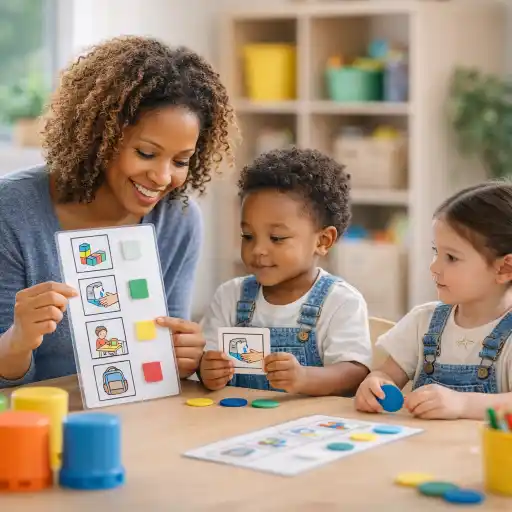
How can visuals support multistep activities and transitions?
When a direction contains several actions, break it into visible, teachable steps. “Get ready to go outside” might involve retrieving a coat, putting it on, and choosing boots. A short picture sequence lets children focus on one action at a time instead of holding the entire instruction in memory. CSEFEL guidance on self-management describes using photographs or drawings to show task steps and helping children monitor their progress as they learn.
Begin with a routine that regularly requires repeated reminders. Identify the actions children actually need to complete, then make a simple sequence and practice it with adult support. A handwashing strip might show: turn on water, use soap, rinse, and dry. A cleanup strip could show: put materials in the labeled container, return the container, and join the group. Adjust the number of steps to the child’s current understanding rather than assuming all preschoolers can manage the same sequence.
For transitions, pair a visual cue with a predictable signal, such as a song, gesture, or timer. Show what is ending and what comes next, and allow reasonable time to finish or save an activity. The CSEFEL transitions brief emphasizes advance cues, individualized supports, and planning transition time—not simply telling children to hurry. If plans change, update the visual and explain the change briefly; predictability can coexist with flexibility.
- Start with one high-priority routine rather than making visuals for everything.
- Use a consistent “now/next” marker or a clear place for finished cards.
- Prepare children for changes with a visible cue and concise explanation.
- Reduce waiting and build transition time into the daily plan.
How should supports be individualized and progress observed?
Visual supports are most effective when they reflect the child’s strengths, communication, and context. Some children benefit from a class schedule; others may need a portable strip, two-picture board, real object cue, or photos of familiar classroom locations. A multilingual child may benefit from images paired with words in a home language. Ask families what cues work at home and share observations in a collaborative, strengths-based way.
Observe the routine before deciding that a child is refusing or that the visual is ineffective. Note when difficulty occurs, which steps are missed, what happens immediately beforehand, and how much adult prompting is needed. These observations can reveal whether the challenge is unclear images, a direction with too many steps, a rushed transition, or a task that needs more modeling. Keep documentation focused on improving access and instruction, not labeling the child.
Look for gradual, meaningful progress: the child checks the picture, completes one step with less help, asks for assistance, or moves to the next activity with fewer reminders. If the support is not helping, simplify the sequence, change the image, adjust its placement, or teach it again during a calm time. Persistent or significant concerns can be discussed with the director, family, and relevant specialists. State requirements vary - check your state licensing agency.
What common mistakes can providers avoid?
Visual supports can lose their value when they are treated as decoration rather than as tools adults and children actively use. A chart that does not reflect the actual day, an image the child cannot interpret, or an adult cue that changes from person to person can add confusion. The answer is usually to make the system simpler and more consistent—not to add more pictures or increase pressure.
- 🧩 Too many steps at once: show only the essential actions and add detail as the child learns.
- Posting without teaching: model the visual and practice using it during the actual routine.
- Repeating directions too quickly: pause after a short cue to allow processing time.
- Inconsistent images or adult language: use the same symbols and agreed-upon phrases across staff.
- Using visuals punitively: keep them available, neutral, and supportive rather than removing them as a consequence.
- Expecting immediate independence: model, practice, prompt as needed, and gradually reduce help.
Directors can strengthen implementation by making time for staff to demonstrate the routine, align cue language, and review whether the visual matches children’s experience. Start small: one routine, one practical visual, shared adult language, and regular observation. This approach respects children’s different ways of processing information while helping staff focus on teaching rather than repeated correction.
Conclusion: Can visuals help preschoolers follow directions more independently?
Yes. When chosen to match the child, explicitly taught, and used consistently, visual supports can make directions and routines easier to understand, remember, and complete. Their value is not that every child will follow every direction without help; rather, they give children another way to access information and a practical scaffold for developing independence.
Start with one routine that is challenging for children or staff. Create a simple picture or photo sequence, model it during a calm moment, pair it with a brief spoken cue, and give children time to act. Observe what changes, adapt the visual with families and colleagues, and fade adult prompts only as the child is ready. Small, responsive adjustments can make everyday routines more inclusive and more manageable for everyone.
For more structured professional learning, explore Every Moment Matters: Schedules and Transitions Buy Now $55.00, which addresses schedule planning, routines, transitions, and classroom climate. Providers seeking broader inclusion strategies can also review Effective Approaches for Autism and Inclusion Buy Now $55.00, focused on adapting materials, supporting communication, and addressing sensory needs.
- 45 Hour Child Growth and Development
- CDA Preschool Credential with Portfolio Review
- 45 Hour Preschool Methods and Materials
- What Makes Me Special: An Overview of Autism and ADHD
- Birth to Five CDA Credential with Portfolio Review
- CDA Bridge Bundle: Preschool
- CDA Bridge Bundle: Preschool without Portfolio Review
- Lesson Planning for Preschoolers
- Texas Director Credential
- CDA Certification en Español: Recursos y Consejos para Educadores Bilingües
- 💛🧩 ¿Cómo puedo hacer que mi enseñanza sea inclusiva para los niños con autismo?
- How can Nevada early childhood educators help preschoolers follow routines and directions?
- Celebrando la amistad en el cuidado infantil durante el Día de los Mejores Amigos
- Canciones, juegos y preguntas de círculo para niños
- Why Do Classroom Management Strategies Fail With 3-Year-Olds—and What Works Instead?
- Preschool Classroom Rules: How to Teach Expectations Without Constant Reminders
- Preschool Visual Schedule: What to Do When Kids Stop Looking at It
- How Can Child Care Providers Support Memory Development in Young Children?
- How Can Child Care Providers Help Children Develop Self-Control?
- How Can Child Care Programs Reduce Decision Fatigue for Children and Educators?
- How Can Providers Build Strong Routines That Reduce Challenging Behavior?
- How Can Child Care Providers Help Young Children Follow Directions?
- How Can Child Care Providers Help Children Develop Self-Control?
- What Should You Do When a Preschooler Refuses to Clean Up?
- Can Every Toddler Reach and Recognize Their Own Storage Space?
- How Can Child Care Providers Help Children Follow Multi-Step Directions?
- Can Visual Supports Help Preschoolers Follow Directions More Independently?
- How Can You Plan Fall Celebrations Every Child Can Follow, Including Children With Different Hearing Needs?
- How Can Teachers Adapt Activities Without Lowering Expectations for Children With Support Needs?
