When arrivals, toileting, outdoor play, and meals collide, handwashing can feel like one more transition to manage—but it remains a practical line of defense against spreading illness. Build a routine around clear cues, reachable supplies, and calm supervision, and explore Preventative Health and Safety  Buy Now $24.00 to strengthen your knowledge of illness prevention, active supervision, and safe care practices. The course offers a broader learning experience that can help you connect everyday hygiene habits to your program’s overall health and safety approach.
Why does handwashing deserve time during a packed day?
Handwashing is not a pause in learning; it is a health routine and a chance to practice self-care. Young children share toys, tables, bathrooms, and learning materials, so germs can travel between hands, objects, and people. The CDC notes that hand hygiene promotion in early care and education settings can help reduce gastrointestinal and respiratory illness and missed days.
For educators, the challenge is often not knowing that children should wash, but arranging the day so the routine can happen without turning every transition into a bottleneck. A predictable plan helps staff supervise actively while children learn a dependable sequence. The Child Care Technical Assistance Network identifies arrival, meals and food handling, toileting, diapering, outdoor play, and contact with body fluids among moments when hand hygiene is needed.
- Protects children, staff, and families by reducing opportunities for germs to spread.
- Builds independence through repeated practice of a useful self-care skill.
- Supports smoother transitions when handwashing is planned rather than improvised.
Routines are also learning opportunities: Head Start guidance describes everyday practices such as handwashing as chances to strengthen children’s development and skills. A steady, respectful routine communicates care—not blame—and helps children understand that washing is something we do for ourselves and one another.
Which key moments should anchor the routine?
During the busiest parts of the day, a short list of predictable “wash moments” is easier to remember than repeated general reminders. Start by identifying the transitions that already occur in every classroom, then build handwashing into the schedule and staff roles. For example, children can wash as they arrive, before eating, after toileting, and after outdoor or messy play.
- At arrival, before joining shared activities.
- Before and after eating, handling food, or helping prepare food.
- After using the toilet, receiving help with toileting, or diapering.
- After outdoor, sand, sensory, or shared-water play.
- After coughing, sneezing, wiping a nose, touching animals, or handling garbage.
Adults need their own clear triggers, including before food preparation or feeding, after helping a child toilet, after diapering, after contact with body fluids, and after cleaning or removing gloves. Check the CFOC list of situations that require hand hygiene when reviewing program procedures.
Use concise transition language: “First wash, then snack,” or “We wash after outside time.” If several groups share a sink, stagger departures by a minute or use additional approved handwashing stations where available. State requirements vary - check your state licensing agency when confirming required handwashing times and procedures.
How can the sink area make handwashing faster and easier?
When the sink area is ready before children arrive, teachers spend less time searching for supplies and children spend less time waiting. Set up the space from a child’s perspective: Can children reach soap and towels safely? Can they see the steps? Is there a clear place to wait without crowding?
- Check that water, soap, and paper towels or a functioning dryer are available.
- Place a stable step stool where a child needs one, and keep the floor around the sink clear.
- Keep the trash can close to the drying area.
- Post a visual sequence at children’s eye level. The Handwashing Steps Poster: Wet, Soap, Scrub, Rinse and Dry Buy Now $0.99 offers a simple numbered reminder to place near the sink.
- Assign a staff member to check and restock supplies during a predictable daily check.
Visual reminders help children remember what comes next and reduce the need for long verbal instructions. The CDC also recommends making hand hygiene supplies accessible and using visible cues such as posters in areas where children wash their hands. A picture-based sequence can be particularly helpful for children learning English and children who benefit from visual or step-by-step support.
Build accessibility into the setup rather than treating it as an exception. Some children may need additional time, adapted equipment, a less crowded washing period, or adult assistance. Plan staffing so one adult can support handwashing while another maintains appropriate supervision of the rest of the group.
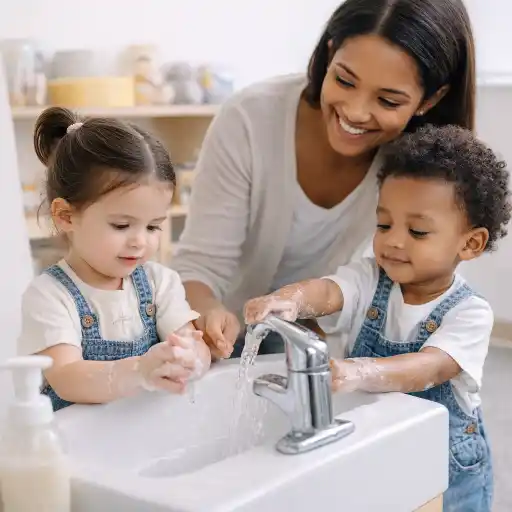
What quick teaching strategies help children complete each step?
Keep the same short script every time: wet, soap, scrub, rinse, dry. The CDC recommends washing with soap and water for at least 20 seconds, then rinsing and drying thoroughly. Demonstrate rather than calling corrections across a busy room: show children how to rub palms, the backs of hands, between fingers, thumbs, and around nails.
- Wet: Wet hands with clean, running water.
- Soap: Apply soap and make a lather.
- Scrub: Rub all hand surfaces for at least 20 seconds.
- Rinse: Rinse thoroughly under running water.
- Dry: Dry hands completely with a clean towel or hand dryer.
Use one consistent song, rhyme, or short story to mark the scrubbing time. Keep the cue brief enough to fit naturally into the transition. Offer specific encouragement: “You remembered your thumbs,” or “You scrubbed between your fingers.” This makes feedback useful and supportive rather than pressuring children to hurry.
Young children will not always complete every step independently, and that is expected. Stay nearby, provide the level of help a child needs, and gradually reduce prompts as skills develop. Treat the routine as a positive part of the #classroom day, not a consequence or a test. When hands are visibly dirty or greasy, after toileting, or after handling garbage, use soap and water rather than relying on sanitizer.
How can staff keep the routine moving without rushing children?
Efficiency comes from preparation and coordination, not from asking children to wash faster. Directors can make the process more consistent by setting shared expectations, planning transitions, and checking whether staffing and the physical setup match the group’s needs.
- Put handwashing on the daily schedule at arrival, before meals, and after outdoor play.
- Prepare sinks and supplies before a transition begins.
- Use small groups or staggered turns when a single sink creates a queue.
- Assign staff roles clearly: one adult supports the children at the sink while another supervises children who are waiting or moving to the next activity.
- Practice the routine at a calm time, so children and new staff are familiar with the steps before the busiest transition.
- Include handwashing procedures in staff orientation and use brief, respectful coaching to address skipped steps.
Hand sanitizer may be useful when soap and water are not readily available, but it is not a substitute for handwashing in every situation. The CDC advises using sanitizer with at least 60% alcohol when appropriate and supervising children under six or children who may need help following directions. Sanitizer is less effective when hands are visibly dirty or greasy and does not remove every type of germ. Store it safely and follow product-label directions and program policy.
For procedures beyond the sink, connect hand hygiene with safe diapering and cleanup. The CDC’s diaper-changing guidance includes washing the child’s hands and the caregiver’s hands as part of the full sequence. Gloves do not replace handwashing. Review routines regularly, and check local rules before changing written procedures.
What common pitfalls can programs prevent?
Busy schedules make shortcuts tempting, but a few small system changes can prevent the most common problems. Rushing the scrub step, running out of soap, or leaving children to manage without the support they need can weaken the routine and create frustration for both children and staff.
- 🔹 Quick rinse instead of scrubbing: Use the same 20-second song or story to cue a full scrub.
- Missing supplies: Add soap and drying materials to a daily opening or mid-day checklist.
- Crowded sink queues: Stagger turns or divide the group into smaller, supervised groups.
- Unclear adult roles: Decide who supports children at the sink and who supervises the rest of the group.
- Overreliance on sanitizer: Prioritize soap and water after toileting, when hands are dirty, and after garbage handling.
- Expecting unsupported independence: Provide visual cues, accessible equipment, enough time, and individualized assistance.
When a child struggles, look for the barrier before assuming the child is being uncooperative. Is the soap pump difficult to operate? Is the waiting area noisy? Does the child need a demonstration, a picture cue, or extra time? This strengths-based approach supports #children while helping the team identify practical improvements.
Track one or two observable patterns for a week: which steps are often missed, when queues form, or which supplies run out. Use what you learn to adjust the setup or schedule. This makes coaching specific and helps directors improve the system instead of relying on repeated reminders alone.
Conclusion: How can handwashing work at the busiest time?
Handwashing is more manageable when programs make it predictable, visible, and accessible. Identify the key moments, prepare the sink area, teach the five steps—wet, soap, scrub, rinse, and dry—and plan adult roles so children receive both assistance and supervision. A clear visual guide, such as the ChildCareEd Handwashing Steps Poster Buy Now $0.99, can reinforce the sequence without adding another long instruction to an already full day.
The central question is not whether a busy classroom can make room for handwashing, but how its schedule and environment can make the routine possible. Small, consistent choices protect health, support children’s growing independence, and ease transitions for staff. For a broader grounding in preventive health practices, explore Preventative Health and Safety Buy Now $24.00, then adapt your program procedures to current local guidance. For additional public-health recommendations, review the CDC’s hand hygiene guidance for early care and education and CFOC hand hygiene situations.
- 45 Hour Child Growth and Development
- Positive Attention: Interactions and Supervision of Infants and Toddlers: For Workforce Solutions
- Emergency Preparedness and Response Planning Resulting from a Natural or Man-Made Event
- Bienvenido! Welcoming All Families
- Positive Attention: Interactions & Supervision for Infants & Toddlers
- CDA Home Visitor Credential Birth to 5
- Texas Director Credential
- Self-Regulation & Change: Helping Children Cope
- Every Moment Matters: Schedules and Transitions
- CDA Certification en Español: Recursos y Consejos para Educadores Bilingües
- Recursos en Español sobre el Sueño Seguro del Bebé
- 10 Ejemplos de Cómo la Cultura Influye en el Desarrollo Infantil
- ¿Cómo solicito la licencia para una guardería en California?
- Normas de Licenciamiento de Cuidado Infantil en Virginia para Centros Diurnos Infantiles y Hogares Diurnos Familiares
- Proporciones de Cuidado Infantil y Tamaños de Grupo por Edad en Nueva Jersey (Guía Rápida para Centros y Hogares)
- Proporciones de Cuidado Infantil y Tamaños de Grupo por Edad en Virginia (Guía Rápida para Centros y Hogares)
- Lista para Guardería en Casa en Illinois: Cómo Iniciar una Guardería en el Hogar
- Capacitación Previa al Servicio para Proveedores de Cuidado Infantil en Nevada
- Celebrando la amistad en el cuidado infantil durante el Día de los Mejores Amigos
- Diversión fresca de verano: actividades del Día Nacional del Helado para niños
- Canciones, juegos y preguntas de círculo para niños
- Cómo simplificar la capacitación para sus empleados de daycare
- First Week of Preschool Lesson Plans: 5 Days of Easy Activities and Routines
- Preschool Classroom Routines: What Should You Teach During the First Week?
- How Can Child Care Providers Create a Preschool Schedule That Supports Learning and Well-Being?
- How Can You Plan a Calm, Organized First Week of Preschool?
- How Can Child Care Providers Create a Predictable Morning Arrival Routine?
- What Should You Review When a Preschool Day Feels Constantly Rushed?
- How Can Child Care Programs Make Handwashing Possible During the Busiest Part of the Day?
