Why turn a pretend spill into a science investigation?
Spills are familiar to young children, and the question “What would clean this up best?” gives them a concrete reason to investigate. In an autumn classroom, you might imagine a little water spill beside paper leaves or a pretend cider stand. Rather than announcing a winner, invite children to explore how different materials behave when they meet water.
This kind of activity helps children practice more than naming objects. They can observe, describe, compare, make predictions, test an idea, and share evidence. These practices align with early childhood science goals that emphasize inquiry, reasoning, and communication. As children handle materials, they may also use new descriptive words such as wet, damp, dripping, dry, absorb, and repel.
For providers, the investigation is low-cost and adaptable. The purpose is not to teach a complex theory of materials, but to make children’s thinking visible and build confidence in asking questions. A simple chart or drawing can help the group remember what happened and revisit their ideas later.
- Connect the question to a familiar classroom moment: “Which material might help with a water spill?”
- Invite children to predict before the test and explain what they already think.
- Celebrate careful noticing and revised ideas—not only a single “right” answer.
How do you set up a fair fall absorbency challenge?
Choose a small collection of clean, age-appropriate materials, such as a paper towel, cotton cloth, felt, tissue paper, sponge, wax paper, and aluminum foil. These familiar examples offer contrasts between materials that tend to take in water and materials on which water tends to remain on the surface. Add autumn touches with leaf-shaped paper labels or a fall-color recording sheet; keep decorations separate from the test so they do not change the results.
For a simple comparison, cut or prepare pieces of similar size. Give each piece the same amount of water, using a dropper or a measured spoonful, and allow the same amount of time before observing. If the class is comparing how much water each material takes up, keep the starting amount and testing method consistent. A fair test changes one factor—the material—while holding the other conditions steady. The American Chemical Society’s absorbency test lesson similarly emphasizes testing materials in the same way to make a useful comparison.
- Prepare a tray, labeled spaces, water, droppers or spoons, and a recording chart.
- Offer just a few materials at once so children can focus on what they see.
- Use large, intact materials and supervise closely; avoid small pieces that are not suitable for the children in your group.
What is a simple, child-friendly way to test absorbency?
Begin with the question: “Which material will soak up the most water?” Ask children to name or point to their predictions. Then test each item using the same procedure. One approach is to place a material on a tray and add the same number of drops to each sample. Wait briefly, then observe whether the water disappears into the material, spreads, remains as droplets, or runs off.
For children who are ready for a more quantitative comparison, use identical small cups. Dip or place equal-sized samples in the same amount of water for the same length of time, then lift each over its labeled cup and squeeze gently in the same way. Compare the water collected. This method is approximate: squeezing pressure and material shape can influence the amount released, so describe the outcome as a classroom comparison rather than a precise scientific measurement.
Keep the conversation open. Ask, “What do you notice?”, “Which sample feels damp?”, or “How could we make this test fair?” Head Start’s preschool science guidance highlights observing, predicting, investigating, analyzing results, and communicating as parts of young children’s scientific reasoning.
- 🧪 Let children take turns adding drops, watching, and recording marks or drawings.
- Use words, gestures, picture symbols, or home languages to support every child’s participation.
- Take a photo or note a child’s observation to revisit during reflection.
Why do some materials soak up more than others?
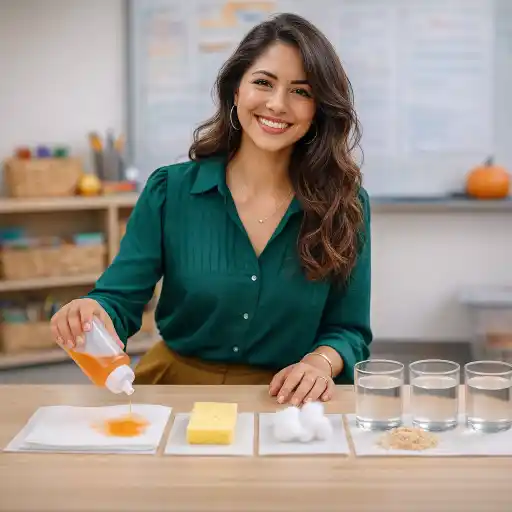
Some materials, such as many papers, fabrics, and sponges, have fibers or small spaces that can take in and hold water. Materials like foil and wax paper generally do not soak up water in the same way; water tends to remain on the surface or move across it. For preschoolers, simple language is enough: “Some materials have tiny spaces where water can go. On other materials, the water stays on top.”
Children do not need a detailed molecular explanation to make a meaningful observation. Help them connect what they can see and feel: the paper towel darkened, the sponge felt heavier, or the foil still had a bead of water on it. Then invite them to compare. The result may vary with the material’s thickness, coating, weave, or condition, so encourage careful observations rather than assuming every sample will behave identically.
Extend the challenge by asking children to choose a material for a specific job: Which would help wipe a table? Which might be useful under a rainy leaf collection? This connects material properties to everyday uses without framing absorbent or water-resistant materials as universally better. The American Chemical Society’s Waterproof Wonders activity also illustrates how porous and non-porous materials behave differently when exposed to water.
How can you document children’s discoveries and extend the learning?
Documentation gives children a way to remember the test and notice how their thinking changes. Keep it simple: draw each material, add a check or mark for “soaked up” or “water stayed on top,” and record a few children’s words. For older preschoolers, the group might order materials from “soaked up a little” to “soaked up more,” explaining the evidence they used.
Revisit the chart after cleanup. Ask whether any predictions changed and what the group would like to test next. Children might compare two kinds of paper, try a cloth with a different texture, or investigate whether a larger sample seems to hold more water. Change only one feature at a time when the goal is to compare results. Documentation in inquiry science can include charts, photographs, drawings, journals, or video; these records help children reflect, communicate, and connect investigations over time.
To support participation, let children contribute through speech, drawing, pointing, movement, or demonstration. Some may prefer to watch before touching wet materials, and that is a valid way to engage. Offer tools such as a spoon or tongs when useful, and keep the setup accessible. The ECE Resource Hub guidance on inquiry recommends supporting children as they observe, predict, experiment, record, and share.
What common mistakes should providers avoid?
A few planning choices can make the challenge clearer and more enjoyable. First, avoid changing several conditions at once. If one sample is much larger, receives more water, or is tested longer than another, it is harder for children to determine whether the material made the difference. Consistency matters more than complex equipment.
Second, resist turning the activity into a race or a quiz with a predetermined winner. A sample may absorb quickly but hold little water, while another may take longer and retain more. Ask children what “best” means for the question they are exploring: fastest, greatest amount, or most useful for cleaning a small spill. The class can refine its question together.
Finally, plan for safety and cleanup. Use small amounts of water, keep floors dry, supervise materials, and follow your program’s procedures. Adapt the activity for children’s developmental levels and sensory preferences. State requirements vary - check your state licensing agency.
- Keep samples and water amounts as consistent as possible.
- Describe surprising results as useful evidence and invite another test.
- Make participation flexible, and prepare towels and a cleanup routine in advance.
Conclusion: Which material soaks up the spill best?
The answer depends on which materials the class tests and how the group defines “best.” A fair comparison gives each sample a similar opportunity, invites children to observe what happens, and uses evidence—such as dampness, visible water, or liquid released—to support a conclusion. The lasting value is the inquiry process: children make a prediction, try an idea, notice results, and communicate what they learned.
Start with a few familiar materials, a small amount of water, and an open question. Record the children’s discoveries, revisit their predictions, and let their next question guide an extension. For more structured professional learning on planning and supporting these experiences, explore ChildCareEd’s Basic Science in Early Childhood Buy Now $25.00 training. Pair the investigation with the Potion Experiment Cards Buy Now $1.50, Little Ice Detectives! Buy Now $2.50, the Sink-or-Float River Boat Challenge Buy Now $1.85, or focused training in Building Early Science Foundations  Buy Now $16.00 and Enhancing STEM Education for Infants and Toddlers Buy Now $16.00. These resources offer other ways to support children’s #curiosity, #observation, #prediction, #absorbency, and #inquiry through play.
- 45 Hour Child Growth and Development
- Classroom Setup for Child Care
- What Makes Me Special: An Overview of Autism and ADHD
- The ABCs of Behavior: Turning Challenges into Learning Opportunities
- 45 Hour Infant and Toddler Methods and Materials
- CDA Bridge Bundle: Family Child Care without Portfolio Review
- CDA Bridge Bundle: Infant/Toddler without Portfolio Review
- CDA Bridge Bundle: Preschool without Portfolio Review
- Lesson Planning for Preschoolers
- CDA Certification en Español: Recursos y Consejos para Educadores Bilingües
- 🤯 ¿Por qué este niño está teniendo un comportamiento difícil de repente?
- Cuáles Son las Señales de Alerta en el Desarrollo Infantil que Todo Educador Debe Conocer?
- 📜 ¿Qué es el Título 22 en el cuidado infantil de California?
- Juegos de Motricidad Gruesa
- Que es Título 22 en California?
- ¿Cuáles son las mejores actividades del Día de la Tierra para niños en casa o en el aula?
- Actividades de Motricidad Gruesa que Desarrollan el Equilibrio, la Coordinación y la Fuerza
- 10 Ejemplos de Cómo la Cultura Influye en el Desarrollo Infantil
- Proporciones de Cuidado Infantil y Tamaños de Grupo por Edad en Wisconsin (Guía Rápida para Centros y Hogares)
- Proporciones de Cuidado Infantil y Tamaños de Grupo por Edad en Nueva Jersey (Guía Rápida para Centros y Hogares)
- Actividades de Otoño Fáciles para Preescolares esta Temporada
- Ejemplos de Crianza Respetuosa vs. Crianza Permisiva
- Capacitación Previa al Servicio para Proveedores de Cuidado Infantil en California
- Calabazas, hojas y manzanas: actividades de otoño para preescolares
- Celebrando la amistad en el cuidado infantil durante el Día de los Mejores Amigos
- Canciones, juegos y preguntas de círculo para niños
- ¿Cómo puede la retroalimentación visual apoyar la fluidez en la multiplicación?
- ¿Faltan Materiales o Falta una Nueva Estrategia? Cómo Revisar los Rincones del Aula
- Which Classroom Material Soaks Up a Spill Best? A Fall Absorbency Challenge
