Frosty mornings and chilly afternoons can make late fall feel like a season for staying indoors—but a tray of ice can bring the changing weather right into your classroom. Try a simple, supervised investigation to help children practice predicting, observing, comparing, and describing change; for a deeper foundation in planning meaningful science experiences, explore ChildCareEd’s Basic Science in Early Childhood Buy Now $25.00 training. The ideas below offer a practical starting point, while the course can help you strengthen your approach to everyday inquiry.
Why is melting ice a meaningful late-fall investigation?
Late fall gives children many chances to notice temperature changes: chilly air, frost on a window, cold hands after outdoor play, or water that freezes overnight. Bringing ice indoors turns these familiar observations into something children can revisit closely. Unlike a quick demonstration, an investigation gives them time to form an idea, watch what happens, and reconsider their thinking.
Melting is also a clear, observable example of change. Children can see a hard, solid ice piece become liquid water, notice drips collect in a tray, and compare what happens in different places. They do not need formal vocabulary or written answers to take part. A gesture, drawing, comparison, or comment such as “This one is smaller” can show careful attention and developing reasoning.
These experiences support more than early science. Children practice waiting, taking turns, using descriptive language, and sharing ideas with peers. As educators, we can value their curiosity without rushing to supply the explanation. The aim is not to make every child memorize a fact about temperature; it is to help them notice evidence and feel that their questions matter. A carefully planned ice activity can make an ordinary seasonal moment a rich opportunity for #curiosity and conversation.
How can providers set up an accessible ice investigation?
Start with a small group, a washable tray, and a few large pieces of ice prepared in advance. The ChildCareEd resource Little Ice Detectives! Melting Ice Science & STEM Activity Pack Buy Now $2.50 is designed for children ages 3–5 and includes guided activities for observing change, comparing indoor locations, and recording discoveries through drawings, marks, or words. You can also build a simple setup with everyday materials.
- Place one large ice piece on a tray in a supervised indoor location. Keep the setup away from walkways and electrical equipment.
- Offer tools such as large-handled droppers, spoons, or tongs when appropriate, along with paper towels for spills.
- Invite children to look closely first. Ask, “What do you notice?” and “What do you think might happen?”
- Let children show their ideas through speech, gestures, home languages, drawings, or pointing to picture choices.
- For comparison, use similar-sized ice pieces in two safe indoor locations, keeping other conditions as similar as possible.
Plan the space and supervision before materials are brought out. Offer participation options for children with tactile sensitivities, mobility differences, or varied communication needs; observing, timing, documenting, and discussing are all meaningful roles. Establish clear rules, prevent mouthing, and follow program safety procedures. State requirements vary—check your state licensing agency.
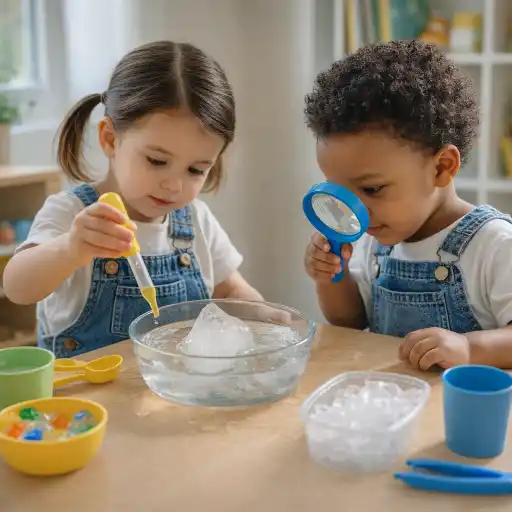
What can children investigate as the ice melts?
Keep the question concrete and within children’s reach. A useful starting question is, “Where might this ice melt faster?” Children can compare two indoor locations, such as a shaded table and a brighter area, while adults ensure the surfaces are safe and the ice is not placed near heat sources or direct hazards. Use similar ice pieces and trays so the comparison is easier to interpret.
Before starting, invite predictions: “Which one do you think will change first?” There is no need to judge predictions as right or wrong. Revisit the trays after a short interval, then again later. Children may notice puddles, smaller pieces, wetness, or differences in the speed of change. If the outcomes are hard to distinguish, that is still useful information: the group can discuss what was alike or different and consider what to adjust in another trial.
Other simple extensions include watching one ice piece at several time points, comparing a dry tray with a wet one, or observing what happens when a child uses a dropper to add a small amount of warm—not hot—water with adult supervision. Change only one feature at a time when possible, so children can make a clearer comparison. Avoid adding salt or other substances unless the activity is specifically planned with suitable supervision and clear safety procedures. The focus is on children’s observations and questions, not on producing a dramatic result.
How can educators guide inquiry without taking over?
Educators create structure through thoughtful materials, clear boundaries, and open-ended prompts, while leaving room for children to investigate. The scientific method in the early childhood classroom can be understood as an adaptable cycle: ask a question, make a prediction, explore, notice what happened, and share a conclusion. With young children, this cycle may unfold through play and conversation rather than a formal worksheet.
Try prompts that invite observation and reasoning:
- “What do you notice about the ice now?”
- “What changed since we looked earlier?”
- “How could we compare these two trays?”
- “What makes you think that?”
- “What would you like to find out next?”
Pause after asking; children may need time to think, watch a peer, or respond nonverbally. Reflect their ideas without immediately correcting them: “You think the brighter spot may make it change sooner. Let’s keep watching.” If the result differs from a prediction, treat that as a discovery rather than a failure. Children can revise an idea as evidence accumulates. In its guidance on preschool investigations, For Happy Baby’s ice science and safety overview likewise emphasizes balancing children’s autonomy with gentle, thoughtful support. A calm adult presence helps children stay engaged while preserving their agency.
How can documentation extend the learning?
Simple documentation helps children remember what they noticed and gives educators insight into their thinking. Take a photo of the setup at the beginning and later in the investigation, make a two-column class chart for “Our predictions” and “What we noticed,” or invite children to draw before-and-after pictures. An adult can write down a child’s exact words, including a brief comment such as “The water is making a lake.”
Documentation should make children’s ideas visible, not turn the activity into a test. Some children may use marks, symbols, pointing, movement, or home-language descriptions rather than conventional writing. Offer these ways to participate and allow enough time for children to revisit the evidence. If the group is interested, bring out the photos or drawings the next day and ask what they remember or wonder now.
Use your notes to plan a next step: repeat the comparison with larger ice pieces, observe ice at a different time of day, or connect the investigation to frost seen outdoors. Share a short, privacy-conscious update with families describing what children explored and a question they asked. The ChildCareEd article on turning one science question into a preschool investigation offers related guidance on following children’s questions, documenting discoveries, and letting inquiry develop over time. Thoughtful documentation helps the experience become part of a connected curriculum rather than a one-day novelty.
What common pitfalls should educators avoid?
A common pitfall is explaining the science before children have had time to observe. Briefly name the materials and safety expectations, then let children explore and share their initial ideas. Another is treating a prediction as a test with a single “correct” answer. An unexpected result can lead to an even better question; invite children to describe what they actually saw before offering additional information.
It can also be tempting to change several conditions at once—location, amount of water, size of ice, and timing. That makes it difficult for children to compare results. Keep the first investigation simple and vary one feature at a time. Avoid overly complicated equipment or long waiting periods that do not fit the group’s attention and schedule; short check-ins can preserve interest while still showing change over time.
Safety and access deserve equal attention. Ice and water can create slippery surfaces, and small pieces may pose a choking risk for young children. Choose age-appropriate materials, supervise actively, keep ice and tools out of mouths, clean spills promptly, and stop if a child becomes uncomfortable with the cold. Adapt the activity so children can participate by looking, predicting, timing, drawing, or talking. Clear boundaries make exploration more confident and welcoming.
Conclusion: How can one tray of ice support real science learning?
A late-fall melting investigation can be simple and purposeful: begin with a question, invite predictions, provide time to observe, and help children compare what they notice. A tray of ice offers concrete evidence of change and creates natural opportunities for vocabulary, cooperation, early reasoning, and documentation. Children do not need to reach an adult-level explanation to have meaningful learning; their observations and evolving ideas are the work of science.
Keep the experience safe, accessible, and open-ended. Change one condition at a time, use prompts that encourage thinking, and treat unexpected results as information to explore. For a ready-to-use set of preschool melting investigations, consider the Little Ice Detectives! activity pack Buy Now $2.50. To strengthen your broader approach to classroom inquiry, explore the two-hour Basic Science in Early Childhood Buy Now $25.00 course, which focuses on planning meaningful experiences that support children’s scientific reasoning.
More ChildCareEd learning options
- Basic Science in Early Childhood Buy Now $25.00 — strategies for planning science experiences and supporting children’s reasoning.
- Building Early Science Foundations
 Buy Now $16.00 — play-based science inquiry for infants and toddlers.
- Tomorrow’s Einsteins: Infant and Toddler Science Buy Now $16.00 — ways to expand infants’ and toddlers’ curiosity through discovery.
- Children at the Wheel: Emergent Curriculum — connecting children’s interests and questions with curriculum planning.
- Preschool Assessments & Observations Buy Now $24.00 — observing children and using what you learn to plan responsive experiences.
- 45 Hour Child Growth and Development
- Moving About the Classroom: Effective Transitions for Everyday
- What Makes Me Special: An Overview of Autism and ADHD
- Staying Positive: Guidance for Preschoolers
- From Tantrums to Triumphs: Equipping Preschoolers with Self-Regulation Skills
- The ABCs of Behavior: Turning Challenges into Learning Opportunities
- Building Equity: Inclusionary Practices in Preschool
- Lesson Planning for Preschoolers
- CDA Certification en Español: Recursos y Consejos para Educadores Bilingües
- 💛🧩 ¿Cómo puedo hacer que mi enseñanza sea inclusiva para los niños con autismo?
- Cómo ser director de cuidado infantil en Maryland
- ¿Qué preguntas aparecen en el examen CDA para preescolar?
- Proporciones de Cuidado Infantil y Tamaños de Grupo por Edad en Virginia (Guía Rápida para Centros y Hogares)
- Calabazas, hojas y manzanas: actividades de otoño para preescolares
- Celebrando la amistad en el cuidado infantil durante el Día de los Mejores Amigos
- Diversión fresca de verano: actividades del Día Nacional del Helado para niños
- Canciones, juegos y preguntas de círculo para niños
- Cómo simplificar la capacitación para sus empleados de daycare
- How can superhero-themed winter science activities energize your classroom?
- How can seasonal activities (spring, summer, fall, winter) combine fun with clear educational goals?
- How Can Preschool Sorting Activities Teach Temperature Concepts Safely?
- How Can One Science Question Become a Preschool Investigation?
- How Can Toddler Sensory Play Become a Science Investigation?
- Why Does Ice Melt Faster in Some Places? A Simple Preschool Science Investigation
- How Can Late-Fall Melting Investigations Turn Ice into Preschool Science?
- How Can Preschoolers Explore Ice, Frost, Snow, and Melting Through Winter Science?
- How Can You Teach Temperature Before Children Understand Weather Numbers?
- How Can Michigan Preschool Teachers Turn Snowy Days Into Learning Opportunities?
