A fall walk can spark wonder, but returning to one familiar tree helps children notice changes that a busy outing may miss. Explore Creating the Natural Outdoor Classroom  Buy Now $16.00 for ideas on turning outdoor spaces into purposeful places to learn, and consider Basic Science in Early Childhood Buy Now $25.00 for strategies that nurture young children’s questions and reasoning. A simple five-visit plan can help you build an ongoing investigation without adding a complicated lesson to an already full day.
Why return to the same tree instead of taking another nature walk?
A nature walk offers a lively collection of discoveries; a repeated visit offers continuity. When children return to one tree, they have a shared reference point for comparing what they see today with what they remember or recorded earlier. That comparison makes gradual change more visible and gives children a meaningful reason to look closely.
Early scientific thinking grows through habits such as noticing, describing, comparing, wondering, and revisiting ideas—not just through memorizing facts. A child who says, “It looks the same,” has made an observation. Another who notices fewer leaves on a branch is comparing evidence. Both contributions can shape what the group investigates next.
This kind of project also connects children with a familiar place in their community. The tree becomes more than scenery: it is a dependable subject children can get to know over time. A documented project in Looking at the Trees around Us illustrates how children’s questions, field observations, drawings, and investigations can grow into a sustained study.
For providers, the approach is practical. Five brief visits can provide a manageable beginning, and the group can continue if children remain interested. Keep the goal open: children do not have to discover a dramatic seasonal transformation for the investigation to be worthwhile.
How can five visits create a simple inquiry arc?
Choose a safe, accessible tree that the group can revisit, and set a realistic schedule. Weekly visits are one option; shorter intervals may suit your outdoor routine. Try to start from a similar spot so children can compare views, while welcoming details they notice from new angles.
- Visit 1 — Meet the tree: Invite children to look and listen. Ask, “What do you notice?” Record initial observations through words, gestures, sketches, or a photograph of the tree.
- Visit 2 — Look for patterns: Ask what seems the same or different. Notice leaves, branches, bark, the ground, and the surrounding environment.
- Visit 3 — Follow a question: Revisit a question children raised, such as whether wind moves the leaves or where fallen leaves collect. Observe rather than assume an answer.
- Visit 4 — Compare records: Look back at an earlier drawing, quote, or photo. Invite children to describe what changed and what stayed consistent.
- Visit 5 — Share what we know and wonder: Bring together observations and children’s current questions. Decide whether the group wants to continue, investigate a related topic, or celebrate what it has noticed.
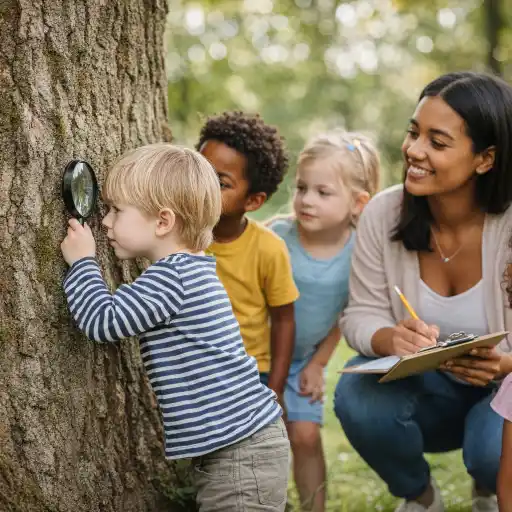
Keep each visit brief and responsive. A planned question can guide attention, but children’s discoveries should be allowed to redirect the conversation. The purpose is a repeated cycle of #observe, record, compare, and wonder—not a checklist that every child must complete in the same way.
What should children notice and how can educators document it?
Begin with the particular tree and local conditions rather than a fixed picture of fall. Some trees lose leaves; evergreen trees generally retain their needles. Species, climate, and weather all influence what children will see, and a tree may show little visible change between visits.
Encourage children to look beyond leaf color. They may notice the number or position of leaves, visible branches, buds or seeds, bark texture, fallen leaves, twigs, light, wind, rain, or animal activity. Open prompts support comparison without pointing children toward one expected answer: “What looks the same?” “What looks different?” and “What could we check next time?”
- Record the date and the tree or viewing location.
- Capture one or two specific observations, using children’s exact words where possible.
- Invite a drawing, pointing, gesture, dictated phrase, or photograph as a record.
- Keep entries in sequence so children can revisit earlier evidence.
A brief note such as “On Thursday, Sam pointed to the lower branch and said, ‘There are fewer leaves’” is more useful than a broad judgment about what Sam understands. A printable Fall Tree Change Observation Checklist Buy Now $2.00 can help educators record dates and compare visible changes across visits.
📝 Keep documentation descriptive and child-centered; the record should make children’s thinking easier to revisit, not turn the outing into a test.
Which learning areas can grow from repeated tree watching?
A sustained tree study naturally brings several learning domains together. When a child says, “This branch has fewer leaves,” the child is comparing quantities, using language, and referring to visible evidence. Peers can add different observations, practice listening, and consider what the group might look for next.
- Science: Notice features, compare evidence, ask questions, and make tentative predictions.
- Math: Count visible leaves, compare “more” and “fewer,” sort observations, or make a simple picture chart.
- Language and literacy: Dictate journal entries, learn words such as “bare,” “attached,” “rough,” and “damp,” and revisit a shared record.
- Art and representation: Draw the same tree on different dates and compare what each drawing shows.
- Social learning: Share attention, take turns contributing, and listen to peers’ explanations.
Model precise vocabulary in context rather than quizzing children. If a child says, “The tree is empty,” you might respond, “You noticed fewer leaves on the branches. Let’s see what is on the ground.” This honors the child’s idea while adding language for closer description. Observation can also guide responsive planning: the Eastern Connecticut State University resource Science with Young Children features an investigation in which young children studied trees over several months.
How can the investigation be safe, inclusive, and manageable?
Before each visit, scan the area for hazards such as sharp objects, unstable branches, traffic, animal waste, standing water, or unfamiliar plants and fungi. Maintain active supervision and follow program procedures for weather, allergies, outdoor play, and handwashing. Do not invite children to taste unknown plants or handle unfamiliar materials without checking their safety. State requirements vary - check your state licensing agency.
Make participation flexible. Children can observe from a seated spot, use a magnifier, point to a detail, dictate words, draw indoors from a photo, or watch before joining the conversation. Visual prompts, accessible routes, adaptive tools, and home-language vocabulary help children enter the same investigation in different ways. Touching a leaf or speaking in a group should not be prerequisites for contributing.
Keep materials developmentally appropriate. Small seeds, nuts, and similar natural objects can pose choking risks, particularly for children who mouth items. If collecting is not appropriate or permitted, use photographs or adult-selected examples. Protect living things by observing plants and wildlife without disturbing them.
- 🍂 Avoid turning visits into quizzes; welcome varied observations and questions.
- Do not expect a dramatic change every time. “It looks the same” is useful information.
- Let children help document the investigation instead of doing all the recording for them.
- Look beyond color to include branches, ground, weather, and surroundings.
How can educators extend the investigation beyond the fifth visit?
Use the children’s records and questions to decide what comes next. If they are comparing leaf amounts, make a simple picture chart. If wind caught their attention, revisit on a breezy day and notice what moves. If they wonder where fallen leaves go, look for evidence over time or share an appropriate book. Be honest when an explanation is uncertain or a natural process takes longer than the project.
Invite children to look back at their early drawings and observations. Ask what they might add now, what they still wonder, and what evidence helped them change or strengthen an idea. This reflection makes learning visible without requiring one correct final answer.
Share selected documentation with families, following program privacy practices. A short note or a photo of the tree can invite families to notice seasonal changes in their own neighborhoods. For more professional learning on designing nature-rich spaces and making the outdoors a purposeful part of the program, explore Creating the Natural Outdoor Classroom Buy Now $16.00. Providers who want to strengthen objective documentation may also find Preschool Assessments & Observations Buy Now $24.00 relevant.
Conclusion: What can five visits to one tree teach children?
Five returns to one familiar tree can help preschoolers notice gradual change, compare evidence, develop descriptive language, represent ideas, and ask new questions. The value lies not in producing a dramatic discovery but in making time and careful attention part of children’s everyday experience.
Choose an accessible tree, establish a repeatable routine, record a few child-led observations, and adjust the next visit in response to what children notice. Keep the experience safe and inclusive, and let “the same” be as meaningful as “different.” In that steady rhythm, an ordinary fall walk can become a genuine investigation—and a lasting connection to a place children know.
- Creating the Natural Outdoor Classroom
- 45 Hour Child Growth and Development
- CDA: Creating the Outdoor Classroom
- 45 Hour Preschool Methods and Materials
- Birth to Five CDA Credential with Portfolio Review
- 45 Hour Infant and Toddler Methods and Materials
- CDA Bridge Bundle: Preschool
- 45 Hour School Age Methods and Materials
- Lesson Planning for Preschoolers
- CDA Certification en Español: Recursos y Consejos para Educadores Bilingües
- Cómo Abrir Una Quardería En Casa Sin Dinero?
- Requisitos Para Ser Maestra Principal En Un Daycare: Lo Que Necesitas Para Empezar
- Proceso CDA: Entrenamiento, Portafolio, Examen y Visita de Verificació
- 10 Ejemplos de Cómo la Cultura Influye en el Desarrollo Infantil
- ¿Qué Preguntas Vienen en el Examen CDA de Nacimiento a los Cinco Años?
- Proporciones de Cuidado Infantil y Tamaños de Grupo por Edad en Nueva Jersey (Guía Rápida para Centros y Hogares)
- Lista para Abrir una Guardería en Casa en Dakota del Norte: Cómo Empezar
- Lista para Guardería en Casa en Illinois: Cómo Iniciar una Guardería en el Hogar
- Cómo Ser Maestra de Preescolar en Illinois
- Cómo Ser Maestra de Preescolar en Wisconsin
- Cómo Ser Maestra de Preescolar en California
- Cómo Ser Maestra de Preescolar en Maryland
- Celebrando la amistad en el cuidado infantil durante el Día de los Mejores Amigos
- Canciones, juegos y preguntas de círculo para niños
- How Can One Plant Help Children Notice Gradual Change Outdoors?
- Why Can Observing the Same Tree Teach Preschoolers More Than a Nature Walk?
- How Can Five Visits to the Same Tree Become a Preschool Investigation?
- How Can Preschoolers Tell Evergreen Trees from Trees That Change Color?
