Fire safety is a critical professional responsibility in every child care program because young children depend entirely on trained adults to protect and guide them during an emergency. This article provides practical, developmentally appropriate strategies for teaching children basic fire-prevention habits, introducing alarms and emergency vocabulary without creating fear, conducting consistent evacuation drills, and partnering with families to reinforce safety at home. It also explains how directors and providers can prepare staff, assign emergency responsibilities, maintain clear evacuation routes, and evaluate each drill to improve future responses. To strengthen your program’s fire and emergency readiness, explore ChildCareEd’s Emergency and Disaster Preparedness – Online  Buy Now
 $55.00$45.00 and Creating an Emergency and Disaster Preparedness Plan Buy Now $16.00. If budget is a concern, see our guide on how to save on emergency preparedness training, which outlines discounts and package options to help centers access essential disaster-preparedness courses. These trainings help child care professionals develop emergency protocols, evacuation procedures, and organized program-level plans. Remember that state requirements vary, so always check with your state licensing agency when developing fire-safety lessons, policies, and drill procedures.
What should young children actually learn about fire safety?
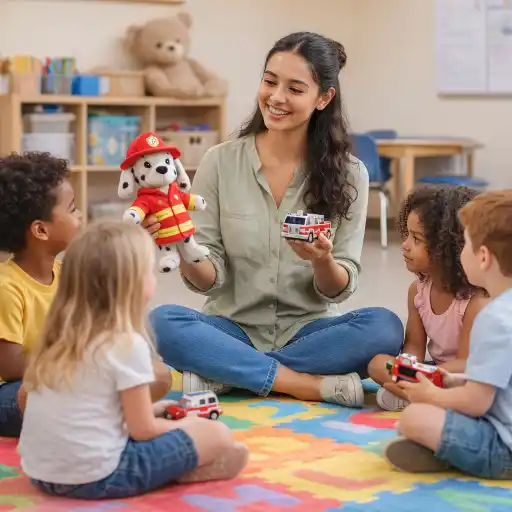
- 👩🚒 Know who firefighters are and that they are helpers — reduce fear by introducing gear and faces, as recommended in the NFPA/Sparky preschool curriculum and classroom resources like Sparky.org/ NFPA materials.
- 🧯 Keep away from matches and lighters; tell an adult if you find them — reinforce with sorting activities and role play as suggested in early childhood lesson guides.
- 🔥 Practice “Stop, Drop, and Roll” and when/how to crawl low under smoke — teach with songs and kinesthetic practice (see the Red Cross guidance at Red Cross Fire Safety for Kids).
- 🚪 Know two ways out of every room and a safe outside meeting place — create simple maps and practice routes; home and center versions are available from ChildCareEd: Our Home Fire Escape Plan Buy Now $0.00.
- ☎️ Only call 911 from a safe place; remind children it’s the way to get help after they are out.
Why it matters: clear, repeated messages increase recall under stress. Children who practice drills calmly are more likely to follow adult direction during a real incident — which saves seconds and lives (Maryland State Fire Marshal guidance).
How can staff design engaging fire safety activities that teach skills without creating fear?
- 🎨 Arts & Props: crafts (fire trucks, helmets) and labeled anchor charts to build vocabulary — see classroom examples from Pre-K Printable Fun and Preschool Plan-It. Consider collaborating with arts-in-education partners such as Story Tapestries for arts-integration workshops and story-based performances that reinforce safety themes in culturally responsive ways.
- 🚒 Community Connections: arrange a firefighter visit or virtual tour — normalize protective gear and answer children’s questions; resources and visit tips are in many center guides like One Sharp Bunch.
- 📚 Story & Literacy Integration: emergent readers, safety-rule books, and songs that reinforce key phrases (e.g., “Get out, stay out”) — use ready-made curricula such as the NFPA early childhood packets noted at Sparky.org.
- 🎯 Sensory & Motor Practice: stop/drop/roll with music, low-crawl obstacle courses, and “put out the flames” fine-motor games to practice skills safely (activity ideas).
- 🧩 Centers & Differentiation: literacy/maths themed centers with fire-safety vocabulary and problem-solving tasks help integrate concepts across the day (center examples).
Practical tips for classroom delivery:
- Start with curiosity, not alarm: show a firefighter’s helmet, read a reassuring story, then practice one short skill.
- Use repetition: 2–3 short activities across several days beats a single long lesson.
- Include culturally responsive examples and family routines — invite take-home sheets or a home escape map activity (family letters and worksheets).
How often and how should centers practice drills and rehearse emergency plans?
 📅 Frequency & Variety:
- Conduct formal fire drills at least monthly — many programs and state licensing bodies require monthly drills; check local rules because state requirements vary - check your state licensing agency (ChildCareEd: Basic Health & Safety).
- Vary times and scenarios (nap-time, transition, outside) so staff and children experience realistic variations.
- 📝 Documentation & Debrief:
- Record date, time, attendance, exit route used, timing, problems observed, and corrective actions. Use a drill log — required in many licensing systems (When Seconds Count).
- After every drill, hold a brief staff debrief (a “hot wash”) to identify improvements and update your Emergency Operations Plan.
- 🚪 Practical drill features:
- Use real alarm sounds occasionally to familiarize children and staff with sensory cues, while minimizing excessive repetition that could cause anxiety (practice tips).
- Assign staff roles (lead, sweep, attendance, family liaison) and rotate them so substitutes know expectations.
- 🔄 Review & Adapt: Annual review of the plan and after any facility change; coordinate with the local fire department for inspections and feedback (Maryland State Fire Marshal).
Why it matters: rehearsed teams act more calmly; documentation protects children and programs during audits and improves continuous quality (CDC early care guidance).
What equipment and staff training should every child care program maintain?
Equipment, routine checks, and staff competence form the backbone of an effective fire safety program. At minimum:
- 🔔 Working smoke alarms and carbon monoxide detectors on every level and outside sleeping areas; test monthly and replace batteries at least annually or per manufacturer guidance (Red Cross).
- 🧯 Fire extinguishers placed and inspected per local code; key staff should receive basic extinguisher training and learn the P.A.S.S. technique (Pull, Aim, Squeeze, Sweep) as described in the industry guidance (Fire news).
- 🚑 Emergency supplies: first-aid kits, evacuation backpacks, contact lists, and at least one staff member with current pediatric CPR/First Aid on-site at all times (ChildCareEd training guide).
- 🪜 Escape tools: for multi-story centers, ensure windows have quick-release devices or accessible escape ladders where required (Red Cross).
- 👩🏫 Staff training: regular fire safety induction, hands-on drills, and tabletop exercises. Coordinate with local fire responders to conduct familiarization visits and practice realistic scenarios (When Seconds Count).
Practical compliance tip: create a visible checklist for monthly safety tasks (alarms, extinguishers, emergency kits) and log completion to demonstrate due diligence during inspections.
How can programs partner with families and avoid common mistakes?
Family engagement strengthens home–center consistency and reduces confusion during emergencies. Use these actionable steps:
- 📢 Communicate clearly:
- Send concise take-home materials with family activities (home escape map, meeting place worksheet). ChildCareEd and NFPA materials provide family letters and printable activities (NFPA resources).
- Host an annual safety night or virtual briefing that models a home drill and explains your reunification plan.
- 👨👩👧👦 Encourage family drills: invite families to practice twice-yearly home drills and return a simple completion form; this builds consistency between home and center (Nemours KidsHealth).
- ❌ Common mistakes and how to avoid them:
- Rushing drills — keep them calm and scripted; prioritize clear adult direction.
- Not rotating staff roles — cross-train everyone so substitutes can execute plans.
- Overloading children with frightening details — use age-appropriate language and focus on helpers and steps they can do.
- Failing to document — always log drills and equipment checks.
- 🤝 Build community partnerships: invite local firefighters to review plans and provide child-centered messaging; they can also advise on safety hardware and building-specific escape options (Maryland guidance).
FAQ — Practical questions child care providers ask
- How often should we change smoke alarm batteries? Replace batteries at least annually and immediately when alarms chirp; test alarms monthly (Red Cross).
- Are children too young to practice drills? No — practice short, calm drills adapted to developmental levels; toddlers can learn a simple cue and follow an adult to an assembly spot (Preschool Plan-It).
- Should we teach “stop, drop, and roll” to toddlers? Yes — teach with songs and movement, keeping the practice brief and positive (lesson ideas).
- How do we include children with mobility needs? Build individualized evacuation plans, ensure assigned staff are trained for assisted evacuation, and practice these plans regularly (preparedness guide).
Summary
Teaching fire safety in early care is about doing a few things very well: simplify messages for children, design engaging practice that builds skill without fear, rehearse and document drills consistently, maintain the right equipment and staff training, and partner with families. Start by picking 3 classroom activities and one policy change (e.g., monthly documented drill or family escape map) to implement this month. Small, consistent steps build a strong #firesafety culture that protects children, reassures families, and supports staff confidence. For additional center-ready materials and training, review the ChildCareEd resources linked throughout this article and remember: state requirements vary - check your state licensing agency.
Young learners need a small set of clear, memorable rules they can recall under stress. Distill adult-level emergency plans into 4–6 simple, repeatable concepts you teach by modeling, story, and movement. Core messages to teach include: Regular practice and documentation are non-negotiable. Drills build muscle memory; they also reveal gaps in plans and equipment. Use the following guide: Young children learn best through multi-sensory, playful experiences. Aim for activities that are: short, concrete, repeated, and scaffolded. Practical activity types include:
- Stay Alert! Steps for Emergency Prep
- CDA Home Visitor Subject Area 3 Part 3 Birth to 5
- CDA Home Visitor Subject Area 2 Part 3 Birth to 5
- Basic Health & Safety and Breastfeeding Awareness
- CDA Family Child Care Credential
- Birth to Five CDA Credential with Portfolio Review
- Emergent Learning & Development
- Texas Director Credential
- Preventative Health and Safety
- Ensure the Health and Safety of Young Children
- D.C. Emergency Preparedness Training
- CDA Certification en Español: Recursos y Consejos para Educadores Bilingües
- Basic Health and Safety Training: The Essential Guide for New Child Care
- 🔍 ¿Qué ves cuando observas a un niño aprender?
- Cómo Solicitar una Licencia de Guardería en Texas
- Regulaciones de Cuidado Infantil en Maryland para Centros y Hogares de Cuidado Infantil Familiar
- Normas de Licenciamiento de Cuidado Infantil en Virginia para Centros Diurnos Infantiles y Hogares Diurnos Familiares
- Proporciones de Cuidado Infantil y Tamaños de Grupo por Edad en Maryland (Guía Rápida para Centros y Hogares)
- Proporciones de Cuidado Infantil y Tamaños de Grupo por Edad en Nueva Jersey (Guía Rápida para Centros y Hogares)
- Proporciones de Cuidado Infantil y Tamaños de Grupo por Edad en Virginia (Guía Rápida para Centros y Hogares)
- Normas de Licenciamiento de Cuidado Infantil en Illinois: Guía para Centros y Hogares de Cuidado Infantil
- Lista para Abrir una Guardería en Casa en Georgia: Cómo Empezar
- Lista para Guardería en Casa en Texas: Cómo Iniciar una Guardería en el Hogar
- Cómo Trabajar en el Cuidado Infantil en California: Requisitos y Pasos
- Cómo Ser Maestra de Preescolar en Maryland
- Canciones, juegos y preguntas de círculo para niños
- Cómo simplificar la capacitación para sus empleados de daycare
- How Can Child Care Programs Teach Fire Safety Effectively to Young Children?
- How Can Child Care Programs Teach Fire Safety to Young Children?
