When four- and five-year-olds can arrange, label, and explore the stages of an apple tree’s growth, a big science idea becomes something they can see and explain. The Basic Science in Early Childhood Buy Now $25.00 course offers educators practical guidance for nurturing inquiry through meaningful classroom experiences; explore it for a deeper foundation as you try the activities below.
Why teach the apple life cycle through hands-on activities?
A life cycle is more than a list of stages: it is a pattern of growth and renewal. Preschoolers are beginning to understand how living things change over time, but the idea can feel abstract if it is only explained verbally. Pictures, real objects, movement, and conversation give children multiple ways to build a mental model of that process.
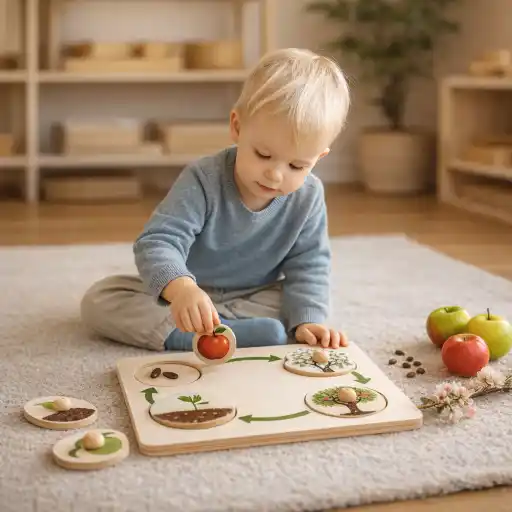
An apple is a familiar entry point. Children may have eaten one, seen an orchard, or noticed blossoms and fruit in a picture book. Connect that knowledge to the sequence—seed, sprout, young tree, mature tree, blossom, fruit, and seeds again—and help children see how one stage relates to the next. The final return to seeds is especially useful: it shows why this is a cycle, not simply a one-way growth chart.
Sequencing and labeling also make science learning visible to educators. As children place a picture, name a stage, or explain a choice, providers can notice what they understand and where another prompt or example may help. These activities can support:
- Scientific observation and early understanding of living things.
- Vocabulary, storytelling, and listening to others’ explanations.
- Fine-motor practice through placing, cutting, tracing, or drawing.
- Persistence and reasoning as children solve a simple maze or reconsider an order.
The aim is not to require every child to memorize every term. It is to invite #curiosity and give children concrete ways to discuss change, growth, and the repeating pattern of a #lifecycle.
How can sequencing cards make growth easier to understand?
Sequencing cards help children organize events in time and explain how one stage leads toward another. Use clear illustrations or photographs that show the seed, sprout, seedling, growing tree, blossom, and fruit-bearing tree. Invite children to arrange the cards on a mat, along a floor path, or in a small-group pocket chart. The ChildCareEd Apple Tree Life Cycle activity pack Buy Now $2.00 includes six stage cards and a sequencing mat, along with labeling and maze activities.
Before asking children to put the cards in order, take time to look closely together. Ask, “What do you notice?” and “Which picture might come first?” Then invite a child to explain a placement. If children disagree, treat that as an opening for discussion rather than a mistake to correct immediately. Ask what clues in the pictures support each idea.
- Model the sequence once with a think-aloud: “A seed comes before a sprout because the sprout grows from the seed.”
- Offer just a few cards at first, then add stages as children become comfortable.
- Invite children to retell the sequence in their own words or act it out with their bodies.
- Ask what comes after the apple: the seeds can begin the pattern again.
A simple sequence can be revisited over several days. Children may first match pictures, later arrange them independently, and eventually tell a story about the process. Keep the focus on reasoning and meaningful language, not speed or perfect recall. Use words such as #seed, sprout, blossom, and fruit as part of the conversation, and welcome gestures or home-language explanations as children share what they see.
What does picture labeling add to the science conversation?
Picture labeling links words to visible features. A cross-section of an apple can introduce skin, flesh, core, and seeds. Point to each part on a real apple or clear image, say the word, and invite children to find the matching feature. Then let them place picture or word labels, draw lines, or dictate a label for an adult to write.
For four- and five-year-olds, labeling should be an invitation to notice and name—not a spelling test. Some children may recognize a word or attempt to copy it; others may point, match a card, describe what they see, or use a language spoken at home. Each response gives the educator information about children’s understanding and offers a chance to expand vocabulary naturally.
Use open prompts that connect anatomy with the life cycle:
- “Where do you see the seeds?”
- “What do you notice around the seeds?”
- “How might these seeds connect to the beginning of our sequence?”
- “What part of the tree do you think the apple grew from?”
If you use a real apple, plan for supervision, food allergies, hygiene, and safe cutting by an adult. Children can observe without tasting or touching. Labeling works well as a small-group activity or science-center invitation; repeat it later with a drawing or model so the words have more than one context. In this way, a picture becomes a starting point for observation, description, and early scientific reasoning—not just a worksheet to finish.
How can a maze encourage problem-solving without taking over?
A simple maze can give children a playful way to think about a seed’s journey toward becoming a tree. As they trace a route, they practice looking ahead, choosing a path, and changing direction when they meet a dead end. The task can also strengthen visual tracking and hand control, but the learning value lies in children’s decisions and reflections—not simply reaching the finish.
Introduce the challenge with a brief invitation: “Can you help the seed find a way to grow?” Let children begin with a finger, a large token, or a crayon, depending on their comfort and motor skills. If a child reaches a blocked route, pause before offering the answer. Try prompts such as “What do you notice?” “Where could you try next?” or “Would you like to look at the path together?”
- Choose a route with a manageable number of turns; make it more complex only when the child is ready.
- Provide a finger-tracing or token option before expecting pencil control.
- Let children explain a choice with words, gestures, or pointing.
- Notice persistence, planning, and trying another route—not just completion.
🧩 When a child changes direction after a dead end, acknowledge the strategy: “You found that path was blocked and tried another way.” That response treats an error as useful information and builds confidence to keep exploring. If frustration grows, simplify the task, offer a brief break, or solve one section together. A maze is most effective when it remains a supportive challenge, with the adult nearby as a calm guide rather than the person steering every move.
How can educators connect the activities into a meaningful lesson?
Use sequencing, labeling, and the maze as parts of one short inquiry rather than unrelated worksheets. Begin with a read-aloud, an apple, or a set of pictures. Invite children to share what they already know, then arrange the life-cycle stages together. Next, examine an apple illustration or real apple to label its parts, and finish with a maze that asks children to plan a route. Revisit the stages at another time so children can retell or draw what they remember.
Keep the educator’s role responsive. Offer enough information to clarify a misconception, but allow children to make predictions and test their ideas against pictures, objects, or one another’s explanations. A child who says the apple comes before the flower may need to see the stages side by side and discuss what the pictures show. Use precise language without expecting adult-level explanations.
Adapt the experience so each child can participate. Use larger, high-contrast pictures; reduce the number of cards; offer a pointing or verbal response; or pair children to talk through choices. For a child who is ready for more, ask how the cycle repeats or compare the apple cycle with another plant. Keep documentation simple: note a child’s words, an independent sequence, or a strategy used in the maze. These small observations can guide what to revisit next.
Common pitfalls are manageable:
- Rushing through the answers: pause for children to observe and explain.
- Expecting every child to use the same words or complete the task in the same way.
- Teaching a growth sequence without helping children connect fruit back to seeds.
- Making the maze so difficult that solving it replaces the science idea.
Thoughtful planning connects materials to children’s interests while respecting different ways of communicating and learning. For more guidance on science inquiry and developmentally appropriate activity design, providers may explore the English-language ChildCareEd courses Lesson Planning for Preschoolers  Buy Now $24.00, DAP for Preschool Buy Now $24.00, Building Vocabulary Buy Now $16.00, and Curriculum Planning Buy Now $35.00. State requirements vary - check your state licensing agency.
Summary: What helps preschoolers understand how an apple tree grows?
Children can make the apple tree’s life cycle more understandable when they actively arrange its stages, connect names to visible parts, and work through a simple problem. Sequencing cards support awareness of order and change; picture labeling builds vocabulary and careful observation; and a maze offers a low-pressure opportunity to plan, persist, and try a new route. Together, these activities make an abstract science concept concrete and engaging for four- and five-year-olds.
Keep activities flexible, invite children to explain their thinking, and treat different responses as useful information about what they understand. Most of all, help children connect the fruit-bearing tree back to the seeds that can begin the cycle again. For a fuller foundation in planning purposeful science experiences, explore ChildCareEd’s Basic Science in Early Childhood Buy Now $25.00 course and use the activities as invitations to look closely, wonder, and learn together.
- 45 Hour Child Growth and Development
- 45 Hour Preschool Methods and Materials
- What Makes Me Special: An Overview of Autism and ADHD
- Children at the Wheel: Emergent Curriculum
- The Science of Growing Up: Typical and Atypical Development
- Our School Age Family Tree: Children, Staff, & Parents
- 45 Hour School Age Methods and Materials
- Building Early Science Foundations
- Montessori Cultural Activities: Exploring the World Through Play and Learning
- CDA Certification en Español: Recursos y Consejos para Educadores Bilingües
- 10 Ejemplos de Cómo la Cultura Influye en el Desarrollo Infantil
- Proporciones de Cuidado Infantil y Tamaños de Grupo por Edad en Virginia (Guía Rápida para Centros y Hogares)
- Cómo Celebrar el Día Nacional del Kindergarten
- Actividades de Otoño Fáciles para Preescolares esta Temporada
- Lista para Guardería en Casa en Illinois: Cómo Iniciar una Guardería en el Hogar
- Cómo Trabajar en el Cuidado Infantil en Carolina del Norte: Requisitos y Pasos
- Calabazas, hojas y manzanas: actividades de otoño para preescolares
- Celebrando la amistad en el cuidado infantil durante el Día de los Mejores Amigos
- Canciones, juegos y preguntas de círculo para niños
- Cómo simplificar la capacitación para sus empleados de daycare
- Mixed-Age Daycare Schedule: How to Plan a Day for Different Age Groups
- Fall Detectives: 10 Questions Pre-K Kids Can Investigate This Season
- Rosh Hashanah Sensory Bin Ideas: Apples, Honey, Shofars, and Sweet New Year Play
- How Can Preschool Activities Help Children Follow an Apple Tree’s Life Cycle?
- How Can an Apple Stand Become Meaningful Preschool Math?
- Why Can Observing the Same Tree Teach Preschoolers More Than a Nature Walk?
- Can Everyone Reach the Apples? How Can Fall Pretend Play Teach Positional Words?
- How Can Children Connect Spring Pollination to the Fall Apple Harvest?
- How Can Fall Classroom Play Help Children Stretch, Reach, and Twist?
