When children bite into a fall apple, they can trace its story back to spring blossoms and the pollinators that visited them. Build that year-spanning connection through simple observations and play, and consider ChildCareEd’s Basic Science in Early Childhood Buy Now $25.00 course to strengthen your planning for inquiry-rich classroom experiences. The focused training supports educators in creating meaningful opportunities for children to investigate, question, and develop scientific reasoning.
Why connect pollination with harvest?
Fall apple activities often begin with what children can hold, taste, count, and compare. Connecting the harvest to spring pollination helps them see that food has a history: an apple begins as a flower, and its development depends on conditions and relationships children may not immediately notice. This makes a familiar seasonal theme a rich entry point for life science and environmental learning.
The connection also gives children a reason to revisit ideas over time. A spring blossom and an autumn apple may seem unrelated until teachers help children build a sequence: flowers bloom, pollinators move pollen among blossoms, fruit develops, and seeds form inside. The focus is not memorizing a vocabulary list, but understanding that living things change and interact.
For providers, this approach makes curriculum more coherent across seasons. Children can practice observation, sequencing, comparison, and explanation while strengthening their sense of connection to food and place. It also honors their everyday questions—“Where did this apple come from?”—as meaningful scientific thinking.
What is the relationship between apple blossoms and fruit?
Apple trees produce blossoms in spring. When pollen is transferred to a flower’s reproductive parts, fertilization can occur and the flower may develop into fruit. As an apple grows, seeds develop within it. Pollinators such as bees can carry pollen between flowers while visiting for food; some apple varieties also depend on compatible varieties flowering nearby for effective cross-pollination.
Use accurate but child-friendly language. Explain that pollen is a fine powder made by flowers, and pollination happens when pollen moves from one flower to another. Avoid implying that every blossom automatically becomes an apple: pollination is part of the process, and fruit development depends on additional conditions.
- Show a photo sequence: spring blossom, visiting pollinator, small developing fruit, ripe apple.
- Use a real apple to locate the seeds, then relate them back to the flower-to-fruit story.
- Invite children to explain the sequence in their own words, drawings, gestures, or home language.
This connection turns an ordinary snack or harvest display into a meaningful #science conversation and helps children notice how plant life cycles unfold across seasons.
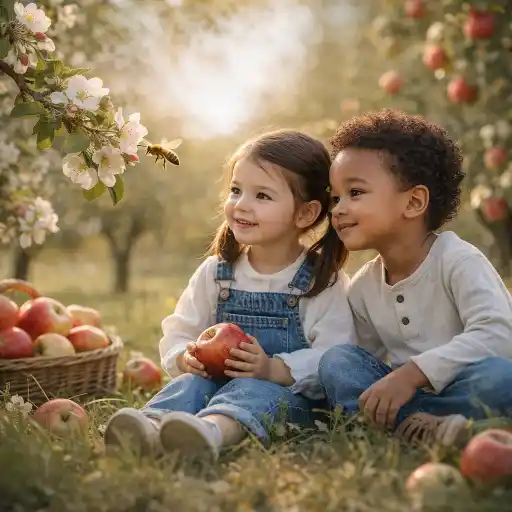
How can educators make pollination visible and memorable?
Young children learn best when an idea becomes something they can observe, model, and talk about. Pollination itself may be quick and difficult to see outdoors, so use representations alongside real-world observations. A simple role-play can make pollen transfer visible without handling insects or flowers.
- Set out paper flowers and small pieces of tissue or washable chalk dust as pretend pollen. Children move a cotton ball or paper bee from flower to flower and notice what transfers.
- Read a picture book about flowers, bees, or apples, then ask children what they noticed and what they wonder.
- On a supervised outdoor walk, look for blossoms and pollinator activity from a respectful distance. Avoid touching or disturbing insects.
- Invite children to draw a flower, pollinator, and developing apple, then connect the drawings with arrows.
Keep the model conceptually clear: the cotton ball represents pollen transfer; it is not a bee’s actual behavior in every detail. Ask open questions such as “What changed after the pollinator visited?” and “What might happen if a flower does not receive pollen?” Accept developing explanations and return to them as children gather more evidence.
For a classroom-ready activity sequence and teacher support, explore ChildCareEd’s Apple Tree Life Cycle Activity Pack Buy Now $2.00. It includes sequencing and observation materials that can help children revisit how a tree grows and bears fruit.
How can you carry the learning from spring into fall?
A single activity can introduce the idea, but revisiting it across the year helps children build a more durable understanding. Start in spring by observing blossoms, sharing photos, or planting a pollinator-friendly container garden if your program has a suitable space. Record what children notice with drawings, dictated comments, or a shared chart.
In summer, revisit the documentation and look for changes in nearby trees or orchard photographs. In fall, bring the story back during an apple investigation. Compare varieties by color, size, smell, or texture; cut fruit with adult supervision to examine its parts and seeds; and ask children to place images in the order they think the events occurred.
- Spring: Notice blossoms and discuss what pollinators do.
- Summer: Revisit photos and observe whether small fruit is developing.
- Fall: Explore harvested apples and connect seeds and fruit to the earlier blossom stage.
- Across seasons: Keep a simple class journal with dates, pictures, and children’s observations.
Not every program has access to an orchard or a flowering tree. Books, photographs, short videos, and produce from local markets can support the same conceptual sequence. Invite families to share seasonal observations or familiar foods when appropriate, while recognizing that not every child has the same experiences with gardens or farms.
How can you support inquiry, inclusion, and safety?
Use children’s ideas as a starting point rather than expecting them to reach one polished answer immediately. Ask what they notice, what they think happened, and what evidence might help them decide. Record their words and revisit them later. A child might first say that apples “grow from bees”; with pictures and discussion, the group can refine that idea into a more accurate account of flowers, pollen transfer, and fruit development.
Make participation flexible. Children can communicate through speaking, pointing, drawing, acting, or using home languages. Offer photographs or models for children who prefer not to be near insects, and do not require contact with flowers, pollen, or outdoor materials. Before outdoor activities, check allergy information, follow program health and supervision plans, and use age-appropriate materials. State requirements vary - check your state licensing agency.
Common pitfalls include describing pollination as bees “making” apples, presenting the model as a literal account, or treating one observation as proof of every step. Be clear that pollinators help transfer pollen and that fruit development involves plant processes beyond the visible visit. Keep explanations simple without making them misleading. These practices value children’s #curiosity while grounding discussion in careful observation.
Conclusion: How can children understand the journey from pollination to apples?
Children can connect the spring pollination period to the fall apple harvest when educators make the stages visible and revisit them over time. Blossoms, pollinators, developing fruit, ripe apples, and seeds form a meaningful sequence that children can explore through observation, dramatic play, books, and hands-on apple investigations.
Start with a question children genuinely have, use simple models and accurate language, and return to the same idea as the seasons change. Keep activities safe, accessible, and responsive to children’s ways of communicating. With thoughtful support, an apple at snack can become a reminder of spring, plant relationships, and the natural processes behind familiar foods.
To deepen your classroom science practice, explore these English-language ChildCareEd courses:
- Basic Science in Early Childhood Buy Now $25.00 — inquiry, investigation, and scientific reasoning.
- Building Early Science Foundations
 Buy Now $16.00 — play-based exploration and foundational science learning.
- Creating the Natural Outdoor Classroom Buy Now $16.00 — strategies for meaningful nature-based experiences.
- Tomorrow’s Einsteins: Infant and Toddler Science Buy Now $16.00 — supporting science curiosity in the earliest years.
- Children at the Wheel: Emergent Curriculum Buy Now $25.00 — using children’s interests to guide inquiry and planning.
- CDA Home Visitor Subject Area 3 Part 3 Birth to 5
- CDA Home Visitor Subject Area 2 Part 3 Birth to 5
- Birth to Five CDA Credential with Portfolio Review
- Pediatric RSV First Aid & CPR/AED
- CDA Bridge Bundle: Family Child Care without Portfolio Review
- CDA Bridge Bundle: Infant/Toddler without Portfolio Review
- CDA Bridge Bundle: Preschool without Portfolio Review
- Connections That Count: Building Relationships in Child Care
- Texas Director Credential
- Every Moment Matters: Schedules and Transitions
- Seasonal Changes and School Prep: Adapting to Weather and Activities
- CDA Certification en Español: Recursos y Consejos para Educadores Bilingües
- 💛🧩 ¿Cómo puedo hacer que mi enseñanza sea inclusiva para los niños con autismo?
- ❄️ What Outdoor Activities Work Well for Illinois Kids in Every Season? 🌷🍂
- Cómo ser director de cuidado infantil en Maryland
- Actividades de Motricidad Gruesa que Desarrollan el Equilibrio, la Coordinación y la Fuerza
- 10 Ejemplos de Cómo la Cultura Influye en el Desarrollo Infantil
- Capacitación en Salud y Seguridad Preventiva en Línea para Proveedores de Cuidado Infantil
- ¿Qué preguntas aparecen en el examen CDA para preescolar?
- Regulaciones de Licenciamiento de Cuidado Infantil en California para Centros y Hogares de Cuidado Infantil Familiar
- Proporciones de Cuidado Infantil y Tamaños de Grupo por Edad en Nueva Jersey (Guía Rápida para Centros y Hogares)
- Proporciones de Cuidado Infantil y Tamaños de Grupo por Edad en Virginia (Guía Rápida para Centros y Hogares)
- Lista para Guardería en Casa en Illinois: Cómo Iniciar una Guardería en el Hogar
- Retraso del Habla en la Guardería: Cómo Pueden Ayudar los Proveedores
- Las Mejores Ideas de Excursiones para Guarderías en Texas
- Calabazas, hojas y manzanas: actividades de otoño para preescolares
- Celebrando la amistad en el cuidado infantil durante el Día de los Mejores Amigos
- Canciones, juegos y preguntas de círculo para niños
- Cómo simplificar la capacitación para sus empleados de daycare
- How Can Children Connect Spring Pollination to the Fall Apple Harvest?
