Turn a familiar pretend-play center into a lively place for children to count, compare, sort, and explain their thinking. The Lesson Planning for Preschoolers course  Buy Now $24.00 can help you plan developmentally appropriate experiences with clear learning goals; for focused strategies on math through hands-on play, explore Early Mathematics Through Play Buy Now $24.00. A few intentional choices can transform an apple stand from a fun theme into a rich, flexible learning environment.
Why does an apple stand offer meaningful math learning?
An apple stand is familiar enough for children to enter the story quickly, yet open-ended enough to support substantial mathematical thinking. As children pretend to be growers, shoppers, or cashiers, they encounter quantities and relationships for a real purpose: gathering apples, filling baskets, comparing prices, or making sure each customer receives an order.
These playful exchanges give educators opportunities to connect concrete actions with mathematical language. Counting apples one by one supports one-to-one correspondence; grouping by color or size develops classification; weighing and comparing invites measurement; and discussing which variety is most popular introduces data. Children can revisit the same ideas across several days, gradually taking on more complex challenges.
The value is not in making every interaction a quiz. Instead, adults notice what children are trying, name useful concepts, and pose questions that invite reasoning. An apple market can also strengthen language, cooperation, and problem-solving as children negotiate roles and share materials. In this way, early #math is integrated with the social and imaginative work of play.
How should you set up the market for exploration?
Keep the center inviting and manageable. A small table, baskets, pretend apples, reusable bags, a toy register or simple checkout box, and a few signs can establish the scene. Add a child-height shelf or clearly marked bins so children can reach, organize, and return materials independently. Real apples can be used for supervised observation or taste-testing when program procedures and family needs allow; pretend produce is often the simplest option for sustained role play.
Choose props that make mathematical actions possible, not just a polished-looking display. A balance scale encourages comparing weight, while price cards, order pads, number cards, and play money create reasons to count and represent quantities. Consider including different colors and sizes of apples so children have meaningful attributes to sort and describe.
- Offer baskets, tongs, and trays for collecting, transferring, and grouping.
- Use picture labels as well as numerals so children can participate in different ways.
- Include clipboards, blank paper, and markers for lists, signs, and informal records.
- 🍎 Begin with a few clear props, then add materials in response to children’s ideas.
Inspect materials for damage and choking risks, supervise small items, and follow sanitation procedures. State requirements vary - check your state licensing agency. Inclusive materials and labels in children’s home languages can help more children take part confidently.
Which math ideas can children practice in the market?
Counting is an obvious starting point, but the stand can support a broader range of concepts. Invite a child to place one apple in a basket for each number word, then ask, “How many apples are in the basket?” This links counting to cardinality—the understanding that the final number names the total. Number cards or dot cards can give children visual support.
Sorting and comparing are equally important. Children might group apples by color, size, or type, then explain their sorting rule. Ask whether one basket has more, fewer, or the same number of apples. Matching one apple from each group can make comparison visible before children rely on number symbols.
Prices can be used flexibly without expecting formal money skills. Set simple prices, such as one play coin per apple, and encourage children to count out the required number. Older or more experienced preschoolers might combine small quantities or compare two orders. The goal is reasoning with objects and language, not speed or perfect transactions.
- Counting: Count apples into an order or basket, touching each item once.
- Sorting: Organize produce by color, size, or another chosen feature.
- Comparison: Decide which basket has more, fewer, or an equal amount.
- Patterns: Arrange red-green-red-green apples and invite children to continue.
- Measurement and data: Compare weights or graph which apple color shoppers choose.
Apple-themed counting, patterning, and graphing are common hands-on approaches described in preschool apple math activities. Choose only a few targets at a time so play remains coherent and enjoyable.
How can educators extend play without taking it over?
Before children enter the center, introduce the market with a brief conversation, a related story, or a demonstration of one possible role. Model a useful interaction—“I’d like three apples, please”—then invite children to decide what happens next. A short model can make the space accessible, especially for children who are new to dramatic play, while preserving their ownership of the scenario.
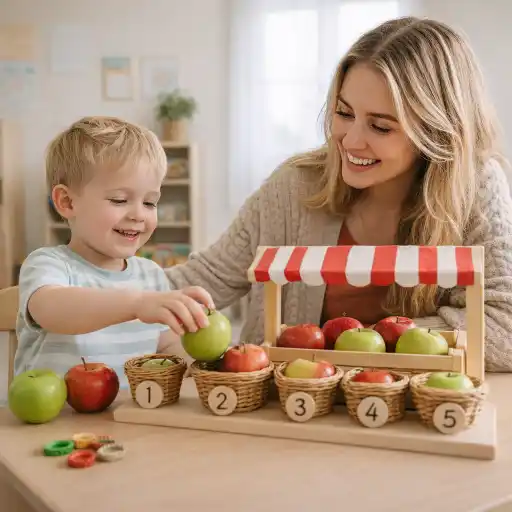
During play, use prompts that help children notice, predict, and explain. “How could we make sure each shopper gets two apples?” supports counting and planning. “Which basket feels heavier? How could we check?” invites comparison and measurement. “What do you notice about the pattern?” encourages children to identify and extend a sequence. If a child’s strategy is not yet accurate, explore it together rather than correcting immediately: “Let’s touch each apple as we count.”
Observe first, then decide whether a question, new prop, or extra challenge would be useful. A child who is still learning to count small sets may benefit from fewer apples and dot cards; a child who counts reliably may be ready to compare two orders or make a simple graph. Keep the center open long enough for play to develop. The goal is intentional scaffolding, not directing every move.
Planning with explicit objectives and flexibility is central to effective preschool instruction; the ChildCareEd guide to lesson planning for preschoolers offers related planning ideas.
How can you adapt the center and learn from what children do?
Preschool classrooms include children with different interests, language experiences, motor skills, and levels of mathematical understanding. Offer multiple ways to participate: children can point to an apple, match a picture, use a gesture, speak, draw, or handle objects. Larger props, stable trays, and easy-to-grip baskets may support children who need additional motor access. Pair key words such as “more,” “same,” and “heavy” with gestures, visuals, and home-language terms when possible.
Use brief observations to guide the next step. Rather than writing “understands counting,” record what you saw: “Leo touched each of five apples once and said ‘five’ when asked how many.” Then consider what would extend learning: perhaps compare two baskets or invite Leo to make a set of six. Photos of a child’s arrangement, a market sign, or a simple graph can capture thinking without interrupting play.
Common pitfalls are easy to avoid. Too many props can overwhelm children; start small and add selectively. Adult-led scripts can narrow children’s ideas; model briefly and step back. Worksheets may have a place in a broader curriculum, but they should not replace children’s hands-on exploration. Finally, avoid assuming that every child is ready for the same number range or challenge.
Offer choices that invite participation and adjust the task—not the child’s sense of belonging. The market is successful when children can explore, communicate, and build on their own strategies.
Conclusion: What makes an apple stand a meaningful math center?
An apple stand becomes meaningful preschool math when educators connect children’s play to a few intentional, developmentally appropriate goals. Counting, sorting, comparing, patterning, measuring, and simple data conversations can all emerge naturally as children shop, stock, and sell pretend apples.
To make the center work in practice:
- Set up a few accessible props that invite counting, grouping, and comparing.
- Use mathematical language in warm, conversational questions.
- Observe children’s strategies and adjust materials or prompts to extend thinking.
- Support different abilities and languages with visual, tactile, and verbal options.
- Protect child-led play while offering brief, purposeful scaffolding.
The main question—how can an apple stand become meaningful preschool math?—has a practical answer: build from children’s pretend-play ideas, make quantities visible, and respond with curiosity. A shared market can offer many small, joyful opportunities for children to see themselves as capable mathematical thinkers.
For ready-to-use dramatic-play materials, consider the Preschool Harvest Market Dramatic Play Setup and Play Guide Buy Now $2.00 or the Autumn Farmers Market Pretend Play guide Buy Now $1.50. To extend professional learning beyond this article, review the Math Foundations in Early Childhood Buy Now $16.00 course.
- 45 Hour Child Growth and Development
- Birth to Five CDA Credential with Portfolio Review
- Children at the Wheel: Emergent Curriculum
- Emergent Learning & Development
- Creating Environments that Nurture Growth and Community
- Lesson Planning for Preschoolers
- Texas Director Credential
- 45-Hour Infant and Toddler Curriculum
- CDA Certification en Español: Recursos y Consejos para Educadores Bilingües
- Cómo Abrir Una Quardería En Casa Sin Dinero?
- Requisitos Para Ser Maestra Principal En Un Daycare: Lo Que Necesitas Para Empezar
- ¿Qué Calificaciones Necesitas para Trabajar en Cuidado Infantil?
- Normas de Licenciamiento de Cuidado Infantil en Virginia para Centros Diurnos Infantiles y Hogares Diurnos Familiares
- Proporciones de Cuidado Infantil y Tamaños de Grupo por Edad en Virginia (Guía Rápida para Centros y Hogares)
- Lista para Guardería en Casa en Texas: Cómo Iniciar una Guardería en el Hogar
- Cómo Ser Maestra de Preescolar en Illinois
- Cómo Ser Maestra de Preescolar en Wisconsin
- Cómo Ser Maestra de Preescolar en California
- Cómo Ser Maestra de Preescolar en Maryland
- Cómo Ser Maestra de Preescolar en Virginia
- Calabazas, hojas y manzanas: actividades de otoño para preescolares
- Celebrando la amistad en el cuidado infantil durante el Día de los Mejores Amigos
- Canciones, juegos y preguntas de círculo para niños
- Cómo simplificar la capacitación para sus empleados de daycare
- Rosh Hashanah Kindergarten Lesson Plans: 5 Days of Apples, Kindness, and New Beginnings
- ¿Cómo puede la retroalimentación visual apoyar la fluidez en la multiplicación?
- ¿Todos los niños deben participar en el tiempo de círculo?
- How Can an Apple Stand Become Meaningful Preschool Math?
