When children wonder where animals go—or how they endure the cold—you have a natural opening for lively, meaningful science. A playful winter inquiry can build vocabulary, observation, collaboration, and early reasoning; ChildCareEd’s Basic Science in Early Childhood Buy Now $25.00 offers practical guidance for planning experiences that invite children to investigate and ask questions. Explore the course as a next step, then use the ideas below to bring hibernation, migration, and other winter strategies to life through play.
Why teach winter survival through play?
Winter animal learning connects children’s everyday observations—cold weather, changing daylight, birds overhead—with the needs of living things. The central idea is not that every animal sleeps through winter or travels south, but that animals use different strategies as food and conditions change. The National Park Service identifies migration, dormancy, and physical or behavioral adaptations among these strategies; some animals also store food or remain active.
Play gives children a way to model these ideas with their bodies and materials before they can explain them in formal scientific language. Building a den involves planning and testing; pretending to migrate makes movement and destination concrete; sorting animal pictures helps children notice similarities and differences. These experiences also support oral language, cooperation, fine- and gross-motor development, and curiosity.
Keep the learning responsive rather than aiming for perfect recall. Listen for children’s theories, value their questions, and use books, photographs, and observation to refine ideas together. For additional inspiration, ChildCareEd’s winter classroom activities for child care providers includes ideas for seasonal science, movement, and sensory exploration.
How can we introduce hibernation accurately and accessibly?
Begin with a concrete question: “What might an animal need when winter brings less food?” Invite children to notice what they already know and what they wonder. Explain that hibernation is a form of dormancy involving significant changes in an animal’s body and energy use—not simply a long, uninterrupted human-style nap. Winter strategies differ across species, so avoid describing all bears or all animals as behaving in exactly the same way.
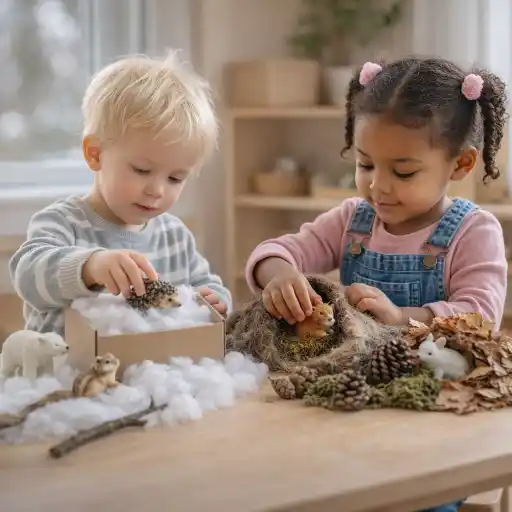
Use photographs, nonfiction picture books, and toy animals to connect the idea to real habitats. Children can build a cave, burrow, or sheltered resting place from blocks, fabric, leaves, and cardboard. Ask them to explain how their structure might protect an animal; then invite them to revise it after a gentle “winter wind” test, such as fanning a paper sheet nearby.
- Set up a small-world den-building area with animal figures and open-ended materials.
- Offer a “prepare for winter” dramatic-play prompt: What might the animal need before settling into its shelter?
- Use picture cards to compare animals and discuss which examples need more information.
- Make room for different ideas; ask, “What makes you think that?” rather than supplying every answer.
For a play-based extension, children can design dens in the block area and draw or dictate what they discovered. Keep materials age-appropriate and supervise small objects carefully, particularly with infants and toddlers.
How can migration become an active classroom game?
Migration is seasonal movement from one habitat to another, often connected to food, climate, or reproduction. It is more than a one-way trip to somewhere warm: many species make seasonal journeys that include a return. National Geographic Education describes varied migration patterns across animal groups, and a child-friendly classroom simulation can make movement and destination tangible without implying that every animal follows the same route.
Make a simple route across the room with two clearly marked “habitats.” Children can carry an animal picture or puppet along the path as they respond to story prompts: “The food is harder to find here,” or “The weather is changing.” Pause to ask what clues might influence an animal’s journey. Use a wall map or floor map to trace a real example, such as monarch butterflies traveling to overwintering areas in Mexico, while noting that the trip spans generations.
- Invite children to choose how their animal travels—flying, swimming, or walking—and act it out safely.
- Place picture cards along the route as “rest stops” and discuss why an animal might pause.
- Have children work together to make a large migration path with yarn, blocks, or paper arrows.
- 🧭 Add a simple map and ask children to point out the starting place, destination, and return route.
After the game, ask children to retell the journey in sequence. Their explanations can reveal whether they understand movement as a response to changing needs, rather than simply “going somewhere sunny.”
How can children compare different ways animals cope with winter?
Hibernation and migration are memorable, but they are only part of the story. Some animals remain active and rely on adaptations such as thicker coats, camouflage, sheltered roosting, or food storage. The National Park Service’s overview of wildlife winter survival describes migration, dormancy, and adaptations as distinct strategies, while its lesson on preparing for winter also highlights storing food. Use these examples to help children see winter survival as a range of possibilities rather than a two-choice quiz.
Create a three-part sorting area labeled “moves,” “rests or becomes dormant,” and “stays active or uses another strategy.” Use a small number of well-supported animal examples, photographs, and captions. Model how to say “This is one example” and “Some members of this group…” because animal behavior can vary by species, location, and conditions. Children can sort, explain their reasoning, and then reconsider a card when they learn new information.
Extend the classification into movement and construction: children can act out a migrating flock, build a sheltered nest, camouflage an animal against a paper snow scene, or hide pretend food for later. These playful comparisons foster #curiosity and #observation while supporting language, categorization, and reasoning. A hands-on photo-card activity such as How Animals Prepare for Winter picture cards Buy Now $2.00 can prompt small-group discussion and comparison.
How do we plan inclusive, purposeful play and assess learning?
Effective activities give children varied ways to participate. Some may explain an idea aloud; others may show it through movement, drawing, building, or pointing to a picture. Offer familiar materials, visual cues, and choices, and adapt the challenge to children’s ages and abilities. A migration path can be walked, rolled with a toy animal, or followed visually; den-building can be collaborative or explored individually.
Plan a short sequence: introduce one question, provide time to explore, then revisit children’s thinking. Capture their words or drawings with brief notes. Rather than testing whether every child remembers a list of animals, listen for evidence of developing understanding: Can a child describe a winter challenge? Compare two strategies? Give a reason for a choice? These observations help you decide whether to add a new example, clarify vocabulary, or let the investigation continue.
- Ask open-ended questions: “What might happen if the animal cannot find food?”
- Model precise but accessible vocabulary, including habitat, migrate, shelter, and adapt.
- Use real photographs and books to distinguish pretend-play scenarios from factual claims.
- Share children’s questions and discoveries with families through a display or short classroom update.
Check that props and sensory materials are safe for the children in your care, and maintain active supervision. State requirements vary - check your state licensing agency when planning activities that involve materials, outdoor observation, or special supervision considerations.
What common misconceptions should educators avoid?
A playful lesson can still be scientifically careful. One common pitfall is treating “hibernation” as a synonym for ordinary sleep. Explain simply that dormancy involves changes that help some animals conserve energy, and use age-appropriate examples without overloading children with technical detail. Another is saying that all animals migrate south. Migration routes and triggers vary, and many animals stay in place while using other survival strategies.
Also avoid assigning one strategy to an entire broad group. For example, not every bird migrates, and animal behaviors can vary across species and habitats. Use accurate picture books or reputable wildlife sources to check examples before teaching. If children offer an idea that is partly right, respond appreciatively and investigate together: “That’s a thoughtful guess. Let’s look for clues.”
Finally, keep pretend play distinct from claims about nature. Children may enjoy pretending that a bear sleeps all winter, but you can gently add that real animals’ winter behavior is more complex. End with a question that keeps inquiry open—“What evidence could help us find out?”—and let children’s questions guide the next read-aloud, observation, or classroom investigation.
Conclusion: How can play make winter survival meaningful?
Children can understand how animals survive winter when educators make the strategies visible, active, and open to investigation. Den building can introduce shelter and dormancy; route games can model migration; sorting and camouflage play can highlight adaptations, food storage, and the diversity of animal behavior. The most useful learning comes from connecting play to photographs, books, careful conversation, and children’s own observations.
Keep the key message clear: animals respond to winter in different ways, and examples should be described with care. Ask questions, notice children’s reasoning, adapt materials so everyone can participate, and follow their curiosity toward new discoveries. With intentional play, the question “How do animals survive winter?” becomes a rich invitation to think, move, collaborate, and learn.
- Tomorrow's Einsteins: Infant and Toddler Science
- Pediatric RSV First Aid & CPR/AED
- CDA Bridge Bundle: Family Child Care without Portfolio Review
- CDA Bridge Bundle: Infant/Toddler without Portfolio Review
- The Best Promotion is Play
- CDA Bridge Bundle: Preschool without Portfolio Review
- Texas Director Credential
- Building Early Science Foundations
- Building Vocabulary
- Access for All: Inclusion and the ADA
- DIY Snow Globes: The Fine Motor Craft That’ll Keep Kids (and Adults) Busy for Hours
- CDA Certification en Español: Recursos y Consejos para Educadores Bilingües
- 💛🧩 ¿Cómo puedo hacer que mi enseñanza sea inclusiva para los niños con autismo?
- 10 Ejemplos de Cómo la Cultura Influye en el Desarrollo Infantil
- Proporciones de Cuidado Infantil y Tamaños de Grupo por Edad en Maryland (Guía Rápida para Centros y Hogares)
- Proporciones de Cuidado Infantil y Tamaños de Grupo por Edad en Nueva Jersey (Guía Rápida para Centros y Hogares)
- Proporciones de Cuidado Infantil y Tamaños de Grupo por Edad en Virginia (Guía Rápida para Centros y Hogares)
- Lista para Guardería en Casa en Illinois: Cómo Iniciar una Guardería en el Hogar
- Por Qué la Supervisión Activa Es Clave para la Seguridad en el Cuidado Infantil
- Cómo Trabajar en el Cuidado Infantil en Carolina del Norte: Requisitos y Pasos
- Celebrando la amistad en el cuidado infantil durante el Día de los Mejores Amigos
- Canciones, juegos y preguntas de círculo para niños
- Cómo simplificar la capacitación para sus empleados de daycare
- Why Is Animal Bingo a Great Way to Introduce Habitats and Classification?
- How Can Child Care Providers Keep Young Children Active When It’s Freezing Outside?
- How Can Rainforest Animals Help School-Age Children Understand Adaptation?
- How Can Cozy Animal Bedtime Play Teach Preschoolers Sequencing in Fall?
- How Can Child Care Providers Keep Toddlers and Preschoolers Active Indoors During Winter?
- No Snow? No Problem! How Can You Create Winter Sensory Activities for Every Childcare Classroom?
- How Can Play Help Children Understand How Animals Survive Winter?
