When preschoolers tuck a plush fox into a leafy den, they can do more than enjoy a cozy autumn scene: they can practice putting events in order and telling what happens next. Try the Language Development in Early Childhood  Buy Now $16.00 course to strengthen your toolkit for supporting children’s verbal and nonverbal communication; it offers practical ideas for building a language-rich classroom. Read on for a simple, flexible bedtime-play plan that turns seasonal animal interests into meaningful learning.
Why does bedtime play make sequencing meaningful?
Sequencing is the ability to organize events in a logical order. For preschoolers, this abstract idea becomes easier to understand when it is connected to familiar actions: an animal finds a cozy place, settles in, rests, and wakes when the season changes. Children can see, move, and narrate the steps instead of relying on words such as “first” and “next” in isolation. Picture-based sequencing likewise helps young children connect event order with following directions and understanding how a process unfolds (sequencing activities for preschoolers).
Fall offers inviting details—cooler weather, leaves, animal homes, and preparations for winter—that make the play feel fresh and concrete. Keep the science accurate and age-appropriate: not every animal hibernates, and animals have varied winter behaviors. The purpose here is to explore a pretend bedtime sequence, not to teach that all woodland animals sleep through winter.
There is a language benefit, too. As children assign roles, describe animal actions, and negotiate what comes next, they practice vocabulary, listening, and storytelling. Research reviews report an association between pretend play and children’s language development, while recognizing that findings do not establish a simple cause-and-effect relationship (review of pretend play and early language; meta-analysis of pretend play and language).
How can educators set up a cozy fall animal bedtime scene?
Create a small, calm play area with a few stuffed animals or sturdy animal figures, fabric “leaves,” a box or basket den, and picture cards showing a simple sequence. Use safe, age-appropriate materials and maintain supervision; avoid loose pieces that could present a hazard for younger children. A small set is often more inviting than a crowded collection.
Choose three or four clear steps, such as:
- First, the animal gathers leaves or finds a den.
- Next, it settles into its cozy bed.
- Then, it rests while the evening gets quiet.
- Last, it wakes and stretches in the morning.
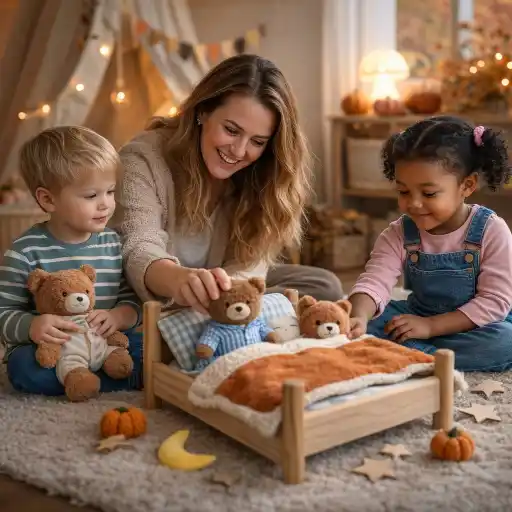 Introduce the sequence with pictures, gestures, and a brief model. Say, “First, the hedgehog finds a soft place. Next, it curls up.” Invite children to arrange the cards, act out the steps, or tell the story in their own way. Familiar daily routines can also support early sequencing; ChildCareEd’s day-and-night sorting ideas connect routine language with concrete pictures and conversation.
Let children choose the animal and setting where possible. A squirrel might rest in a nest, while a child may invent a cozy den for a rabbit. Invite ideas rather than treating the activity as a quiz: “What could happen before the animal rests?”
What language can teachers model during the play?
Model a small set of sequence words repeatedly: “first,” “next,” “then,” and “last.” Pair them with descriptive vocabulary such as “rustling,” “soft,” “quiet,” “den,” “curl,” and “stretch.” Children need time to process and respond, so allow a pause after a prompt rather than filling every silence. Expand what children communicate naturally: if a child says “fox sleep,” you might respond, “The fox is settling into its leafy bed.”
Use open-ended prompts that invite children to reason and create:
- “What does the animal do before it curls up?”
- “How can we tell this picture comes next?”
- “What might the animal notice when it wakes?”
- “Would your animal’s bedtime story be different?”
Children can participate through speech, pointing, gestures, signs, movement, or augmentative and alternative communication. Respect home languages and invite family contributions, such as words for animals or bedtime routines. Everyday responsive exchanges—listening, following a child’s interest, and adding a little language—support communication more meaningfully than rapid-fire questioning (everyday conversation and early language development).
Storytelling can grow from the play itself. The National Literacy Trust recommends using props, role-play, puppets, and children’s own ideas to encourage story creation (supporting early years storytelling). Follow the child’s lead and let an unexpected plot twist become part of the shared story.
How can you adapt the activity for different learners?
Start with the child’s current skills and adjust the number of steps and level of support. Some children may confidently arrange four pictures; others may benefit from two choices, an adult model, or real objects paired with photographs. Begin with the animal settling and waking, then add a preparation step when the child is ready. A gradual approach to sequencing—from two events toward longer sequences—can make the task more accessible (sequencing activities and skill progression).
Offer multiple ways to take part:
- Use large, easy-to-handle pictures or objects for children who find small cards difficult.
- Provide a visual strip with spaces for “first,” “next,” and “last.”
- Let children act out the sequence, point to a choice, or dictate a story for an adult to record.
- Offer quiet participation or a small group for children who prefer less sensory or social stimulation.
- Use familiar animals and include pictures, vocabulary, and routines that reflect children’s families and communities.
Support does not need to make the activity less challenging; it can make the learning goal reachable. Observe children’s strategies without insisting that every invented story match an adult’s preferred plot. For providers seeking more guidance on practical language strategies across communication modes, Language Development in Early Childhood Buy Now $16.00 offers additional professional learning.
How can educators extend the play and notice learning?
Keep the play available long enough for children to revisit it. Add a favorite fall book, a simple song, a flashlight for evening pretend play, or a drawing station where children illustrate the animal’s beginning, middle, and end. After reading a story about an animal, invite the group to retell key events with figures or picture cards. Story-based retelling gives children a visual structure for recalling events in order (classroom books about hibernation and migration).
For a low-preparation extension, take photographs of the children’s play sequence—with appropriate permissions—and let them arrange the pictures the next day. Ask them to explain their choices, but accept a gesture or short phrase as meaningful communication. Watch for evidence such as whether a child:
- Recognizes or places two or more events in an order.
- Uses, understands, or responds to sequence words.
- Describes an animal’s actions or adds an idea to the story.
- Participates with peers by taking a turn, listening, or negotiating a role.
Record brief, objective notes: “Placed the den card before the resting card and said, ‘Then sleep.’” Use these observations to choose a next step, such as adding another picture or modeling a new word. Avoid judging learning by who speaks most or finishes first. State requirements vary - check your state licensing agency when determining whether any activity or related training counts toward required professional development.
Conclusion: What should providers remember about cozy bedtime sequencing?
Cozy animal bedtime play gives preschoolers a concrete, engaging way to practice sequence while building vocabulary, storytelling, and social communication. A simple fall-themed scene, clear picture steps, repeated language, and room for children’s ideas can transform pretend play into purposeful learning without taking away its warmth or spontaneity.
Begin with a few steps, model “first, next, then, last,” and adapt materials so every child can participate through words, gestures, pictures, or action. Notice children’s thinking and use those observations to guide what comes next. When providers pair responsive play with continued professional learning—such as ChildCareEd’s Language Development in Early Childhood Buy Now $16.00 course—they can strengthen the language-rich interactions that make these small classroom moments so valuable.
Explore five relevant ChildCareEd courses
- What Makes Me Special: An Overview of Autism and ADHD
- From Tantrums to Triumphs: Equipping Preschoolers with Self-Regulation Skills
- From Tantrums to Triumphs: Equipping Preschoolers with Self-Regulation Skills
- Working Together: Teachers & Preschoolers
- CDA Bridge Bundle: Family Child Care without Portfolio Review
- CDA Bridge Bundle: Infant/Toddler without Portfolio Review
- CDA Bridge Bundle: Preschool without Portfolio Review
- Building Equity: Inclusionary Practices in Preschool
- Lesson Planning for Preschoolers
- DIY Snow Globes: The Fine Motor Craft That’ll Keep Kids (and Adults) Busy for Hours
- Juegos de Motricidad Gruesa
- Actividades de Motricidad Gruesa que Desarrollan el Equilibrio, la Coordinación y la Fuerza
- 10 Ejemplos de Cómo la Cultura Influye en el Desarrollo Infantil
- Proporciones de Cuidado Infantil y Tamaños de Grupo por Edad en Maryland (Guía Rápida para Centros y Hogares)
- Proporciones de Cuidado Infantil y Tamaños de Grupo por Edad en Nueva Jersey (Guía Rápida para Centros y Hogares)
- Actividades de Otoño Fáciles para Preescolares esta Temporada
- Cómo Trabajar en el Cuidado Infantil en Carolina del Norte: Requisitos y Pasos
- Cómo Trabajar en el Cuidado Infantil en California: Requisitos y Pasos
- Cómo Ser Maestra de Preescolar en Illinois
- Cómo Ser Maestra de Preescolar en Maryland
- Las Mejores Ideas de Excursiones para Guarderías en Texas
- Cómo Ser Maestra de Preescolar en Virginia
- Calabazas, hojas y manzanas: actividades de otoño para preescolares
- Celebrando la amistad en el cuidado infantil durante el Día de los Mejores Amigos
- Canciones, juegos y preguntas de círculo para niños
- Cómo simplificar la capacitación para sus empleados de daycare
- Hello, Fall! Cozy Activities to Help Babies Explore the Season
- How Can You Build a Pretend Animal Burrow That Combines Fall Movement With Route Planning?
- How Can Cozy Animal Bedtime Play Teach Preschoolers Sequencing in Fall?
