Rainforest animals are more than memorable characters—they are vivid examples of how living things meet the challenges of a particular environment. Use the forest’s layers to help school-age children connect habitat, survival features, and ecological relationships, and consider the Lesson Planning to Meet School Age Needs  Buy Now $16.00 course for practical strategies to make inquiry engaging and responsive to varied learners. The activities below offer a starting point; the course can help you build a fuller toolkit for planning learning experiences.
Why does adaptation make a powerful learning topic?
For children, adaptation becomes easier to understand when it is connected to a real problem: finding food, avoiding predators, moving through dense vegetation, or conserving energy. Rather than memorizing a list of animal traits, learners can ask how a feature helps an animal function in a particular place. This approach supports observation, evidence-based reasoning, vocabulary development, and an appreciation of biodiversity.
Rainforests are especially useful for this exploration because conditions vary vertically. Light, moisture, shelter, food sources, and access routes differ from the forest floor to the emergent layer. The four-layer model—forest floor, understory, canopy, and emergent layer—gives children a clear organizing framework for comparing habitats, while reminding them that real ecosystems are complex and layers can overlap.
Adaptation also opens a thoughtful conversation about interdependence. An animal’s behavior and body features relate to plants, prey, predators, and the physical conditions around it. Encourage children to explain their ideas with evidence: “I think this feature helps because…” Such discussion nurtures curiosity and helps children see themselves as capable investigators.
How do the rainforest layers shape animal habitats?
Present the layers as distinct but connected neighborhoods, each with different conditions and opportunities. The forest floor is dim and humid, with fallen leaves and decomposing material. The understory receives limited light and has dense vegetation in places. The canopy forms a leafy network that provides abundant food and shelter for many species, while emergent trees rise into brighter, windier conditions. These patterns are summarized in the Amazon Rainforest Learning Note: The Four Layers and Animal Adaptations Buy Now $1.50, a family follow-up resource designed for children ages 8–12.
Make a large vertical forest diagram together. Invite children to place animal cards in a likely layer, then ask what evidence supports each choice. A sloth may be shown high in branches, a jaguar moving through the forest, and insects among leaf litter; explain that species ranges can cross layers, and the diagram is a helpful model rather than a strict boundary.
- Forest floor: What might help an animal find food or move through leaf litter in low light?
- Understory: How could camouflage or climbing help in a shaded, crowded space?
- Canopy: What features might support swinging, gripping, jumping, or reaching fruit?
- Emergent layer: How might animals cope with open air, wind, and greater exposure?
Children can label each layer with light, moisture, shelter, and food clues. This helps them see that a #habitat is not simply an address; it is a set of conditions that supports living things.
Which survival features can children investigate?
Choose a small number of examples and guide children to connect each feature to a function. Sloths, for example, spend much of their lives in trees; their slow movement and energy-saving physiology relate to a low-energy leaf diet, while algae on their fur can help them blend into the surroundings. Spider monkeys use long limbs and grasping tails to move among branches. Toucans’ bills can help them reach or handle food, and a jaguar’s spotted coat can break up its outline in dappled forest light. These examples are drawn from sources on rainforest animals and their survival features, including BBC Bitesize’s account of sloths and howler monkeys and the Teaching Wiki overview of rainforest adaptations.
Invite children to look closely at photos, illustrations, or short descriptions. Have them separate what they can observe from what they infer. “The tail wraps around a branch” is an observation; “it helps the monkey balance or hold on” is an inference to investigate. This distinction builds scientific habits and discourages guessing presented as fact.
- Camouflage: How might a color or shape make an animal less noticeable?
- Movement: What body structures help an animal climb, swing, glide, or fly?
- Feeding: How might beak shape, teeth, or diet help an animal access a food source?
- Behavior: How could activity at night or a choice of location affect risk or competition?
Emphasize that adaptations are features or behaviors that support survival and reproduction over generations, not deliberate changes an individual animal makes because it “wants” to adapt. A simple example can strengthen children’s understanding of #adaptation without oversimplifying evolutionary change.
How can educators connect animal features to ecological relationships?
An animal does not survive through its features alone. It relies on food sources, shelter, suitable conditions, and relationships with other organisms. A canopy animal’s ability to move between branches matters because the canopy offers routes and resources; insects, plants, fruit, and predators all shape its choices. The rainforest’s vertical structure therefore helps children consider how organisms share space and use resources in different ways.
Try a “relationship web.” Put a rainforest plant or tree in the center, then invite children to add animals that may eat its fruit, use its branches, pollinate its flowers, or shelter nearby. Ask what might happen if one part of the web changed. This is not about finding one simple cause for every outcome; it is about noticing connections and generating questions. The National Geographic Kids rainforest habitat resource frames habitat learning around organisms’ needs and how living things can depend on one another.
- Ask: “What resource does this animal use, and where does it find it?”
- Compare two species that use different layers or food sources.
- Explore how habitat change could affect shelter, food, movement, or relationships.
- Use words such as predator, prey, competition, shelter, and food source in context.
Keep discussions respectful and accurate when describing people connected to rainforest regions. Avoid treating the forest as an uninhabited wilderness: Indigenous peoples and other communities have deep histories, knowledge, and relationships with these environments. Ecological learning is richer when children understand that humans are part of environmental systems too.
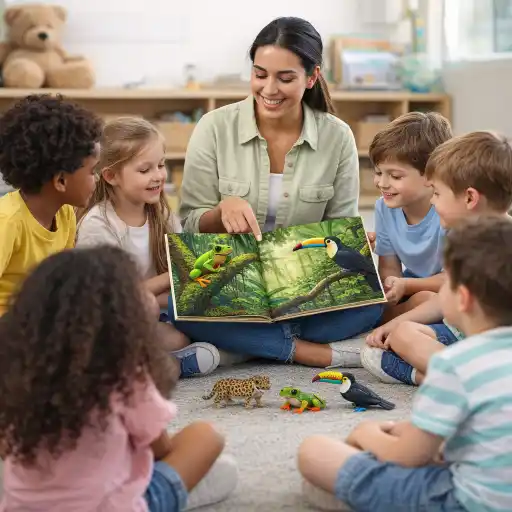
What hands-on activities help school-age children reason about adaptation?
School-age children benefit from opportunities to investigate, represent, and revise ideas. A short activity can become a meaningful science lesson when the educator makes the question explicit and invites children to explain their reasoning. Adapt the complexity to the group’s age, interests, and prior knowledge.
- Layered habitat map: Create a tall paper forest and add animal drawings or cards. Children annotate each placement with a habitat clue and a feature that may help the animal there.
- Beak-tool investigation: Provide safe tools such as spoons, tongs, or clothespins and several pretend “foods.” Children test which tool works for each item, then discuss why this model is limited and how real beaks and diets differ.
- Camouflage observation: Hide paper shapes against different backgrounds. Children record which are easiest to notice and connect the results to the idea of visibility—not to a claim that every animal uses camouflage.
- Build an imagined animal: Children design a creature for a specified layer, label its features, and explain how each feature relates to light, movement, food, or shelter.
- Family connection: Send home a drawing or question prompt so children can share one discovery and invite a caregiver’s question.
🌿 Encourage children to revise a design after learning more—for example, “What would your animal need if it moved from the canopy to the dark forest floor?” Revision shows that scientific thinking is an active process. Use the ChildCareEd Designing Your School Age Classroom Buy Now $35.00 course to explore lesson planning, learning environments, multi-age groups, and accommodations that can support inquiry in a school-age program.
How can educators assess learning and avoid common pitfalls?
Assessment can be conversational and visible. Listen for children’s ability to connect a feature to a habitat condition, support an explanation with an observation, and recognize that organisms interact. Ask a follow-up question rather than immediately correcting an incomplete idea: “What did you notice that makes you think that?” or “Would the same feature help in another layer?” Brief notes, labeled drawings, exit slips, or a group concept map can document growth over a lesson.
Common pitfalls include presenting the four layers as rigid zones, implying that every animal has one permanent location, and describing adaptation as a purposeful choice made by an individual. Avoid suggesting that a single trait guarantees survival. Traits may be useful in some conditions and less useful when the environment changes. Explain that the four-layer framework is an accessible model, and examples may vary among rainforest regions and species.
- Use more than one source or image when making a factual claim.
- Distinguish observation from inference, and welcome children’s questions.
- Offer drawing, speaking, building, and writing options so learners can show understanding in varied ways.
- Discuss habitat change carefully: effects may differ among species and involve many interacting factors.
If you are connecting the lesson to professional training or program expectations, remember that state requirements vary—check your state licensing agency. A useful next step is the ChildCareEd course Supporting School Age Development ONLINE Buy Now $24.00, which addresses developmentally appropriate instruction, diverse needs, and supportive school-age environments.
Conclusion: What should children take away about adaptation?
Rainforest layers give educators a practical way to help school-age children explore how habitats differ and how organisms relate to their surroundings. By studying animals in the forest floor, understory, canopy, and emergent layer, children can connect observable features and behaviors with food, shelter, movement, predators, and environmental conditions.
The most valuable outcome is not memorizing where every animal lives. It is learning to ask careful questions, use evidence, explain relationships, and revise ideas as new information appears. With maps, models, observation, and creative design, providers can turn rainforest animals into an engaging introduction to ecology and scientific reasoning—and help children see the living world as connected, diverse, and worthy of care.
Helpful ChildCareEd courses
- Lesson Planning to Meet School Age Needs Buy Now $16.00 — strategies for engaging content and varied learners.
- Designing Your School Age Classroom Buy Now $35.00 — lesson planning, classroom design, and multi-age considerations.
- Supporting School Age Development ONLINE Buy Now $24.00 — approaches for developmentally appropriate instruction and supportive environments.
- Watch Me Grow: School Age Development ONLINE Buy Now $24.00 — an overview of development for children ages 6–13.
- Creating the Natural Outdoor Classroom Buy Now $16.00 — ideas for enriching children’s learning through nature and outdoor environments.
- Watch Me Grow: School Age Development ONLINE
- Teach with Respect ONLINE
- CDA Home Visitor Subject Area 3 Part 3 Birth to 5
- Lesson Planning to Meet School Age Needs
- Birth to Five CDA Credential with Portfolio Review
- Our School Age Family Tree: Children, Staff, & Parents
- Connections That Count: Building Relationships in Child Care
- Texas Director Credential
- Growing the Whole Child: Health, Emotions & Early Learning
- Professional Integrity in Child Care
- CDA Certification en Español: Recursos y Consejos para Educadores Bilingües
- 💛🧩 ¿Cómo puedo hacer que mi enseñanza sea inclusiva para los niños con autismo?
- Requisitos Para Ser Maestra Principal En Un Daycare: Lo Que Necesitas Para Empezar
- Menos Estrés a la Hora de Comer: Rutinas Simples Que Sí Funcionan
- ¡Obtén Tu Certificación de Cuidado Infantil de 90 Horas En Línea!
- ¿Cuáles son los pasos, los requisitos y las opciones en línea para la certificación de 90 horas para cuidado escolar en Maryland?
- ¿Cómo empiezo mi certificación CDA en Florida en línea?
- 10 Ejemplos de Cómo la Cultura Influye en el Desarrollo Infantil
- Proporciones de Cuidado Infantil y Tamaños de Grupo por Edad en Maryland (Guía Rápida para Centros y Hogares)
- Proporciones de Cuidado Infantil y Tamaños de Grupo por Edad en Nueva Jersey (Guía Rápida para Centros y Hogares)
- Proporciones de Cuidado Infantil y Tamaños de Grupo por Edad en Virginia (Guía Rápida para Centros y Hogares)
- Lista para Guardería en Casa en Illinois: Cómo Iniciar una Guardería en el Hogar
- Retraso del Habla en la Guardería: Cómo Pueden Ayudar los Proveedores
- Cómo Trabajar en el Cuidado Infantil en Carolina del Norte: Requisitos y Pasos
- Capacitación Previa al Servicio para Proveedores de Cuidado Infantil en Maryland
- Celebrando la amistad en el cuidado infantil durante el Día de los Mejores Amigos
- Canciones, juegos y preguntas de círculo para niños
- Cómo simplificar la capacitación para sus empleados de daycare
- How Can Rainforest Animals Help School-Age Children Understand Adaptation?
