A cardboard box can become a bridge, a shop, or the starting point for a lively design challenge—without a costly supply order. Washington preschool providers can use safe, thoughtfully chosen recyclables to support creative play, problem-solving, language, and collaboration; the Beautiful Junk: Using Recycled Materials in the Classroom  Buy Now $16.00 course offers practical ideas for making those materials purposeful, while Role of Play in Learning Buy Now $16.00 helps connect children’s play with development and learning. Keep reading for adaptable activities, safety considerations, and ways to make recycled-material exploration work for different preschoolers.
Why do recycled materials make valuable learning tools?
Recycled materials are often open-ended: they do not come with one prescribed way to play. A cardboard box can become a home, a bus, or a tunnel; a paper tube might be a telescope, a support for a structure, or a pretend microphone. Because children decide what the objects mean, they practice #creativity, planning, language, and flexible thinking as they make and revise ideas.
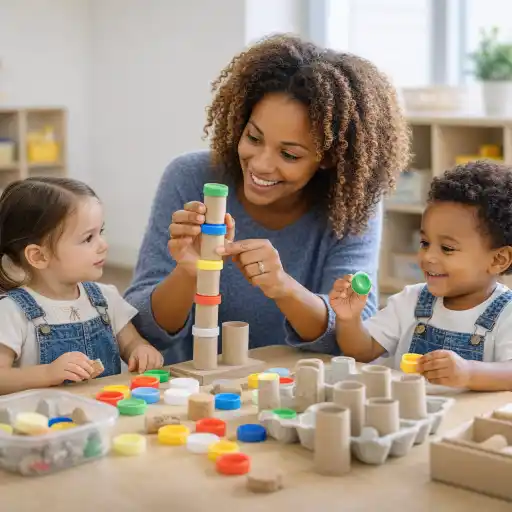
These experiences are more than a way to occupy a center. When children build together, they compare sizes, test whether a structure stays upright, negotiate roles, and explain what they are trying to do. Dramatic play turns clean containers and packaging into props for a market or restaurant, inviting storytelling, early math, and social cooperation. Art with paper scraps and cardboard supports choice and self-expression without requiring a uniform finished product.
Reusing suitable materials can also help programs provide rich experiences with modest budgets and open everyday conversations about reducing waste. The learning is strongest when educators connect materials to children’s interests, observe the process, and offer a question or resource that extends exploration rather than directing a single outcome. This focus on play and inquiry makes ordinary classroom discards feel like valuable resources.
How can providers choose and prepare materials safely?
Start with materials that are clean, sturdy, and easy to inspect. Cardboard boxes and paperboard can support construction and pretend play; paper tubes can become parts of a build or a storytelling prop; clean, unbroken containers can invite sorting, filling, or dramatic play; and packaging paper can be used for collage, wrapping, or design. Ask families to contribute only from a short list of requested items, and make clear that donations are optional.
Inspect every item before it enters a classroom. Check for sharp edges, staples, splinters, cracks, residue, mold, peeling surfaces, loose components, and parts that could break off. Wash and fully dry washable containers according to program procedures. Discard materials that cannot be cleaned or whose previous contents are unknown or potentially hazardous. Keep plastic bags, cords, button batteries, small magnets, and other unsafe items out of children’s play areas.
Washington’s rule, WAC 110-300-0165, requires providers to keep program materials free from hazards and in safe working condition. It identifies objects with an overall dimension of 1¾ inches or less as potential choking, aspiration, or ingestion risks for infants and toddlers, including small parts that detach from larger objects. The rule is not a reason to assume every larger item is safe: assess the whole item, its durability, and how children may use it. State requirements vary—check your state licensing agency. Washington providers can also consult the state’s licensed child care program guidance.
- Use only materials that are intact, stable, and appropriate for the children who can access the space.
- Keep items that may pose choking hazards inaccessible to infants and toddlers, including in mixed-age settings.
- Recheck materials after use and remove damaged or newly hazardous pieces promptly.
- Plan active supervision and clear storage so materials remain visible and manageable.
What learning activities can recycled materials support?
Choose a simple intention—such as testing stability, representing a familiar place, or exploring texture—then offer a few safe materials and space for children’s ideas. The possibilities below can be adapted to children’s interests and your classroom setup.
- Building and engineering: Offer large boxes, cardboard pieces, and paper tubes with blocks or child-safe tape. Invite children to build a bridge for toy animals or a structure that stands on its own. Ask, “What could help it stay up?” Children can test, notice what happens, and revise.
- Problem-solving and cause and effect: Arrange tubes and sturdy cardboard as a path for a large ball suitable for the group. Children can change the slope or route and observe the result. Keep the challenge focused on experimenting—not producing a perfect model.
- Dramatic play: Clean containers, boxes, and paper packaging can become pretend groceries, a post office, a delivery station, or a restaurant. Add paper for menus, labels, signs, or order forms to bring writing and early math into the play.
- Art and design: Offer clean paper scraps, flattened packaging, and cardboard as collage materials. Children can combine textures, shapes, and colors to create an image or a three-dimensional design. Let each child choose what the work becomes.
- 🎨 Child-led invitation: Place a small collection of boxes and tubes in the construction area and ask, “What could these become today?” Follow children’s ideas with new materials only when they help extend the play.
These activities draw on the same versatility described in recycled learning centers: the material becomes a prompt for inquiry, not a finished project children must copy. Invite children to name their plans, compare their designs, and tell a story about what they have made.
How can activities suit different developmental levels and abilities?
Developmental fit depends on the children in the room, not only the activity label. For preschoolers who are beginning to explore, offer a few larger pieces, sturdy boxes, and simple tasks such as placing, stacking, or filling. Children with more experience may enjoy combining materials, planning a multi-step structure, testing a design, or adding signs and written details to dramatic play. Keep the same basic invitation available at different levels of complexity.
Make participation flexible. Some children may build, while others may choose materials, describe an idea, test a structure, draw a plan, or take a turn as storyteller. Provide adapted tools, pre-cut pieces, stable work surfaces, visual cues, and clear pathways when helpful. Welcome communication through home languages, gestures, drawings, demonstrations, and conversation. A child should not need to use one particular tool or speaking style to contribute.
Watch how children interact with each material and adjust accordingly. If packaging is noisy or a texture is uncomfortable, offer another option. If a center feels crowded, reduce the number of materials or arrange a smaller-group experience. For mixed-age groups, consider whether younger children can reach the materials and whether supervision can remain attentive throughout the activity. Open-ended play is most inclusive when every child can access, influence, and enjoy the experience.
Use observation to make thoughtful adjustments. A short note about a child’s strategy, collaboration, or interest can help you decide whether to simplify the setup, add a challenge, or offer a different way to participate next time.
How can teachers extend learning without taking over?
The educator’s role is to prepare the space, observe carefully, and respond in ways that keep children’s ideas in the lead. Begin by noticing what children select, how they combine materials, and where a problem or new question appears. A brief pause can give children time to test their own solution before an adult steps in.
Use open-ended prompts that invite thinking without implying there is one right answer:
- “What are you noticing about the way those pieces fit?”
- “What could you change to make the bridge stronger?”
- “How will you decide whether your idea works?”
- “What might this box be in your story?”
Introduce precise vocabulary naturally—such as balance, sturdy, compare, connect, flexible, and predict—and allow wait time. Children may communicate their thinking through action as well as words. If a structure falls, acknowledge the effort and invite another try; a change in the design can provide useful information rather than signal failure.
Document the process, not just the finished creation. A photograph paired with a child’s words or a concise observation can capture a plan, revision, mathematical comparison, or moment of collaboration. Use what you observe to plan a next step: add a new challenge, rotate a material, or give children more time to revisit their work. A free Silly Ideas and Child Voice: Preschool Idea Documentation Form can help make children’s thinking visible; search the ChildCareEd resource library by its title to locate the form.
What common pitfalls should providers avoid?
Recycled-material activities can be simple and manageable, but a few common missteps can limit their value. Saving every possible item can quickly create clutter and make safety checks harder. Instead, build a small, intentional collection that children can access and adults can supervise. Rotate materials as interests change, and set aside anything that is damaged, difficult to clean, or unsuitable for the children using the space.
Another pitfall is turning open-ended play into a template craft. When adults prepare a model for children to reproduce, the focus can shift from children’s ideas to matching an expected result. Offer materials and a meaningful prompt instead. Likewise, avoid stepping in too quickly to solve a design problem; children benefit from time to try, observe, and revise.
Keep safety central without treating all reused materials as automatically unsafe. Make an individual assessment, follow Washington requirements and program procedures, and supervise based on the activity and children’s needs. Remember that a material’s condition can change after repeated use, so inspect it regularly. Finally, include cleanup in the plan: labeled bins and child-friendly routines help children care for shared resources and keep the learning area ready for next time.
For further professional learning, explore the English-language ChildCareEd courses Art from the Heart for Preschoolers Buy Now $35.00, which focuses on open-ended art and self-expression; Classroom Setup for Child Care Buy Now $24.00, which addresses intentional, welcoming learning environments; and 1,2,3, Eyes on Me: Classroom Safety Buy Now $32.00, which covers a safe environment and supervision. Review course details and check whether a course fits your professional learning needs.
Conclusion: How can Washington providers use recycled materials meaningfully?
Washington preschool teachers can turn safe recycled materials into meaningful learning by selecting items carefully, connecting them to children’s interests, and leaving room for children to direct the play. Boxes and tubes invite building and design; clean containers and packaging can support dramatic play, sorting, or experimentation; paper scraps and cardboard offer flexible possibilities for art. Across these experiences, children practice creativity, communication, collaboration, and problem-solving.
Begin with a small collection, inspect it before and during use, and match the activity to children’s developmental levels, abilities, and supervision needs. Offer an open invitation, listen to children’s ideas, and document the process to inform what comes next. Recycled materials are most powerful not because they are inexpensive, but because they give children room to imagine, test, and make meaning together.
- 45 Hour Child Growth and Development
- Turning Behavior Around for Toddlers and Preschoolers
- What Makes Me Special: An Overview of Autism and ADHD
- CDA Bridge Bundle: Preschool
- CDA Bridge Bundle: Family Child Care without Portfolio Review
- Art from the Heart for Preschoolers: Open Ended Art Projects that Build Self-Esteem
- CDA Bridge Bundle: Infant/Toddler without Portfolio Review
- CDA Bridge Bundle: Preschool without Portfolio Review
- Beautiful Junk: Using Recycled Materials in the Classroom
- ¿Cuáles son las mejores actividades del Día de la Tierra para niños en casa o en el aula?
- ¿Qué es la Certificación de 90 Horas para Cuidado Infantil en Maryland?
- Proporciones de Cuidado Infantil y Tamaños de Grupo por Edad en Virginia (Guía Rápida para Centros y Hogares)
- Cómo Ser Maestra de Preescolar en Maryland
- Celebrando la amistad en el cuidado infantil durante el Día de los Mejores Amigos
- Canciones, juegos y preguntas de círculo para niños
- How can Washington providers turn 2026 early learning momentum into real staff morale and retention?
- STEM for Preschoolers: Fun Activities That Encourage Curiosity
- How Can STEM Activities Turn Everyday Preschool Play Into Powerful Learning?
- How Can Child Care Providers Create Low-Cost STEM Activities With Items They Already Have?
- How Can Teachers Build Learning Centers on a Tight Budget?
- Which Printable Activities Belong in Every Preschool Classroom?
- How Can Open-Ended Summer Art Encourage Planning and Creativity?
- ¿Todos los niños deben participar en el tiempo de círculo?
- How Can Low-Cost Preschool Materials Still Meet Your Learning Goals?
- ¿Faltan Materiales o Falta una Nueva Estrategia? Cómo Revisar los Rincones del Aula
- How Can Preschool Teachers Encourage Inventive Thinking Without Expensive STEM Materials?
- How Can Washington Preschool Teachers Document Children’s Development Without Extra Stress?
- How Can Washington Preschool Teachers Turn Recycled Materials Into Meaningful Learning?
- How Can Washington After-School Programs Keep School-Age Children Engaged?
