Every day in your program gives clues about what each child needs next. Watching with purpose helps teachers plan moments that matter. This article shows simple steps to use #observation to shape daily #routines that help #children learn and stay safe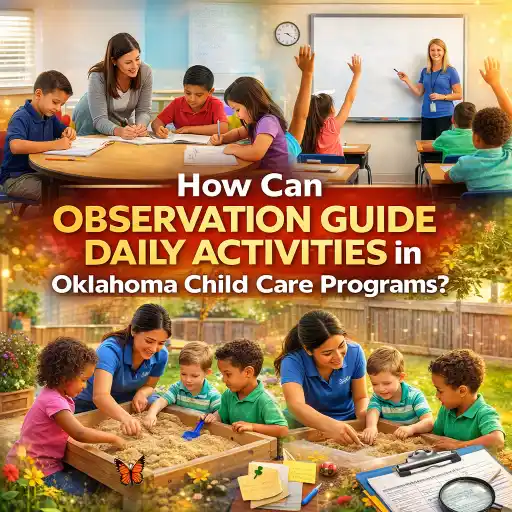 in #Oklahoma programs. Remember: state requirements vary - check your state licensing agency.
How does watching children help us plan better daily activities?
1) Watching kids tells you what they can already do. 2) Watching shows what they need next. 3) Watching helps you match activities to each child’s interests and skills. ChildCareEd explains how observation reveals learning in real moments — see What Do You See When You Watch a Child Learn?.
What to do next (easy steps):
- 🔎 Pick one focus (for example: sharing or using scissors).
- 🕒 Watch for a short time (5–15 minutes) during a routine like snack or centers.
- ✍️ Write one clear note: date, time, setting, what you saw.
- 🔁 Use the note to plan a small activity for the next day.
Why this works: short, repeated notes make it easy to track growth. For forms and tips, try ChildCareEd’s observation guides, like How do I run effective classroom observations (Checklist included)? Use observation to build one small goal and a simple activity into your daily #routines.
What should we look for during routines and play?
- 🧩 Cognitive: problem solving, counting, pretend play.
- 🎤 Language: new words, questions, telling stories.
- 🤝 Social: sharing, taking turns, helping peers.
- 💪 Motor: climbing, cutting, using small toys.
- ❤️ Emotional: handling frustration, asking for help.
Use short methods: time sampling, event sampling, or an anecdotal note. ChildCareEd shows clear examples and templates like the Anecdotal Record Observation Form Template Buy Now $0.00. Take 2–3 quick photos with family permission to show context. Keep notes factual: write what you see and hear, not why you think it happened. This keeps records clear for families and specialists and supports fair #assessment.
How do we turn what we see into daily activities that meet licensing and learning goals?
- 📑 Summarize the observation in one short paragraph (date, setting, exact example).
- 🎯 Make 1–2 small goals (measurable and tied to routines).
- 🛠 Add teacher supports that fit the day (model, cue cards, small group).
- 📆 Put the supports into daily times (circle time, table tasks, outdoor play).
- 🔁 Re-observe in 2–4 weeks and update the plan.
Example: If a child struggles to use a fork at lunch, your goal could be "use a fork to eat 3 bites with teacher help 3 times this week." Add supports during the lunch routine and practice at snack time. State rules and training matter in planning. Oklahoma licensing pages explain program requirements — see Licensing Requirements and the general Child Care Licensing info. Also consider tools like Oklahoma’s Early Learning Inventory for progress tracking.
What common mistakes happen, and how do we avoid them?
Common mistakes and fixes:
- ❗ Writing opinions. Fix: Record only facts ("Tom stacked 6 blocks," not "Tom is good with blocks").
- ❗ Watching only hard moments. Fix: Watch play and routines to see strengths, too.
- ❗ Using one tool only. Fix: Mix notes, checklists, photos, and work samples.
Quick tips to stay on track:
- 🗂 Keep one observation binder or digital folder for each child.
- 🧑🤝🧑 Practice with staff: watch a short video and compare notes to lower bias.
- 📣 Share strengths first with families, then examples and a simple plan.
FAQ (short):
- Q: How often should we observe? A: Short daily notes plus one deeper observation each month works well.
- Q: Who should write observations? A: Staff who know the child best; add another observer sometimes.
- Q: What if a family disagrees? A: Listen, show examples, and invite family observations to make a plan together.
- Q: Where to find forms and training? A: ChildCareEd offers courses like Assessing through Observation Buy Now $35.00 and many templates.
Conclusion
Observation is simple and powerful. Use short, factual notes to make one small goal. Put supports into daily #routines and re-check progress. Keep records clear for families and for licensing checks. For more tools and templates, visit ChildCareEd resources, such as Observations in Childcare and training paths like How do I run effective classroom observations. Your careful watching helps each child grow. Keep it kind, clear, and part of your day.
Use a simple checklist. Watch these areas so you see the whole child: Why it matters: Step-by-step plan to use observation for planning:- 45 Hour Child Growth and Development
- Tracking Progress, Shaping Futures: Observation & Assessment Skills
- 45 Hour Infant and Toddler Methods and Materials
- CDA Bridge Bundle: Family Child Care without Portfolio Review
- CDA Bridge Bundle: Infant/Toddler without Portfolio Review
- CDA Bridge Bundle: Preschool without Portfolio Review
- Privacy Matters: Documentation and Observation in Early Learning
- Texas Director Credential
- Every Moment Matters: Schedules and Transitions
- Today Is Earth Day!
- CDA Certification en Español: Recursos y Consejos para Educadores Bilingües
- Leading with Heart: Why Oklahoma’s Early Childhood Leaders Make All the Difference
- What training bundles are available in Oklahoma and how do they help providers?
- What new child care rules, subsidies, and supports should Oklahoma providers expect?
- How can we use prairie animals and nature activities with young children in Oklahoma?
- How can Oklahoma nature walks and outdoor trips teach young children?
- Which Oklahoma Farms and Ranches Offer Preschool Field Trips That Teach About Animals and Community?
- What are the Oklahoma child care licensing basics every educator should know?
- How can Oklahoma child care programs use daily routines to stay safe and compliant?
- Why should Oklahoma early childhood educators choose ChildCareEd's self-paced courses?
- What's new for child care in Oklahoma and what should providers do?
- How can observation guide daily activities in Oklahoma child care programs?
- How Can Oklahoma Early Childhood Educators Use Classroom Management Strategies to Support Young Learners?
- How Can Oklahoma Early Educators Turn Daily Observations into Better Classroom Support?
- How Do I Get Started Becoming an Early Childhood Teacher in Oklahoma?
- How do I open a day care in Oklahoma and start my child care business?
- What are the supervision basics for child care in Oklahoma?
- Is Oklahoma’s subsidy expansion a win for working families?
