Want practical ways to help young children feel a steady beat, notice repeating patterns, and use singing and movement to boost #language and classroom routines? Start small and intentional: brief body percussion, echo clapping, and simple instrument play teach timing, memory, and listening while calming transitions. For a guided, classroom-ready pathway, consider Mind's Medicine: Music in Early Childhood  Buy Now $16.00 — it shows how to turn musical moments into learning, and pairs well with Planning for Every Child: Responsive Strategies in Action Buy Now $55.00 to make activities inclusive and developmentally appropriate.
What basic musical concepts should I teach first?
Start with the essentials children can experience in their bodies: steady pulse, short rhythmic patterns, and call-and-response phrasing. Introduce pulse as a regular, repeatable beat (walk, march, stomp), then layer short patterns (clap-clap-pause). Use repetition and movement to make abstract ideas concrete — children internalize a #rhythm when they can feel it under their feet. Keep these classroom-friendly strategies in mind:
- Teach pulse before fancy notation — use whole-group marches or a drum.
- Model and echo: perform a four-beat pattern, have the group echo it back.
- Label concepts with simple words: "beat," "pattern," "repeat."
- Use songs with predictable refrains to support #language growth (see research summaries, e.g., ECRP reviews).
Why it matters: early exposure to steady beat and short patterns strengthens auditory sequencing and phonological awareness — foundations for later reading and cognitive tasks (see literature reviews such as Bolduc & Anvari summarized in the research corpus).
How do I introduce steady beat and rhythmic patterns in short, effective activities?
Design micro-lessons you can repeat daily: 1–3 minute pulse activities (arrival), a 3–5 minute rhythm echo game (circle time), and a 2–4 minute instrument phrase (cleanup). Short, frequent exposures produce measurable near-transfer benefits for memory and attention. Practical steps:
- Begin each week with a favorite hello song tied to a steady beat.
- Echo clapping: teacher plays a 4-beat rhythm; children echo — increase complexity gradually.
- Pattern play: show a 4-beat pattern with visuals (icons or beat boxes), then have children build it with manipulatives.
- 🪘 Use a small percussion routine: call-and-response with shakers or drums to teach ensemble timing.
Keep sessions brief and scaffold progression from moving to clapping to instrument play. For ready-made lesson ideas and scripted activities, consult classroom resources such as Montessori Meets Music and Rhythm as part of your planning toolkit. To explore how Montessori principles can shape music and rhythm experiences, read about what happens when Montessori meets music and rhythm.
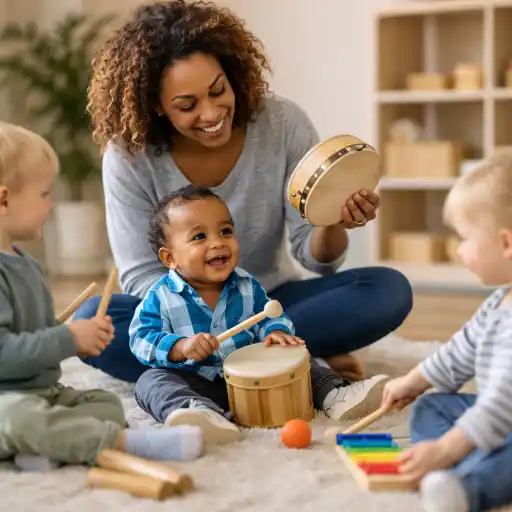
What role do instruments and body percussion play — and which are best for young children?
Instruments and body percussion make rhythm tactile and social. They translate an auditory pulse into a motor response, strengthening coordination and working memory. Choose inexpensive, safe options and rotate them to maintain interest. Best practices include:
- Start with body percussion (stomp, pat, clap, snap) to teach internalized beat.
- Introduce soft handheld instruments (shakers, rhythm sticks, wood blocks) once children can echo patterns reliably.
- Use instruments for ensemble games that require listening and turn-taking; ensemble play builds #social skills and timing.
- Create multi-modal cues: visual icons for a pattern, a tactile prop for a section, and a short lyric to anchor memory.
Research (including classroom quasi-experiments) shows rhythmic instrument play supports phonological memory and later literacy-related skills — but the effect is strongest when experiences are active, repeated, and teacher-led rather than passive background music.
How can I include every child and adapt activities for diverse learners?
Inclusion is practical and necessary: offer multiple ways to participate so children with different sensory profiles, motor levels, or communication needs can join. Use these adaptations:
- Visual supports: beat-box icons, pattern cards, and simple notation so nonverbal learners predict the sequence.
- Choice of response: sing, sign, point to a card, tap a drum — two or three options let children contribute in ways that suit them.
- Seating & space options: cushions, standing spots, or a quiet corner for re-entry to group activities.
- Smaller groups and turn-taking roles to reduce sensory load and increase participation.
- Family connections: invite home songs and rhythms to honor cultural relevance and strengthen engagement (state requirements vary - check your state licensing agency).
For staff planning that pairs musical pedagogy with individualized supports, consider courses such as Language Development in Early Childhood Buy Now $16.00 and CDA Subject Area 2 Buy Now $80.00, which help link music strategies to language and curriculum goals.
How do I embed rhythm practice into daily routines and measure whether it’s working?
Embed music into predictable #routines: a hello pulse at arrival, a short rhythm echo before circle time, a clean-up chant played on an instrument, and a calming melody before rest. Measure impact with simple, classroom-friendly checks:
- Baseline & follow-up: count transition incidents for one week, add music routines the next week, compare frequency.
- Spot checks for listening: how many children can echo a 4-beat pattern after three repetitions?
- Observe language use: note new vocabulary used during musical activities.
- Staff reflection: quick huddle notes — one win and one tweak each week.
Common mistakes to avoid: teacher-heavy, long music sessions; one response mode only; and using music only as background. Fix these by keeping sessions short, offering multimodal entry points, and pairing music with explicit teaching. For broader classroom integration and professional growth, look to a general course like Early Childhood Education Buy Now $99.00$84.00 to organize curriculum goals and progress monitoring.
Conclusion — What should I try this week?
Small, consistent changes yield the biggest results. Try this micro-plan for one week:
- Day 1: Teach one 4-beat echo pattern with body percussion at morning meeting.
- Day 2–4: Use the pattern as a clean-up cue; let one child be the pattern leader each day.
- Day 5: Add a soft shaker and let pairs perform the pattern for the class.
Takeaways: focus on the steady #rhythm first, use short repeated exposures, offer multiple participation options to support #inclusion, and track one simple measure (transition incidents or echo accuracy). For detailed lesson plans, adaptations, and continuing education, explore Mind's Medicine: Music in Early Childhood Buy Now $16.00 and companion courses listed above — they provide practical steps to expand your music practice into sustained learning experiences. Remember: state requirements vary - check your state licensing agency.
- Early Mathematics Through Play
- CDA Home Visitor Subject Area 3 Part 3 Birth to 5
- Teacher-Child Interactions for Stronger CLASS® Outcomes
- Language and Literacy Foundations in Pre-K
- Moving About the Classroom: Effective Transitions for Everyday
- Classroom Setup for Child Care
- Recognize, Respond, Respect: Supporting Diverse Learners
- Montessori Cultural Activities: Exploring the World Through Play and Learning
- Wellness in Action: Teaching Healthy Habits to Children
- Moving About the Classroom: Effective Transitions for Everyday
- Tiny Hands, Big Dreams: Fostering Creativity in Preschoolers
- CDA Certification en Español: Recursos y Consejos para Educadores Bilingües
- 💛🧩 ¿Cómo puedo hacer que mi enseñanza sea inclusiva para los niños con autismo?
- Recursos en Español sobre el Sueño Seguro del Bebé
- Capacitación en Salud y Seguridad Preventiva en Línea para Proveedores de Cuidado Infantil
- Proporciones de Cuidado Infantil y Tamaños de Grupo por Edad en Nueva Jersey (Guía Rápida para Centros y Hogares)
- Proporciones de Cuidado Infantil y Tamaños de Grupo por Edad en Virginia (Guía Rápida para Centros y Hogares)
- Lista para Guardería en Casa en Illinois: Cómo Iniciar una Guardería en el Hogar
- Lista para Guardería en Casa en Texas: Cómo Iniciar una Guardería en el Hogar
- Canciones, juegos y preguntas de círculo para niños
- Cómo simplificar la capacitación para sus empleados de daycare
- How can bilingual music transform your early childhood classroom?
- How and Why Does Music Boost Brain Development in the First Five Years?
- How Can You Celebrate Black Culture and Music Effectively in Your Program?
- How do singing, rhythm, movement and musical play support language, memory and social development in young children?
- How can I introduce children to rhythm and musical patterns?
- How Can Music and Movement Enrich Early Childhood Learning?
- How Can Songs and Rhymes Build Young Children’s Language Skills?
- How Can Simple Music and Movement Activities Build Early Literacy Skills?
