When preschoolers clap, pause, and listen for what comes next, they are doing more than making music: they are exploring how patterns work. Child care providers can use short rhythm games to nurture early pattern recognition and listening through joyful, repeatable play; Mind’s Medicine: Music in Early Childhood  Buy Now $16.00 offers a fuller learning experience for planning developmentally appropriate musical activities. For an additional math-focused perspective, explore Early Mathematics Through Play Buy Now $24.00, which includes patterns among its hands-on early math topics.
Why can rhythm help children notice patterns?
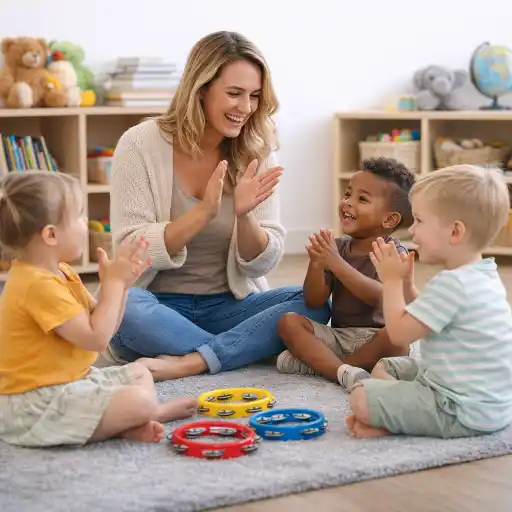
A pattern is an arrangement in which something repeats or changes according to a discernible structure. In a rhythm game, that structure can be heard and felt: clap-clap-pause, stomp-clap-stomp-clap, or tap-tap-tap. Children listen, hold the sequence in mind, and anticipate what may happen next. The body makes an abstract idea concrete, while the repetition gives children a meaningful chance to compare sounds.
Rhythm play can also encourage focused listening, imitation, turn-taking, and early sequencing. Research has found associations between preschoolers’ beat synchronization skills and some preliteracy measures, including phonological awareness and auditory short-term memory; such findings are associations, not proof that clapping alone causes later reading gains. A study of a musical activity program also reported receptive vocabulary gains for participating preschoolers, offering a reason to value intentional, active musical experiences while keeping expectations realistic.
For educators, the practical value is immediate: a rhythm game needs little equipment and can fit into circle time, a transition, or a small group. It gives children a shared purpose—listen, try, and notice—without turning playful exploration into a test. Repeated sound patterns can become an accessible entry point into broader #patterns and early mathematical thinking.
How should educators introduce a rhythm pattern?
Begin with a steady, comfortable pulse and one short sequence. Model it clearly, then invite children to listen before they echo. A simple starting point is “clap, clap, pause”; name the actions as you perform them and leave a brief moment of silence so children can hear that the pause is part of the pattern. Keep the first activity brief and repeat the same sequence enough times for children to become familiar with it.
- Model before inviting: perform the pattern once or twice while children watch and listen.
- Use simple language: say “listen,” “repeat,” “pause,” and “what comes next?”
- Invite an echo: give children time to copy with claps, pats, taps, or another response.
- Change one element at a time: add a stomp or switch the pause to a tap after the basic pattern is familiar.
- 🎵 Let a child lead a short pattern for the group to echo.
As children gain confidence, move from copying to extending and creating. Ask, “Which part happened again?” or “What could we add?” Avoid treating a missed beat as failure: model once more, slow the sequence, or offer a visual cue. The goal is to help children attend to repetition and sequence at their own pace—not to produce a perfect performance.
Which rhythm games build pattern recognition and listening?
Choose games with clear contrasts and room for children to respond. Body percussion is an easy starting point because it requires no instruments and can be adapted for different motor abilities. Once children are comfortable, add a few safe, age-appropriate instruments, such as shakers or a small drum. A visual cue—such as picture cards for clap, stomp, and pause—can help children connect what they hear with what they see.
- Echo clap: Clap a two- or three-part sequence and invite children to repeat it.
- Sound-and-silence: Try “tap, tap, pause” and ask children to show when the quiet part arrives.
- Movement pattern: Alternate two actions, such as pat-clap-pat-clap, and let children copy or lead.
- Pattern cards: Arrange picture symbols in a row; point to each card while performing the sequence.
- Listening detective: Repeat a familiar pattern with one change and ask children what sounds different.
Keep the sequence short enough for children to remember. Introduce a new sound or movement only after the existing pattern feels familiar. Encourage children to describe what they notice using words such as same, different, again, and next. These small conversations make their thinking visible and connect rhythm play with oral language and #listening.
How can providers make rhythm play inclusive and safe?
Children can participate in many ways: clapping, tapping a surface, moving a scarf, pointing to a picture, conducting, signing, using a communication device, or watching before joining. Offer these choices naturally, without suggesting that one response is more successful than another. A child who marks the beat with a gaze, gesture, or small movement may be actively engaged even if they are not clapping.
Consider sensory preferences, motor access, communication styles, and the group’s comfort with sound. Use a quieter instrument, reduce the volume, shorten the pattern, or offer a calm observation space. Provide seated and standing options, and introduce instruments gradually. Invite families to share familiar songs or rhythms, and make room for different languages and musical traditions.
- Check instruments for damage and choose materials appropriate for the children’s ages.
- Set a comfortable volume and a clear start-and-stop signal.
- Keep the playing area clear and supervise actively, especially when materials are shared.
- Offer more than one way to respond, including watching and rejoining later.
Inclusive planning is not an extra layer of complexity; it is how providers make the same learning invitation accessible. When activities involve equipment, noise, or group movement, state requirements vary - check your state licensing agency.
How can teachers observe children’s learning without turning play into a test?
Use brief observations to guide the next invitation rather than to rank children’s performance. Notice whether a child attends to the model, echoes part of the sequence, anticipates a pause, identifies a change, or creates a pattern for others. A child may show understanding through action before being able to explain it verbally. Record the context and the support offered, such as: “During circle, Maya repeated clap-clap-pause after the teacher modeled it twice.”
Build from what you observe. If children are still exploring imitation, keep the pattern short and repeat it. If they readily echo, invite them to extend the sequence or choose a new action. If spoken directions are difficult to follow, pair them with picture cards or gestures. Revisit a favorite game across several days so children can recognize its structure and notice a deliberate variation.
Common pitfalls include making activities too long, increasing complexity too quickly, and expecting every child to respond in the same way. Music used only as background does not offer the same active opportunity to listen, imitate, and create. Keep the experience purposeful and playful, and use a simple reflection prompt for staff: What did children notice? What helped them join? What might we repeat or adjust? This approach supports responsive teaching while keeping the focus on children’s curiosity and growth.
What should providers remember about rhythm games and patterns?
Yes—clapping and rhythm games can help preschoolers explore pattern recognition and listening when educators offer short, clear, repeatable sequences and invite children to attend, echo, predict, and create. The learning is not about getting every beat right; it is about noticing what repeats, hearing what changes, and participating in ways that work for each child.
Try a simple sequence this week: model “clap, clap, pause,” invite an echo, and then let a child choose one change for the group to hear. Use a visual cue or alternate response when useful, and observe how children engage. With thoughtful repetition and flexible participation, a brief musical moment can become a meaningful opportunity for #preschoolers to explore #rhythm, listening, sequence, and early math. For a more structured professional learning experience, the linked music and early mathematics courses offer additional support for planning musical and play-based learning experiences.
- Recognize, Respond, Respect: Supporting Diverse Learners
- Early Mathematics Through Play
- CDA Home Visitor Subject Area 3 Part 3 Birth to 5
- CDA Bridge Bundle: Preschool
- Anxiety: Signs & Strategies
- 24 Hour Texas Pre-Service
- CDA Bridge Bundle: Family Child Care without Portfolio Review
- CDA Bridge Bundle: Infant/Toddler without Portfolio Review
- CDA Bridge Bundle: Preschool without Portfolio Review
- Texas Director Credential
- CDA Certification en Español: Recursos y Consejos para Educadores Bilingües
- 🤝¿Cómo fomentar respeto e inclusión en el aula infantil? 🌻
- ¿Cómo empiezo mi certificación CDA en Florida en línea?
- Actividades de Motricidad Gruesa que Desarrollan el Equilibrio, la Coordinación y la Fuerza
- Proporciones de Cuidado Infantil y Tamaños de Grupo por Edad en Maryland (Guía Rápida para Centros y Hogares)
- Proporciones de Cuidado Infantil y Tamaños de Grupo por Edad en Virginia (Guía Rápida para Centros y Hogares)
- Actividades de Otoño Fáciles para Preescolares esta Temporada
- Cómo Trabajar en el Cuidado Infantil en Carolina del Norte: Requisitos y Pasos
- Celebrando la amistad en el cuidado infantil durante el Día de los Mejores Amigos
- Canciones, juegos y preguntas de círculo para niños
- How do singing, rhythm, movement and musical play support language, memory and social development in young children?
- How Can I Help Children Understand Shapes and Patterns?
- How can I introduce children to rhythm and musical patterns?
- Self-Control Activities for Preschoolers: 10 Games That Teach Stop, Wait, and Try Again
- How Can Child Care Providers Build Phonological Awareness in Preschool?
- ¿Todos los niños deben participar en el tiempo de círculo?
- Why Is Hearing Syllables Different from Naming Letters?
- Teaching Syllables Through Play: What Should Preschoolers Notice?
- Can Clapping and Rhythm Games Help Preschoolers Recognize Patterns?
