Autumn’s rustling leaves, tapping rain, and crunchy footsteps give preschoolers a lively starting point for making music—and for discovering patterns together. The Mind's Medicine: Music in Early Childhood  Buy Now $16.00 course can help you plan developmentally appropriate musical experiences and strengthen your classroom practice; explore it as a next step while gathering ideas for a simple fall sound orchestra.
Why is a fall sound orchestra worth trying?
A seasonal orchestra turns children’s everyday observations into opportunities to listen, imitate, compare, and create. A leaf might inspire a soft swish, an acorn a gentle tap, and a gust of wind a long whoosh. When children arrange these sounds into a sequence that repeats, they are exploring musical patterns through play rather than memorizing abstract notation.
That experience can connect several areas of learning. Children attend to sound and timing, practice taking turns, and use descriptive language to explain what they hear or imagine. A small study of a structured preschool music program reported receptive vocabulary gains for children who participated, while another study linked teacher-guided music instruction with gains in oral vocabulary and grammatical understanding. Such findings support intentional music-making, though they do not mean every musical activity produces the same outcome.
For providers, the approach is practical: a short pattern game can fit into circle time, a transition, or a seasonal learning center. It also gives children a shared creative project where their ideas matter. Music is not an extra performance to perfect; it is a welcoming way to make listening, cooperation, and invention part of the day.
How do you introduce beat, rhythm, and repeating patterns?
Start with a steady beat children can feel: pat knees, tap a drum, or march in place. Then distinguish the regular pulse from a pattern of sounds played over it. Keep the first example short—“tap, tap, pause”—and say the sequence aloud as you model it. Invite children to echo before asking them to invent a variation.
Picture symbols make the sequence visible. Use a leaf for a swish, an acorn for a tap, and a blank or rest symbol for silence. Arrange four cards in a row, point to each one as the group performs it, and repeat the sequence. In ChildCareEd’s Autumn Rhythm Parade printable games Buy Now $1.50, picture symbols such as leaves, acorns, pinecones, and rests are used to support four-beat pattern play.
- Model first, then invite children to echo the same short sequence.
- Use simple words such as beat, pattern, repeat, and pause while demonstrating.
- Change one feature at a time—such as the instrument, speed, or sound—so children can notice what changed.
- 🎵 Give children a chance to lead: the group can echo a child-created pattern.
As children become comfortable, let them rearrange the cards, add a rest, or choose a sound for each picture. The goal is exploration and growing pattern awareness, not a flawless performance.
What materials and roles make the orchestra work?
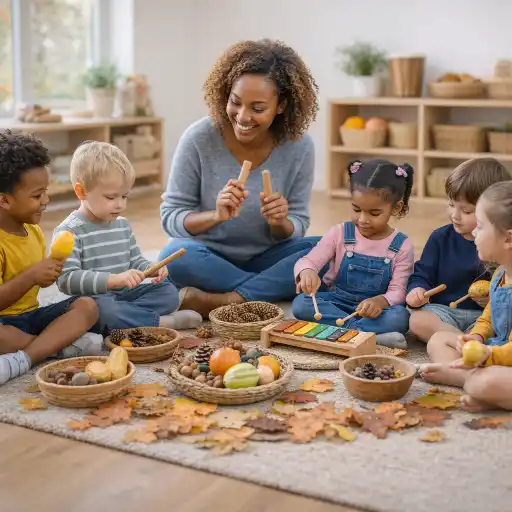
You do not need a complete instrument set. Begin with body percussion—claps, pats, gentle stomps, or finger taps—then offer a few safe, easy-to-hold instruments such as shakers, rhythm sticks, or a small drum. Everyday fall images can cue sounds without requiring children to handle natural objects. If you use found items, inspect them, supervise closely, and avoid small objects that may present a choking hazard.
Make the ensemble manageable by giving children clear roles. One child may be the conductor, another may point to the next picture card, and others may play one sound. Rotate roles so everyone has an opportunity to contribute. The conductor can use easy gestures: hands up means ready, a hand moving side to side means play, and a closed hand means stop and listen.
- Leaf players: make a soft swishing sound with a scarf or shaker.
- Acorn players: tap a rhythm stick or pat a knee.
- Wind players: create a gentle whoosh with breath, voice, or a quiet instrument.
- Rest watchers: show the silence symbol and help the group notice the pause.
Before playing, agree on a comfortable volume and a stop signal. A predictable visual cue can help children regroup when the room becomes lively. Treat each instrument as a shared classroom material: model gentle handling, taking turns, and returning it to its designated place.
How can you guide children to compose and perform a pattern?
Use a simple sequence that moves from listening to creating. First, invite children to notice or imagine fall sounds. Ask, “What might a falling leaf sound like?” or “How could we show a light rain?” Accept varied ideas, then choose two or three sounds to represent with picture cards. Arrange the cards from left to right and perform the pattern together.
For example, a four-part pattern might be leaf swish, acorn tap, leaf swish, pause. Say the sequence, point to the symbols, and play it slowly. Repeat it a few times before inviting the children to change one card. This helps them hear the difference between a repeated pattern and a new sequence. When the group is ready, layer parts: one small group keeps a steady beat while another performs the picture pattern.
- Listen: notice a natural sound or invent an autumn sound.
- Choose: match a picture with a body sound or instrument.
- Arrange: place a few symbols in a clear order.
- Perform and revisit: play the sequence, then ask what the group wants to repeat or change.
Offer children time to decide and listen to one another. A child’s unexpected sound idea can become the group’s favorite motif. Keep the activity playful, and avoid correcting every variation; the important work is noticing, communicating, and making meaning together.
How can you make the orchestra inclusive and responsive?
Participation does not have to mean singing or playing an instrument. A child may point to a card, conduct, move a scarf, use a communication device, tap a surface, watch for a while, or join only during a familiar part. These are meaningful ways to take part. Offer choices and let children enter the activity at their own pace.
Adjust for sensory and motor needs. Use soft instruments, lower the volume, shorten the sequence, or create a quieter observation spot. Provide seated movement and visual cues alongside spoken directions. If a child is uncomfortable with a sound, do not insist that they remain in the center of the group; offer another role or a break, then welcome them back.
Autumn experiences are also shaped by family traditions, languages, and local environments. Invite children and families to share familiar seasonal sounds, songs, or words, without assuming that everyone celebrates the same holidays or experiences the season in the same way. This builds connection while broadening the orchestra’s sound palette.
For a related classroom resource on adapting routines and activities, see ChildCareEd’s guidance on helping children join in Buy Now $0.00. Keep supervision active, choose age-appropriate materials, and check your program’s policies. State requirements vary - check your state licensing agency.
How can teachers reflect and build on children’s musical ideas?
A brief observation can help you decide what to repeat or adapt. Notice whether children attend to the visual cue, echo a short sequence, wait for a pause, or suggest a new sound. Record examples in a quick note rather than expecting every child to demonstrate the same skill at once. The information can help you simplify the next session, add another symbol, or offer more opportunities for child leadership.
Connect the orchestra to other parts of the curriculum without overloading the experience. Children might draw the pattern they played, dictate a sentence about their sound, count the beats, or compare loud and soft. A short autumn sound walk can also provide ideas: listen for rustling leaves, wind, footsteps, or distant birds, then recreate one sound back in the classroom.
Common pitfalls are easy to prevent:
- Using too many instruments at once: start with a small selection and add gradually.
- Making the educator the only composer: invite children to choose and lead patterns.
- Allowing the activity to become prolonged or overly loud: keep it brief and use a clear stop cue.
- Expecting identical responses: offer multiple ways to participate and observe individual engagement.
For deeper professional learning, the Mind's Medicine: Music in Early Childhood Buy Now $16.00 course explores music’s role in child development and curriculum, and supports educators in developing developmentally appropriate musical activities.
Conclusion: How can a fall sound orchestra help preschoolers create patterns?
A fall sound orchestra helps preschoolers create patterns by turning seasonal images and sounds into simple, repeatable sequences they can hear, see, and perform. Begin with a steady beat, use picture cues, model a short pattern, and give children meaningful roles as performers and conductors. Keep materials safe, the volume comfortable, and participation flexible.
The central goal is not musical perfection. It is to help children listen closely, experiment with repetition and change, and create something together. Try one four-part pattern this week, notice how children respond, and let their ideas guide the next rehearsal.
Explore five relevant ChildCareEd courses
- Recognize, Respond, Respect: Supporting Diverse Learners
- CDA Subject Area 2
- Art from the Heart for Preschoolers: Open Ended Art Projects that Build Self-Esteem
- Emergent Learning & Development
- Lesson Planning for Preschoolers
- Texas Director Credential
- DAP for Preschool
- 45-Hour Infant and Toddler Curriculum
- Mind's Medicine: Music in Early Childhood
- Montessori Cultural Activities: Exploring the World Through Play and Learning
- CDA Certification en Español: Recursos y Consejos para Educadores Bilingües
- 🤯 ¿Por qué este niño está teniendo un comportamiento difícil de repente?
- 🚌🍑 Ideas de excursiones en Georgia
- Actividades de Motricidad Gruesa que Desarrollan el Equilibrio, la Coordinación y la Fuerza
- 10 Ejemplos de Cómo la Cultura Influye en el Desarrollo Infantil
- Proporciones de Cuidado Infantil y Tamaños de Grupo por Edad en Maryland (Guía Rápida para Centros y Hogares)
- Proporciones de Cuidado Infantil y Tamaños de Grupo por Edad en Nueva Jersey (Guía Rápida para Centros y Hogares)
- Proporciones de Cuidado Infantil y Tamaños de Grupo por Edad en Virginia (Guía Rápida para Centros y Hogares)
- Actividades de Otoño Fáciles para Preescolares esta Temporada
- Cómo Trabajar en el Cuidado Infantil en Carolina del Norte: Requisitos y Pasos
- Las Mejores Ideas de Excursiones para Guarderías en Texas
- Cómo Ser Maestra de Preescolar en Virginia
- Calabazas, hojas y manzanas: actividades de otoño para preescolares
- Celebrando la amistad en el cuidado infantil durante el Día de los Mejores Amigos
- Canciones, juegos y preguntas de círculo para niños
- Cómo simplificar la capacitación para sus empleados de daycare
- How Can Songs and Rhymes Build Young Children’s Language Skills?
- How Can You Add Rhythm to a Preschool Weather Movement Activity?
- How Can a Fall Sound Orchestra Help Preschoolers Create Musical Patterns?
