Music and movement can turn ordinary routines into joyful opportunities for language, regulation, motor development, and belonging. For a practical foundation, explore Mind's Medicine: Music in Early Childhood  Buy Now $16.00; providers can also consider Balancing Active Play in Child Care Buy Now $16.00 to strengthen scheduling and active-play practices. These courses offer focused professional learning that can help you plan intentional musical experiences rather than using music only as background noise.
Why does music and movement matter in early childhood?
Music and movement engage children physically, cognitively, socially, and emotionally at the same time. A song with gestures can make vocabulary memorable; a steady beat can organize attention; and a predictable movement cue can help children shift from one routine to another. These experiences are especially valuable because young children often communicate and regulate through their bodies before they can explain their thoughts in words.
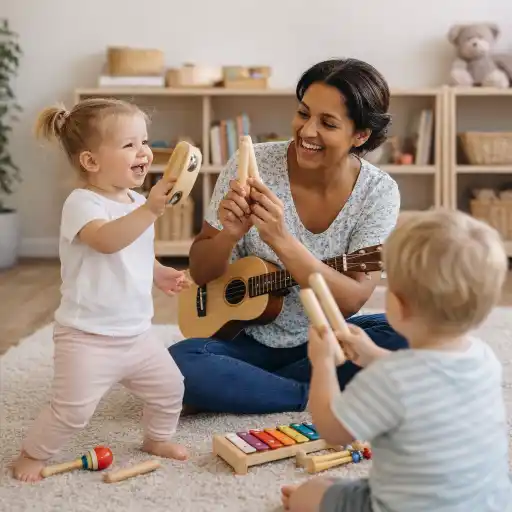
Active participation—not merely listening—creates the richest learning opportunities. When children clap, sing, sway, march, or play an instrument, they practice timing, imitation, auditory discrimination, coordination, and turn-taking. Group music also creates shared moments of success, helping children feel connected to peers and trusted adults.
- Language: rhymes, repetition, syllables, and expressive vocabulary.
- Memory and attention: predictable patterns and multi-step sequences.
- Physical development: balance, bilateral coordination, and motor planning.
- Social-emotional learning: cooperation, self-expression, and regulation.
These benefits make music a meaningful teaching strategy across the day—not an activity reserved for a special class or occasional celebration.
How can providers build a practical daily music routine?
A successful routine does not require musical expertise or elaborate equipment. Begin with three anchor moments: a welcome song, an active movement song, and a calming song. Use the same songs consistently for several days so children learn the cues and anticipate what comes next. Familiarity lowers cognitive demands and supports participation.
Keep segments brief and connect each one to a clear purpose. Toddlers may benefit from one- to three-minute bursts, while preschoolers may engage in five- to ten-minute experiences depending on the group and activity. Consider this simple schedule:
- Arrival: sing children’s names while offering a wave, clap, or stretch.
- Transition: use a clean-up chant with a repeated rhythm.
- Group time: echo-clap a short pattern or sing an action song.
- After active play: slow the tempo and pair music with breathing.
- Dismissal: use a familiar goodbye song to close the day.
Post picture cards for each song and teach the routine explicitly. Model the action, invite children to watch, and then repeat without demanding identical performance. This predictable structure can make transitions smoother while giving children repeated opportunities to practice #attention and self-regulation.
Which activities support language, rhythm, and motor development?
Choose activities that connect sound with meaningful action. Body percussion is an accessible starting point: children can clap, pat their knees, stomp, or tap their shoulders. Begin with a steady pulse and then introduce a short pattern such as clap-clap-pause. Invite children to echo the pattern, lead the group, or represent it with picture cards.
Action songs support receptive language because children hear a direction and demonstrate understanding through movement. Songs about body parts, animals, weather, or emotions can expand vocabulary while strengthening body awareness. Try asking children to move “slowly like a turtle,” “quickly like a rabbit,” or “quietly like a mouse,” then discuss the descriptive words.
- Clap the syllables in children’s names or theme words.
- Use scarves to explore high/low, fast/slow, and wide/narrow movement.
- Play freeze dance to practice listening and inhibitory control.
- Invite children to march with shakers while changing tempo.
- Pair a story with sound effects for characters, weather, or actions.
Repeat activities across the week while changing one element at a time. Repetition strengthens #rhythm and memory, while small variations encourage flexible thinking and sustained engagement.
How can music and movement be inclusive?
Inclusion begins with recognizing that participation can look different for every child. One child may sing loudly, another may hum, point to a picture, tap a drum, watch carefully, or move from a seated position. Each response can be a meaningful form of engagement. Avoid treating one “correct” movement or vocal response as the measure of success.
- Offer multiple response modes: sing, sign, point, tap, sway, or observe.
- Provide seated movement, standing spaces, and a quiet area for re-entry.
- Use visual schedules, gesture cues, and picture cards alongside spoken directions.
- Adjust volume and tempo; provide soft instruments when appropriate.
- Assign meaningful roles, such as beat leader, instrument helper, or card holder.
- Invite families to share songs and rhythms that reflect children’s cultures.
For children with sensory differences, introduce sound gradually and watch for signs of overload. For children with motor challenges, adapt the movement rather than removing the learning goal. A child who cannot march may tap a hand or activate a switch in time with the group. Coordinate with families and specialists when individualized supports are needed. Remember: state requirements vary - check your state licensing agency for supervision, equipment, noise, and safety expectations.
How can directors support safety, staff confidence, and assessment?
Directors can make music and movement sustainable by providing shared planning tools and brief coaching. A one-page song card might identify the learning goal, duration, materials, visual supports, adaptations, and observation prompt. During staff meetings, model one five-minute activity and allow educators to practice it with peer feedback.
Safety requires active supervision and thoughtful preparation. Clear the floor, mark personal spaces, inspect instruments, avoid small parts for children who may mouth objects, and control volume. Head Start safety guidance emphasizes hazard-free environments, active supervision, and communication about safety concerns; these principles apply directly to musical play.
Assessment can remain simple and useful. Select one observable indicator for a week:
- How many children respond to the transition cue?
- Can children echo a two- or four-beat pattern?
- Do children use new vocabulary during the activity?
- How quickly does the group settle after active movement?
Common mistakes include sessions that are too long, music that is too loud, forced participation, and playlists with no instructional purpose. Correct these by shortening activities, offering choices, teaching consistent cues, and documenting one small outcome. Consider CDA Subject Area 2 Buy Now $80.00 for broader coursework connecting music, the arts, physical development, and intellectual development; Effective Approaches for Autism and Inclusion Buy Now $55.00 for individualized supports; and Creating Safe & Healthy Child Care Environments Buy Now $55.00 for safety-focused professional learning.
What should providers remember about music and movement?
Music and movement enrich early childhood learning when they are intentional, brief, repeated, and accessible. The goal is not a polished performance; it is to create meaningful opportunities for children to communicate, coordinate, connect, and regulate. Start with three anchor songs, add one short rhythm or movement activity, and observe one measurable change.
Use children’s interests and family traditions to make the repertoire relevant. Provide alternatives for sensory, communication, mobility, and attention needs. With thoughtful planning and coaching, music can support smoother routines, stronger language, developing motor skills, and a more connected classroom community.
Conclusion: How can music and movement enrich early childhood learning?
They enrich learning by making important developmental work active, memorable, and joyful. When providers pair music with clear goals, inclusive choices, safe environments, and consistent routines, children gain repeated practice in language, memory, motor development, social connection, and emotional regulation. Begin small, learn from observation, and let every child’s way of participating count.
- CDA Subject Area 2
- 24 Hour Texas Pre-Service
- Sensitive Periods in Montessori: Guiding Natural Learning
- Creating Safe & Healthy Child Care Environments
- Mind's Medicine: Music in Early Childhood
- Texas Director Credential
- Montessori Cultural Activities: Exploring the World Through Play and Learning
- Wellness in Action: Teaching Healthy Habits to Children
- CDA Infants/Toddlers: Stages of Development
- Supporting Families and Caregivers in Language and Literacy
- Best Songs for Circle Time
- CDA Certification en Español: Recursos y Consejos para Educadores Bilingües
- 👶 ¿Cuáles son las proporciones y grupos requeridos en Dakota del Norte? 🏫
- Recursos en Español sobre el Sueño Seguro del Bebé
- 10 Ejemplos de Cómo la Cultura Influye en el Desarrollo Infantil
- Proporciones de Cuidado Infantil y Tamaños de Grupo por Edad en Virginia (Guía Rápida para Centros y Hogares)
- Retraso del Habla en la Guardería: Cómo Pueden Ayudar los Proveedores
- Cómo Trabajar en el Cuidado Infantil en Carolina del Norte: Requisitos y Pasos
- Cómo Ser Maestra de Preescolar en Maryland
- Capacitación CDA gratuita en Illinois
- How can music and movement strengthen early childhood programs in North Dakota?
- Canciones, juegos y preguntas de círculo para niños
- Cómo simplificar la capacitación para sus empleados de daycare
- How can child care programs celebrate Latin rhythms and culture with young children?
- How and Why Does Music Boost Brain Development in the First Five Years?
- How Can You Celebrate Black Culture and Music Effectively in Your Program?
- How Can Music and Movement Enrich Early Childhood Learning?
- ¿Todos los niños deben participar en el tiempo de círculo?
